
- All
- Product Name
- Product Keyword
- Product Model
- Product Summary
- Product Description
- Multi Field Search

Views: 46 Author: Yinsu Flame Retardant Publish Time: 2025-12-15 Origin: www.flameretardantys.com


Peering into "Invisible" Trade: The True Export Volume of 50% ATO Products

Deduction One: Possibilities of HS Codes
In the day-to-day trade of antimony products, exports of antimony trioxide and antimony ingots have long dominated the mainstream view, with clear data and traceable trends. However, the movements of antimony products such as antimony glycolate and antimony acetate also warrant attention. Based on their antimony content, they are referred to as "50%" antimony products in this article. When declared at customs, these products are often grouped under tariff codes mixed with other compounds, making them difficult to isolate and precisely count. This results in their export situation remaining in a "visible yet difficult to scrutinize" grey area for an extended period. This year, against the backdrop of overall pressure on mainstream antimony product exports, tracking the significance of this "invisible" trade flow has become even more pronounced. Coincidentally, a set of side data that may partially reflect the situation of "50%" antimony products was obtained and compiled. It must be emphasized that this data source inherently possesses incompleteness and partial inaccuracy. It is not official statistics and can only serve as an important reference for trend analysis and a clue for deduction, aiming to inspire thought rather than make definitive assertions.
Deduction Two: Seasonal Rhythms of Export Activity
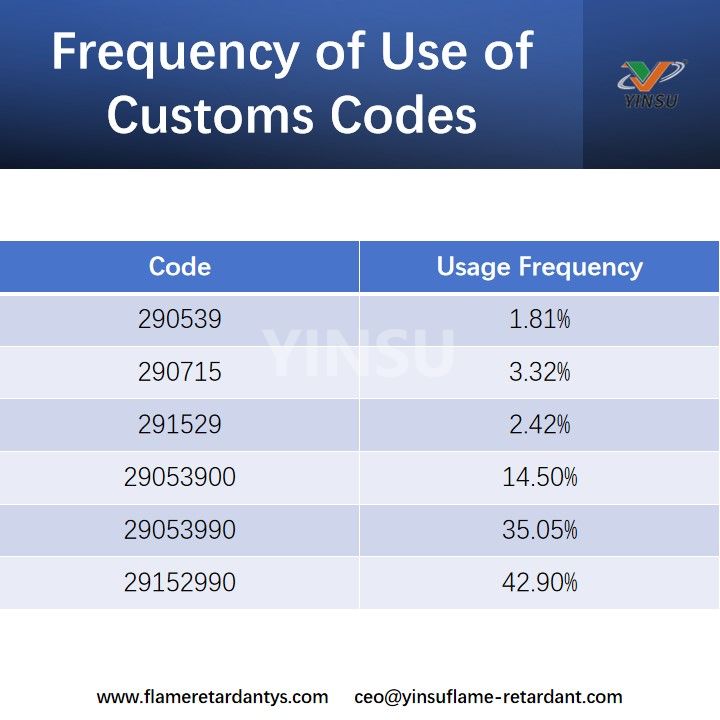
The core obstacle to clarifying the export data of "50%" antimony products lies in the dispersity and variability of their tariff classification. Influenced by export policies, declaration practices, and the specific form of the products, enterprises may choose different codes for declaration. Analysis based on existing data fragments suggests that their export activity is likely primarily hidden under the two major series of codes "2905" (Alcohols, phenols, phenol-alcohols, and their halogenated, sulphonated, nitrated, or nitrosated derivatives) and "2915" (Saturated acyclic monocarboxylic acids and their anhydrides, halides, peroxides, and peroxyacids. Their derivatives). Among these, subheadings such as 29053990 and 29152990 show relatively high frequency of use (35.05% and 42.90% respectively), which could be considered primary directions for tracking. However, the complexity of real-world trade means that we cannot rule out some shipments being cleared under other codes that did not appear frequently in this statistical sample.
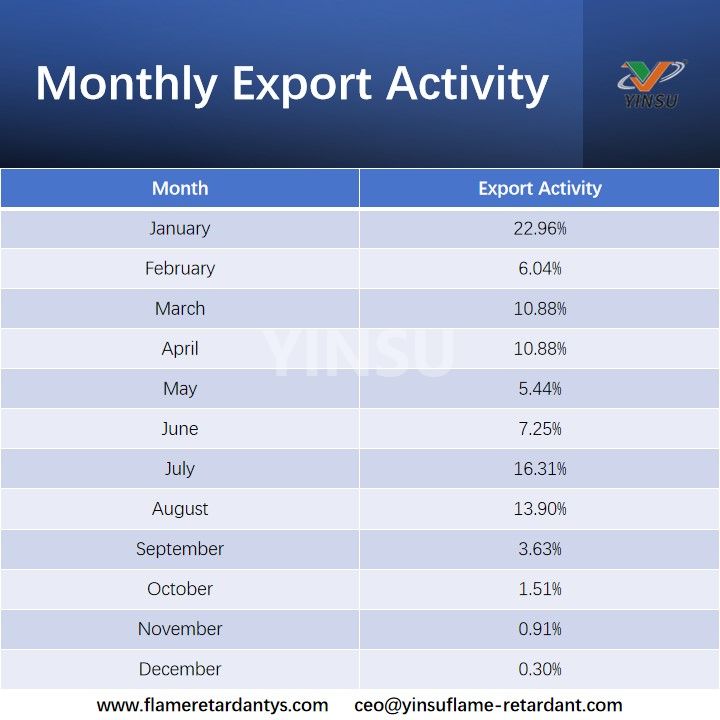
Judging from the compiled monthly export activity level data, the export of "50%" antimony products is not evenly distributed but shows obvious fluctuating characteristics. Annual export peaks are concentrated at the beginning of the year in January (activity level 22.96%) and mid-year in July (16.31%), forming a bimodal pattern. Starting from September, export activity weakened significantly, remaining low for several consecutive months. This is likely related to factors such as international market demand, the global trade environment, and policies. It must be specially noted that the data for December shows an extremely low activity level (0.30%) due to an incomplete statistical cycle and is not representative. Considering that November's data was concentrated in the latter half of the month, it is reasonable to deduce that December's actual performance could potentially be better than November's.
Deduction Three: Emerging Market Structure and Enterprise Concentration

Based on available data estimates, China's reference export volume of "50%" antimony products in 2025 is approximately 5,321 tons, showing significant growth compared to about 2,400 tons in 2024. However, this is far from the complete picture. Since this portion of trade primarily flows to countries like India, Pakistan, and Vietnam, the existing sample likely fails to cover all export achievements, and the actual total volume should be higher than this figure. Simultaneously, the data may also include small amounts of exports of other similar products, introducing some quantitative error here as well. One particularly prominent feature is the high degree of market concentration. The data shows that the export share of enterprise M2 alone is as high as 49.33%, accounting for nearly half of the market. Four other enterprises (Y, A2, L1, T) have shares between 5% and 10%, forming a second tier. Seven enterprises have shares between 1% and 5%. The remaining enterprises have minimal shares.
Comprehensive Deduction and Volume Estimation
Taking into comprehensive consideration the partial representativeness of the data, possible omissions, and a reasonable margin of error, we can conduct a cautious quantitative extrapolation. Based on the existing sample data, applying conservative corrections for its coverage and accuracy, we preliminarily speculate that the actual total annual export volume of China's "50%" antimony products in 2025 may fall within the range of 6,500 to 7,000 tons.
Although this estimate remains an "educated estimate," it is a logical extension based on existing clues. In summary, through the existing data, we have conducted a preliminary sketch of this "50%" antimony product segment, traditionally obscured in data: its export channels are dispersed among several customs codes, and the market is dominated by a small number of key enterprises. Although precise mapping remains difficult, this deduction can provide an important benchmark reference for future, more accurate data, to be used for cross-validation.


