- All
- Product Name
- Product Keyword
- Product Model
- Product Summary
- Product Description
- Multi Field Search

Views: 42 Author: Yinsu Flame Retardant Publish Time: 2026-01-03 Origin: www.flameretardantys.com


Process Technology for Phosphate Ester Flame Retardants
As a mainstay in the halogen-free flame retardant field, phosphate ester flame retardants are indispensable in high-end applications such as electronic appliances and engineering plastics due to their excellent flame-retardant synergism and plasticizing functions. Ensuring their outstanding performance and high purity relies on precise synthesis processes.
Both Tris(isopropylphenyl) Phosphate (IPPP) and Tris(2-chloroethyl) Phosphate (TCEP) involve the alkylation process listed in the "Catalogue of First Batch of Key Regulated Hazardous Chemical Processes" published by the former State Administration of Work Safety.

▶ Tris(isopropylphenyl) Phosphate (IPPP)
1. Alkylation Reaction
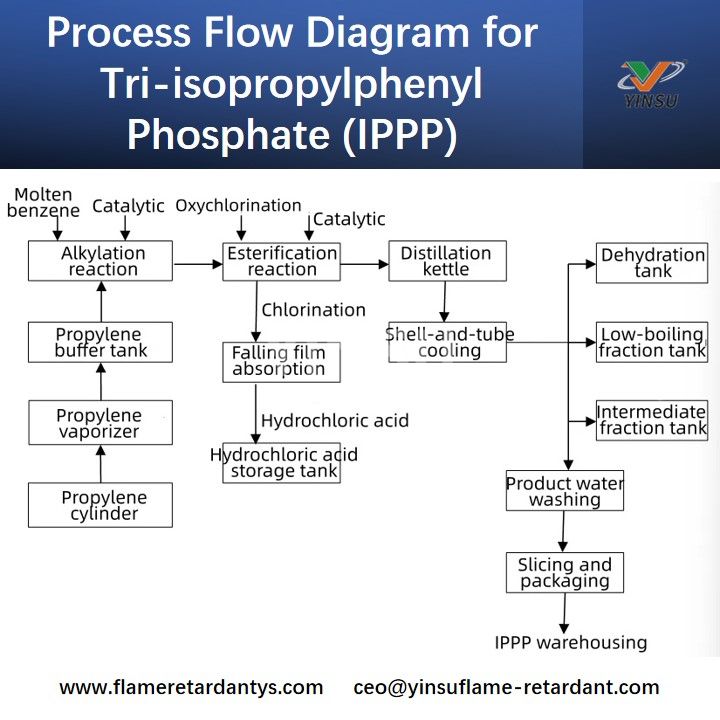
A measured amount of catalyst is added to the alkylation reactor, followed by a measured amount of molten phenol. After cooling to a certain temperature, propylene gas is introduced under stirring. Steam is fed into the reactor jacket to maintain the temperature inside the reactor between 105–115°C at atmospheric pressure until the reaction is complete. The reaction product is transferred while hot to the esterification workshop.
Propylene is pumped from the propylene storage tank in the alkylation unit's tank farm into steel cylinders via automatic metering. The cylinders are manually transported from the tank farm and connected to a propylene vaporizer. The vaporized propylene enters a propylene buffer tank and finally feeds into the reactor.
Reaction Principle:
C₆H₆O + C₃H₆ → C₉H₁₂O
2. Esterification Reaction
The fully reacted solution from the alkylation workshop is transferred while hot into the esterification reactor, which already contains a measured amount of pre-dried catalyst. Cooling water is circulated in the jacket to cool the mixture to 50°C. Under stirring, a measured amount of phosphorus oxychloride is added. Steam is then introduced into the jacket to slowly raise the internal temperature to 155°C, maintaining atmospheric pressure until the reaction is complete. The fully reacted IPPP solution is then transferred to the distillation kettle. Hydrogen chloride gas generated during the esterification is absorbed by a falling film absorber to produce hydrochloric acid, which is stored in a hydrochloric acid storage tank upon reaching the corresponding concentration.
Reaction Principle:
POCl₃ + 3 C₉H₁₂O → C₂₇H₃₃O₄P + 3 HCl↑
3. Distillation
The IPPP crude ester from the esterification workshop is fed into the distillation pot. Using electric heating or carbon heating under vacuum, the temperature of the crude ester is increased. Water distills off first at around 100°C, condenses in a tubular condenser, and enters the dehydration tank. Subsequently, low-boiling components distill at around 140°C, condense, and enter the low-boiler collection tank. Middle fractions distill at around 250°C, condense, and enter the middle fraction collection tank. The final product distills at around 300°C, condenses, and enters the finished product collection tank. After each batch is completed, the product is pumped by a finished product pump to the finished product storage tank. The product is filtered and then packaged for sale. For products requiring higher quality, the finished product at room temperature is first sent to the water washing stage to remove water-soluble impurities. It is then vacuum-transferred to a high-level finished product tank, flows by gravity into a slicing machine for flaking, and is then sold.
▶ Tris(2-chloroethyl) Phosphate (TCEP)
1. Alkylation Reaction
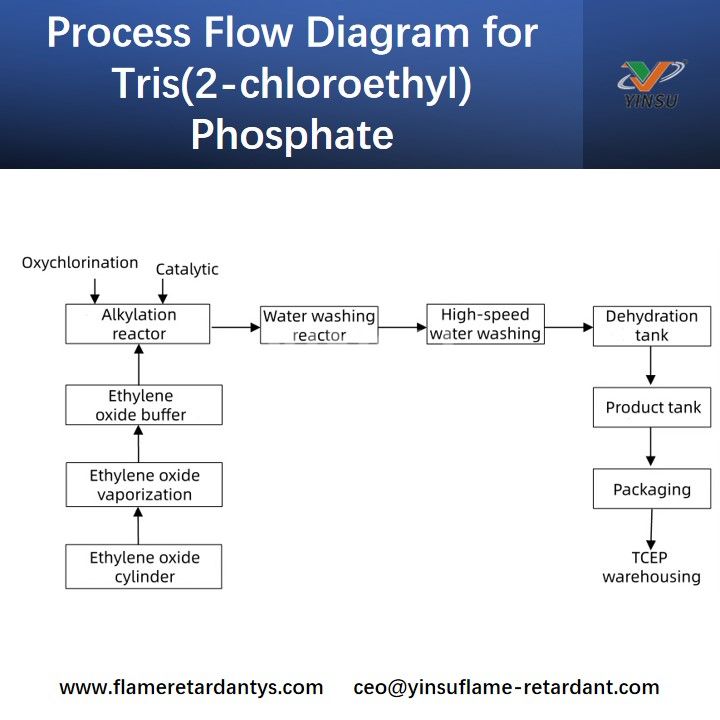
A measured amount of catalyst, ion exchange resin, is added to the reactor, followed by a measured amount of phosphorus oxychloride. Ethylene oxide is then introduced, along with a liquid catalyst simultaneously. Cooling water is circulated in the reactor jacket to maintain the reaction temperature at 60°C. After the reaction is complete, the TCEP product is transferred to the water washing stage.
Ethylene oxide is pumped from the ethylene oxide storage tank in the alkylation unit's tank farm into steel cylinders via automatic metering. The cylinders are manually transported from the tank farm and connected to an ethylene oxide vaporizer. The vaporized ethylene oxide enters an ethylene oxide buffer tank and finally feeds into the reactor.
Reaction Principle:
POCl₃ + 3 C₂H₄O → C₆H₁₂O₄Cl₃P
2. Water Washing
The TCEP semi-finished product from the alkylation workshop enters the water washing kettle under vacuum at 60°C. After water washing, it proceeds to a high-speed water washing kettle. Following another wash in the high-speed water washing kettle, it enters a dehydration tank where it is heated by steam to around 100°C to remove water. The material is then transferred by the dehydration tank feed pump to the finished product tank. During packaging, the dehydration tank feed pump is first used to filter the finished product. After passing quality checks, it is sent for packaging.