
- All
- Product Name
- Product Keyword
- Product Model
- Product Summary
- Product Description
- Multi Field Search

Specialized in PE, PVC, TPE, TPU and Low Smoke Zero Halogen (LSZH) wire and cable compound and materials.
In high-rise buildings, subway tunnels, new energy power stations and industrial complex scenarios, the fire safety of wires and cables is directly related to life and property and system reliability.
YINSU Flame Retardant Company provides customized flame retardant solutions for global customers, covering PE (polyethylene), PVC (polyvinyl chloride), TPE (thermoplastic elastomer), TPU (thermoplastic polyurethane) and LSZH (low smoke and halogen free) wire and cable systems to meet all safety requirements, ranging from UL94 V-0 flame retardant certification to EN 45545 fire protection for rail transportation and IEC 60754 low smoke and halogen free toxicity. All-round safety requirements.
Material Common Use Typical FR Type YINSU Flame Retardant Item No.
PE HDPE, LDPE, LLDPE, Red phosphorus, halogen free FR, PRP-950X, PE-XT-20, B-HFFR, MCA-B, WADP-10
Cross-linked PE cables, Bromine antimony masterbatch FR-ML-01, K100
Plastic insulated cables.
PVC PVC &Plastic insulated power cables, ATO alternatives T3, T30, FRP-950X, K100, ZHS, ZS, ZSB-A
Aluminum stranded wires, Zinc stannate
Prefabricated branch cables.
TPE Insulated wires, flexible cables Organic phosphorus MCA-B, WADP-10, FRP-950X, 95-MC
Shielded insulated cables
TPU Special purpose cables Organic phosphorus MCA-B, WADP-10, FRP-950X, 95-MC
Power cables for frequency converters.
Others Welcome to consult more details.


Polyurethane for automotive interiors must simultaneously meet three standards: FMVSS 302 flame retardancy, low misting (≤2 mg), and low odor (VDA 270 ≤3.0). The phosphorus-nitrogen synergistic system limits the flame retardant loading to 16 parts, achieves an LOI of 29–30%, and meets the V-0 rating, while also reducing the contribution of volatile compounds, providing a viable path for formulation balance.
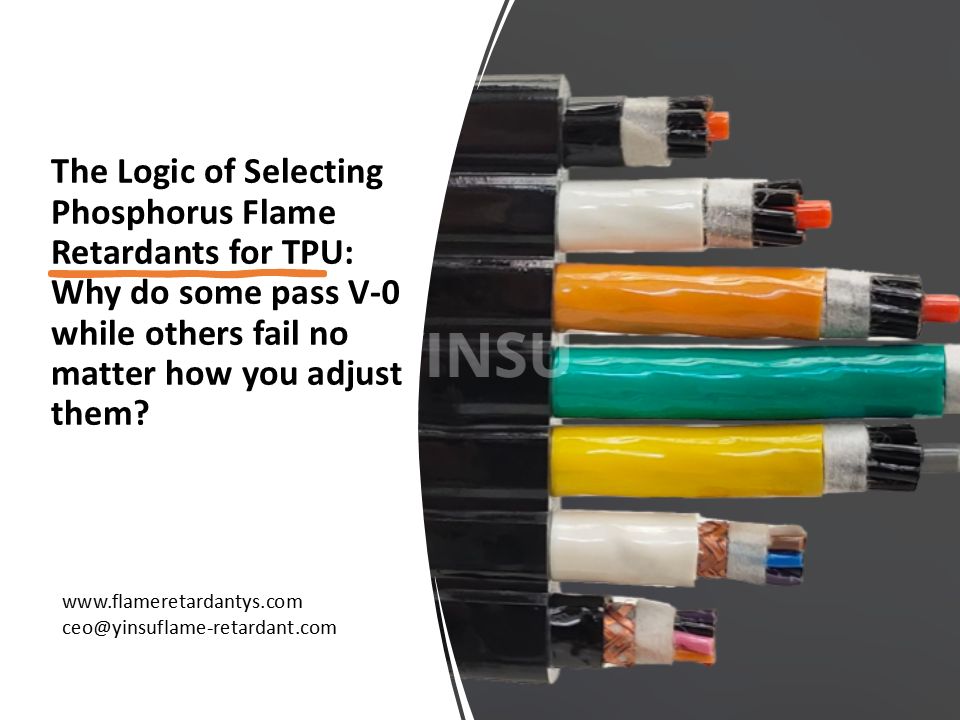
When selecting PU phosphorus-based flame retardants, the key consideration is not the dosage but rather the compatibility between the decomposition temperature and the substrate. This article analyzes the differences in applicability among the three major systems—APP-based, organophosphorus, and red phosphorus—as well as key technical aspects such as migration and leaching, and intumescent flame retardancy.

Why is TPE flame retardancy so challenging? Flammable plasticizers, inconsistent mechanisms across multiphase components, and flame retardant migration—seven pain points explained in one go. Understand the key criteria for selecting TPE/TPU flame retardants and avoid common pitfalls such as wire bloom, surface whitening, and processing difficulties.

30% glass-filled PBT still afraid of high-temperature ignition? We compare brominated, phosphorus-based, and halogen-free flame-retardant solutions, achieving UL 94 V-0 at 0.8 mm thickness, GWIT 775°C, with both toughness and dimensional stability maintained. This provides a safe and reliable "halogen-free flame retardant" upgrade path for automotive connectors and relay housings!

Simultaneously introducing phosphorus-based flame retardants on both the cathode and anode sides—through flame-retardant separator coating and flame-retardant electrolyte additives—forms a "dual flame-retardant" barrier for lithium batteries. Experiments show this approach increases the onset temperature of thermal runaway in lithium metal batteries by 38°C, reduces the peak temperature by 120°C, and extends cycle life by 30%. It provides a scalable, low-impedance, high-safety solution for flame retardancy in high-end battery packs, directly meeting the stringent requirements for new energy vehicle battery pack flame retardancy in standards like GB 38031 and new European/American national regulations.
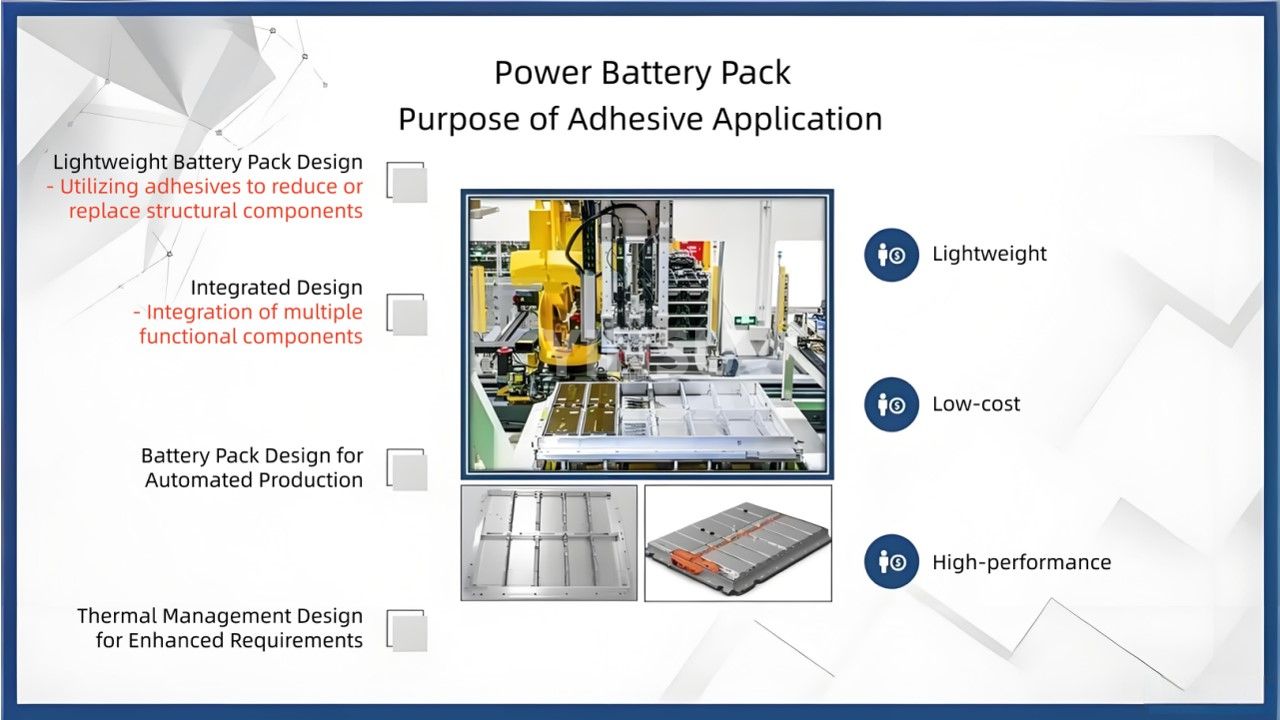
This report reveals how adhesives and flame retardants work together in new energy vehicle battery packs to block thermal runaway within 5 minutes, truly elevating the fire safety of electric vehicles.
