
- All
- Product Name
- Product Keyword
- Product Model
- Product Summary
- Product Description
- Multi Field Search

Views: 46 Author: Yinsu Flame Retardant Publish Time: 2026-02-21 Origin: www.flameretardantys.com


Dual Flame-Retardant Mechanism Assisted Suppression of Thermal Runaway in Lithium Metal Batteries with Improved Electrochemical Performance

Although lithium metal batteries (LMBs) have been extensively researched, their adoption as power sources for transportation vehicles remains challenging from the perspectives of safety and durability.

Therefore, to enhance the safety and electrochemical performance of lithium metal batteries, a team consisting of Ki Jae Kim from the Department of Energy Science at Sungkyunkwan University, Hyun-seung Kim from the Advanced Battery Research Center at the Korea Electronics Technology Institute, and Jang Wook Choi from the School of Chemical and Biological Engineering and the Chemical Process Research Institute at Seoul National University, designed a precision separator composed of decabromodiphenylethane (DBDPE) and CaO nanocomposite. This design simultaneously imparts flame-retardant properties and improves lithium-ion transport performance. During normal operation, the coated CaO particles enhance lithium-ion transport and improve the cycling performance of LMBs due to increased lithium metal cycling efficiency, without causing any side reactions. Conversely, under abnormal conditions, particularly at high temperatures, the coated CaO and DBDPE undergo a chemical reaction, acting as a fire extinguishing agent within the LMB. DBDPE exhibits gas-phase flame-retardant characteristics, generating HBr at high temperatures, which subsequently reacts with CaO nanocrystals to form CaBr₂, possessing liquid-phase flame-retardant properties. Consequently, both liquid-phase and gas-phase flame-retardant characteristics are observed in the DBDPE-CaO coated polyethylene separator (DCPE) within pouch-type LMBs. The in-situ formation of halogen-based materials in the LMB is attributed to a flame-retardant strategy based on a spontaneous chemical mechanism. Thus, the unique functionality of the DCPE separator improves both the electrochemical performance and safety of LMBs. This work, titled "Dual Flame-Retardant Mechanism-Assisted Suppression of Thermal Runaway in Lithium Metal Batteries with Improved Electrochemical Performances," was published in Advanced Energy Materials. The first author is Jin Hyeok Yang.

Figure 1. Schematic diagrams illustrating the enhancement mechanism of the decabromodiphenylethane and calcium oxide coated polyethylene separator (DCPE) compared to a polyethylene separator under a) normal and b) abnormal operating conditions.

Figure 2. a) SEM image of the synthesized DBDPE-CaO nanocomposite, b) Br and Ca EDS mapping, c) TEM image of the synthesized particles, d) FFT of an amorphous region and the corresponding TEM image, e) HR-TEM image, and f) SAED pattern of a crystalline particle.

Figure 3. a) Tensile strength of PE and DCPE, b) Thermal shrinkage, c) Ionic conductivity (inset: soaking test), d) Calculated binding energy of hexafluorophosphate anion to CaO cluster, e) Transference number, f) Raman spectra obtained from PE and DCPE, respectively.
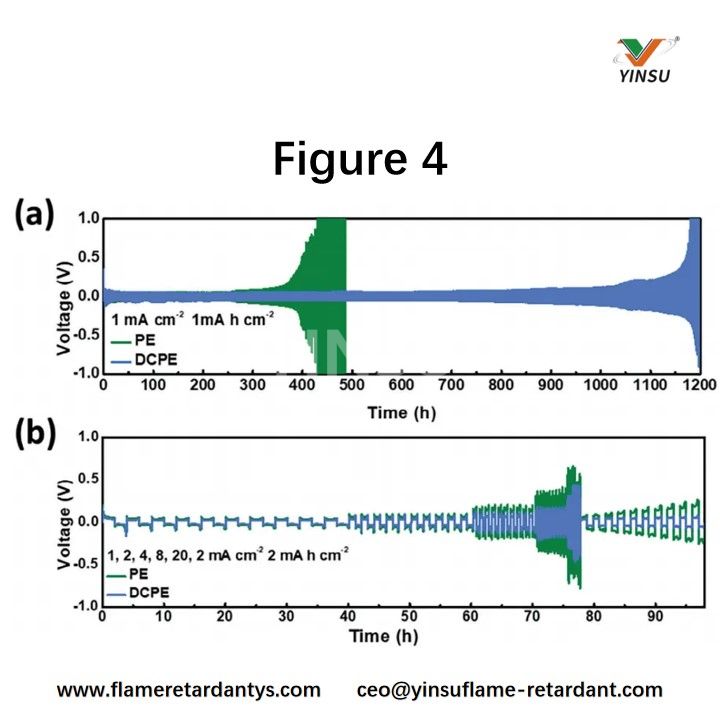

Figure 4. a) Cycling performance at a current density and areal capacity of 1 mA cm⁻², b) Rate capability of Li symmetric cells at an areal capacity of 2 mA h cm⁻². SEM images of Li electrodes from disassembled cells: c) Surface and d) cross-sectional SEM images of lithium metal after the 1st and 15th cycles using PE or DCPE, e) 3D ToF-SIMS signals of SEI components deposited on Li electrodes after the 15th cycle using PE and DCPE.

Figure 5. a) Initial lithium deposition voltage profiles, b) Coulombic efficiency of Cu/Li cells, c) Cycling capability of Li/NCM811 batteries using PE and DCPE.

Figure 6. STA-MS analysis of DBDPE and DCPE: a) TG-DTA curve of DBDPE and b-d) mass spectra, e) TG-DTA curve of DCPE and f-h) mass spectra.

Figure 7. a) Schematic of the condensed-phase flame-retardant mechanism of CaBr₂, b) Schematic of the gas-phase flame-retardant mechanism of HBr, c) Schematic of a lithium metal battery using DCPE coated PE separator under normal state and during thermal runaway. d) Flame-retardant test results for electrolyte without DBDPE, with DBDPE, and with DBDPE-CaO, and e) Flame-retardant test results for PE soaked in electrolyte, DBDPE-coated PE, and DCPE.
Conclusion
Existing flame-retardant additives for LMBs exhibit a distinct trade-off between flame retardancy and electrochemical performance. However, in this study, applying DBDPE-CaO nanocomposite to a polyethylene separator via a simple coating process enhanced both flame retardancy and electrochemical performance. Safety performance results indicate that HBr(g) and CaBr₂(s) generated by DCPE at high temperatures exhibit excellent extinguishing properties. The intentionally synthesized DBDPE-CaO nanocomposite effectively suppressed battery fires by generating both condensed-phase (CR) and gaseous (FR) flame retardants. Bromine released from DBDPE is immediately captured by CaO, forming CaBr₂, which subsequently contributes to HBr formation. Thus, simultaneous CR and FR action is achieved through DCPE. The FR developed using this method significantly improves safety performance even under practical battery abuse conditions. Thermal chamber test results show that during thermal runaway, the temperature rise was less than half, and its onset was delayed by several minutes compared to conventional PE separators. This provides the battery management system with sufficient additional time to detect the onset of thermal runaway and implement safety measures to prevent consequent damage. Furthermore, this technology can be combined with various battery components (such as selected electrodes, solid electrolytes, and polymer electrolytes) using a simple and straightforward method. This strategy can enhance separator performance in high-energy-density systems, thereby offering a new pathway for improving the safety characteristics of LMBs.


