
- All
- Product Name
- Product Keyword
- Product Model
- Product Summary
- Product Description
- Multi Field Search

Specialized in PE, PVC, TPE, TPU and Low Smoke Zero Halogen (LSZH) wire and cable compound and materials.
In high-rise buildings, subway tunnels, new energy power stations and industrial complex scenarios, the fire safety of wires and cables is directly related to life and property and system reliability.
YINSU Flame Retardant Company provides customized flame retardant solutions for global customers, covering PE (polyethylene), PVC (polyvinyl chloride), TPE (thermoplastic elastomer), TPU (thermoplastic polyurethane) and LSZH (low smoke and halogen free) wire and cable systems to meet all safety requirements, ranging from UL94 V-0 flame retardant certification to EN 45545 fire protection for rail transportation and IEC 60754 low smoke and halogen free toxicity. All-round safety requirements.
Material Common Use Typical FR Type YINSU Flame Retardant Item No.
PE HDPE, LDPE, LLDPE, Red phosphorus, halogen free FR, PRP-950X, PE-XT-20, B-HFFR, MCA-B, WADP-10
Cross-linked PE cables, Bromine antimony masterbatch FR-ML-01, K100
Plastic insulated cables.
PVC PVC &Plastic insulated power cables, ATO alternatives T3, T30, FRP-950X, K100, ZHS, ZS, ZSB-A
Aluminum stranded wires, Zinc stannate
Prefabricated branch cables.
TPE Insulated wires, flexible cables Organic phosphorus MCA-B, WADP-10, FRP-950X, 95-MC
Shielded insulated cables
TPU Special purpose cables Organic phosphorus MCA-B, WADP-10, FRP-950X, 95-MC
Power cables for frequency converters.
Others Welcome to consult more details.


The annual Chinaplas exhibition is set to take place in April. At the event, we will be showcasing our red phosphorus flame retardants, antimony trioxide replacement, and halogen-free flame retardants. We invite you to visit the YinSu Flame Retardant Company booth to discuss our products and industry trends.

How can TPU flame retardancy be improved without compromising its excellent physical properties? The combination of inorganic flame retardants and nano-compositing technology discussed in the article is one key approach, and expandable graphite, as a highly efficient synergistic flame retardant, is offering new possibilities for solving this challenge.

To achieve efficient flame retardancy in TPU materials, the alignment of the decomposition temperature of phosphorus-based flame retardants with the substrate is crucial, as it directly impacts flame retardancy efficiency and property retention. The differences in the application of various types of phosphorus-based flame retardants in TPU is a subject worth in-depth exploration.

Simultaneously introducing phosphorus-based flame retardants on both the cathode and anode sides—through flame-retardant separator coating and flame-retardant electrolyte additives—forms a "dual flame-retardant" barrier for lithium batteries. Experiments show this approach increases the onset temperature of thermal runaway in lithium metal batteries by 38°C, reduces the peak temperature by 120°C, and extends cycle life by 30%. It provides a scalable, low-impedance, high-safety solution for flame retardancy in high-end battery packs, directly meeting the stringent requirements for new energy vehicle battery pack flame retardancy in standards like GB 38031 and new European/American national regulations.
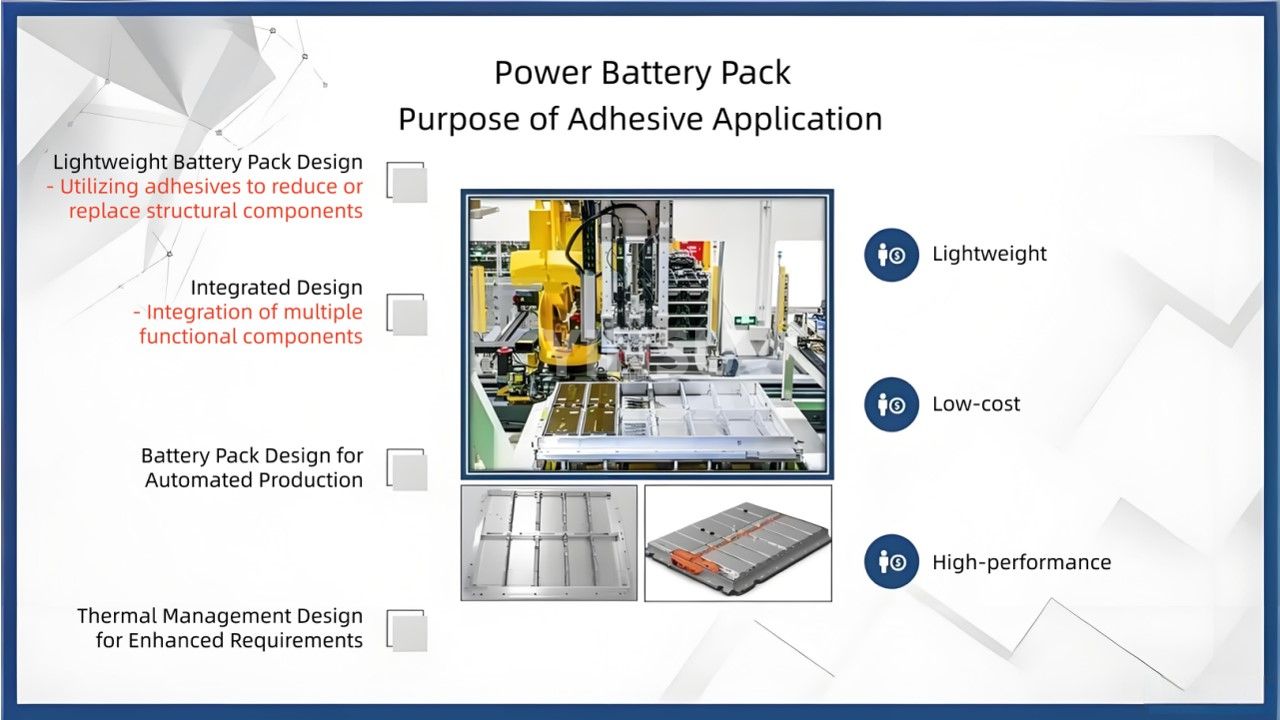
This report reveals how adhesives and flame retardants work together in new energy vehicle battery packs to block thermal runaway within 5 minutes, truly elevating the fire safety of electric vehicles.

Want your adhesive layer to be non-combustible yet remain strongly adhesive? Choosing the right "flame retardant for adhesives" is key! Check out this article, which breaks down three major formulation strategies: phosphorus-nitrogen synergy, intumescent char layers, and ultrafine aluminum hydroxide. Learn how to achieve UL 94 V-0 with the minimum amount of "adhesive flame retardant" additive, maintain peel strength without compromise, keep curing speed unchanged, and easily accomplish the halogen-free flame-retardant upgrade for epoxy, polyurethane, and acrylic systems!
