
- All
- Product Name
- Product Keyword
- Product Model
- Product Summary
- Product Description
- Multi Field Search

Views: 44 Author: Yinsu Flame Retardant Publish Time: 2026-03-28 Origin: www.flameretardantys.com


New Directions in TPU Flame Retardancy: From Phosphate Esters to Intumescent Systems, Phosphorus-Nitrogen Synergy is Becoming the Mainstream Approach
In the application of Thermoplastic Polyurethane Elastomer (TPU), flame retardant modification often faces the challenge of balancing efficiency and physical properties. Phosphorus-based flame retardants, due to their diverse types and clear mechanisms of action, have become one of the key paths to resolving this contradiction. The most commonly used phosphorus-containing flame retardants mainly include those based on Ammonium Polyphosphate (APP), those based on Organic Phosphorus compounds (OP), and those based on Red Phosphorus.
Currently, organic phosphorus flame retardants are widely used in polyurethane flame retardancy because of their good compatibility and stability with polyurethane. Some can even act as plasticizers for polyurethane materials. The organic phosphorus flame retardants used in polyurethane are mostly liquid and solid phosphate esters and phosphonate esters. They offer advantages such as high flame retardant efficiency, low viscosity, good compatibility, moderate thermal stability, and resistance to "charting."
The decomposition temperature of organic phosphorus flame retardants significantly impacts the flame retardancy of TPU. Research has been conducted on the flame retardant effects of tris(β-chloroethyl) phosphate and tris(2,3-dibromopropyl) phosphate on TPU, as shown in table below.
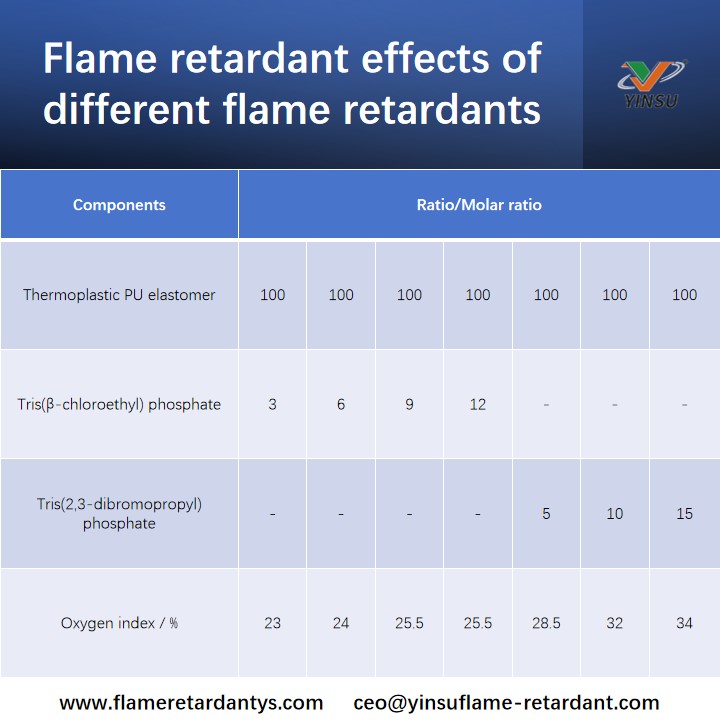
It can be seen that although the two flame retardants have similar structures and compositions, their flame retardant effects differ significantly. An analysis of the flame retardant mechanism reveals that the flame-retardant components are most effective only when they are released at a temperature below or close to the initial decomposition temperature of the polymer. If the decomposition temperature is too low, the flame retardant may decompose completely before the polymer fully combusts, and some may even be lost during thermal processing, failing to achieve the desired effect. Conversely, if the decomposition temperature is too high, the effective flame retardant components may not be sufficiently released during polymer combustion, also resulting in poor flame retardancy. Among the tested flame retardants, the thermal decomposition temperature of tris(β-chloroethyl) phosphate is 240–280°C, while that of tris(2,3-dibromopropyl) phosphate is >300°C. The thermal decomposition temperature of polyurethane is around 400°C. The decomposition temperature of tris(2,3-dibromopropyl) phosphate is closer to that of polyurethane, making it a better match relatively speaking, and thus its flame retardant effect is superior to that of tris(β-chloroethyl) phosphate.
Diphosphate ester compounds can also serve as flame retardants for polyurethane materials. The group connecting the two phosphate esters can be alkylene, arylene, alkylene-arylene, or other divalent linking groups such as -SO-, -S-, -SO₂-, etc. However, a problem with these flame retardants is that under environmental conditions above 100°C, the flame retardant itself or existing impurities can volatilize from the polyurethane material, forming fog on glass surfaces. This issue is particularly severe in the automotive industry. Polyphosphates can be used to solve this problem. Generally, adding 0.5 to 50 parts of a polyphosphate flame retardant containing 10 phosphate groups per 100 parts of polyurethane material can impart good flame retardancy while preventing the volatilization of the flame retardant at high temperatures and reducing fog formation.
Most flame retardants can migrate or volatilize within polyurethane materials, affecting the stability of material properties. Introducing compounds with hydroxyl groups into the flame retardant molecule allows them to react with isocyanates in the polyurethane material, forming chemical bonds and preventing the migration and volatilization of the flame retardant molecules. Such flame retardants can be diphosphates or polyphosphates with up to 10 phosphate groups. These di- or poly-phosphate molecules carry at least two or more hydroxyl groups capable of reacting with isocyanates. These compounds possess high flame retardant efficiency and excellent migration resistance. Adding 50 parts of such a flame retardant per 100 parts of polyurethane material can achieve a SE grade (self-extinguishing) when evaluated according to the FMVSS 302 standard.
Another development direction for organic phosphorus flame retardants is intumescent flame retardants. These are phosphorus compounds that achieve flame retardancy through the combined action of multiple mechanisms, including phosphorus-nitrogen synergy, foaming with non-combustible gases, and dehydration and carbonization of polyols and esters to form a flame-retardant char layer. The mechanism involves consuming the decomposition gases produced during polymer combustion, promoting the formation of non-combustible char, and preventing the oxidation reaction, thereby inhibiting combustion. The Shanghai Research Institute of Chemical Industry compounded a new phosphorus-nitrogen system halogen-free intumescent flame retardant (ANTI-2) using APP, formaldehyde, melamine, and melamine-formaldehyde prepolymer. Using ANTI-2 to flame-retard TPU, tests on oxygen index, UL94 burning rating, tensile strength, elongation, and hardness showed that ANTI-2 is an effective flame retardant for TPU elastomers. When the ANTI-2 content increased to over 35%, the burning rating reached V-0. However, with increasing ANTI-2 content, the hardness of the flame-retardant modified TPU increased, tensile strength decreased, while elongation did not change significantly.
As flame retardant technology advances, relying solely on traditional phosphorus-based systems can no longer meet the stringent requirements for temperature resistance, yellowing resistance, and ultra-thin processing in high-end TPU applications. The efficient, modified organic phosphinate flame retardants with ultra-fine particle size developed by Yinsu Flame Retardant have made significant progress in high-temperature resistance and yellowing resistance, offering a new breakthrough direction for resolving the conflict between flame retardancy efficiency and property retention in TPU.
Disclaimer: This content is excerpted from relevant literature and is intended for knowledge sharing only, not for commercial use.


