
- All
- Product Name
- Product Keyword
- Product Model
- Product Summary
- Product Description
- Multi Field Search

Specialized in PE, PVC, TPE, TPU and Low Smoke Zero Halogen (LSZH) wire and cable compound and materials.
In high-rise buildings, subway tunnels, new energy power stations and industrial complex scenarios, the fire safety of wires and cables is directly related to life and property and system reliability.
YINSU Flame Retardant Company provides customized flame retardant solutions for global customers, covering PE (polyethylene), PVC (polyvinyl chloride), TPE (thermoplastic elastomer), TPU (thermoplastic polyurethane) and LSZH (low smoke and halogen free) wire and cable systems to meet all safety requirements, ranging from UL94 V-0 flame retardant certification to EN 45545 fire protection for rail transportation and IEC 60754 low smoke and halogen free toxicity. All-round safety requirements.
Material Common Use Typical FR Type YINSU Flame Retardant Item No.
PE HDPE, LDPE, LLDPE, Red phosphorus, halogen free FR, PRP-950X, PE-XT-20, B-HFFR, MCA-B, WADP-10
Cross-linked PE cables, Bromine antimony masterbatch FR-ML-01, K100
Plastic insulated cables.
PVC PVC &Plastic insulated power cables, ATO alternatives T3, T30, FRP-950X, K100, ZHS, ZS, ZSB-A
Aluminum stranded wires, Zinc stannate
Prefabricated branch cables.
TPE Insulated wires, flexible cables Organic phosphorus MCA-B, WADP-10, FRP-950X, 95-MC
Shielded insulated cables
TPU Special purpose cables Organic phosphorus MCA-B, WADP-10, FRP-950X, 95-MC
Power cables for frequency converters.
Others Welcome to consult more details.

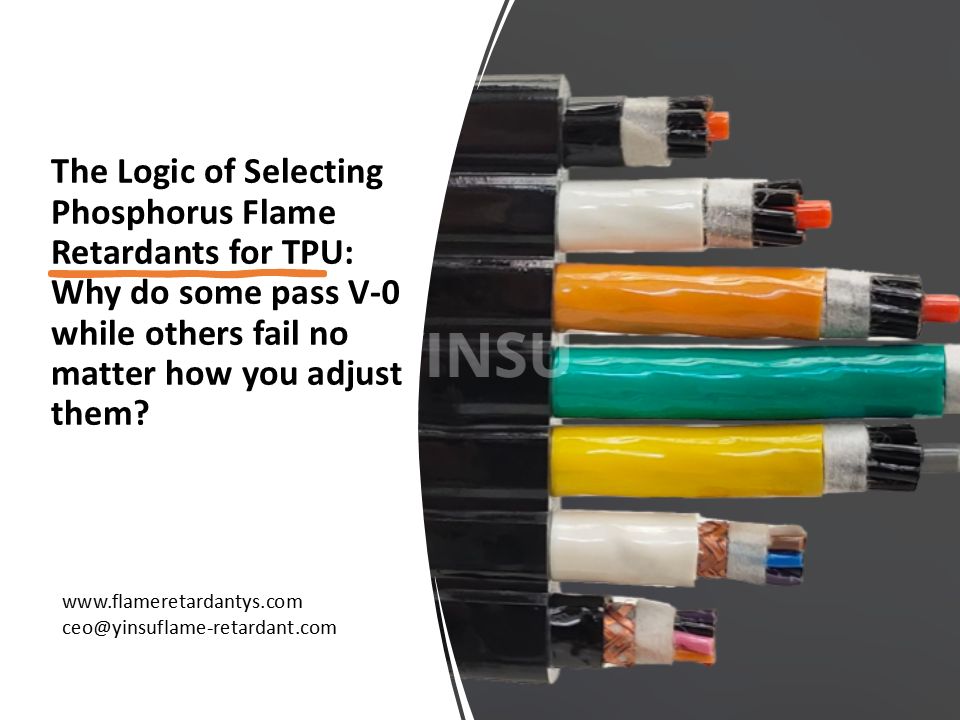


Inorganic flame retardants such as ATH and MDH require high loading levels in TPU to achieve the required flame retardancy rating; however, high loading levels severely degrade the material’s mechanical properties and flexibility. Through nano-blending strategies—such as the physical barrier effect of nano-clay layers and the carbonization mechanism of expandable graphite—it is possible to enhance flame retardancy while reducing the amount of inorganic additives, thereby providing an alternative to phosphorus-based flame retardants for TPU.
When selecting PU phosphorus-based flame retardants, the key consideration is not the dosage but rather the compatibility between the decomposition temperature and the substrate. This article analyzes the differences in applicability among the three major systems—APP-based, organophosphorus, and red phosphorus—as well as key technical aspects such as migration and leaching, and intumescent flame retardancy.
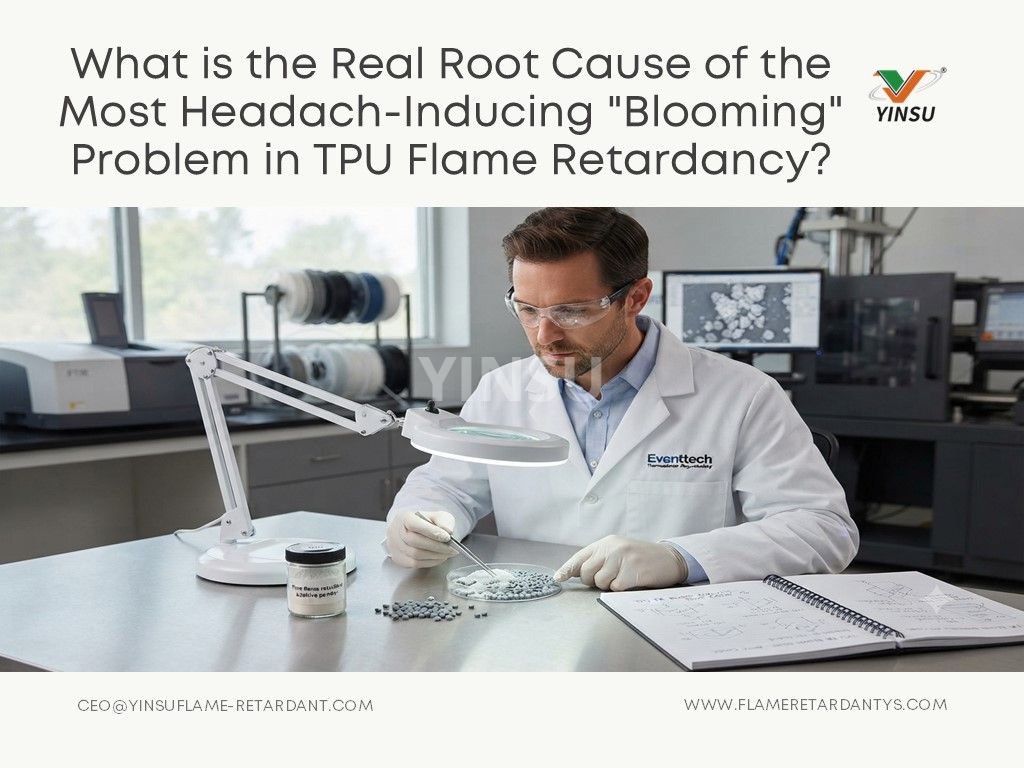
The whitening that occurs on the surface of flame-retardant TPU products is caused by poor compatibility between low-molecular-weight flame retardants and the base material, leading to migration and leaching. Hydrolysis of polyester-based TPU, excessively high processing temperatures, or high-temperature storage environments can all accelerate this process. Using coated flame-retardant masterbatches can effectively block the migration pathway, thereby resolving the blooming issue at its source.
Flame-retardant TPE is rapidly replacing traditional PVC and rubber, becoming the preferred soft flame-retardant material for new energy cables, electronics & electrical appliances, and automotive parts industries. This article provides a detailed analysis of the core advantages of halogen-free flame-retardant TPE (customizable V-0 grade flame retardancy, eco-friendly and odorless, elastic hand-feel, easy processing and weather resistance), covering mainstream application scenarios such as cable jackets, EV charging station accessories, automotive interior seals, and flame-retardant components for home appliances—helping engineers and procurement professionals quickly grasp key selection criteria and industry trends.
Why does TPE flame retardancy always get stuck at V-2? Three main culprits: plasticizers are inherently flammable, the multiphase system lacks synergy, and flame retardants tend to migrate and bloom. A comprehensive analysis of TPE/TPU flame retardant selection challenges and processing pitfalls to avoid.
Why is TPE flame retardancy so challenging? Flammable plasticizers, inconsistent mechanisms across multiphase components, and flame retardant migration—seven pain points explained in one go. Understand the key criteria for selecting TPE/TPU flame retardants and avoid common pitfalls such as wire bloom, surface whitening, and processing difficulties.
