What is the Real Root Cause of the Most Headach-Inducing "Blooming" Problem in TPU Flame Retardancy?
To be honest, after years of working on TPU flame-retardant formulations, our biggest fear isn't failing the flame retardancy test. If it fails, we can add more, switch materials, or keep trying. What we fear most is this—the test bars look perfectly fine when molded, but after sitting for two weeks, the surface starts to whiten. Touch it with your hand, and there is a layer of powder. When the client asks what happened, the salesperson can only stammer, "Let me look into it when I get back."
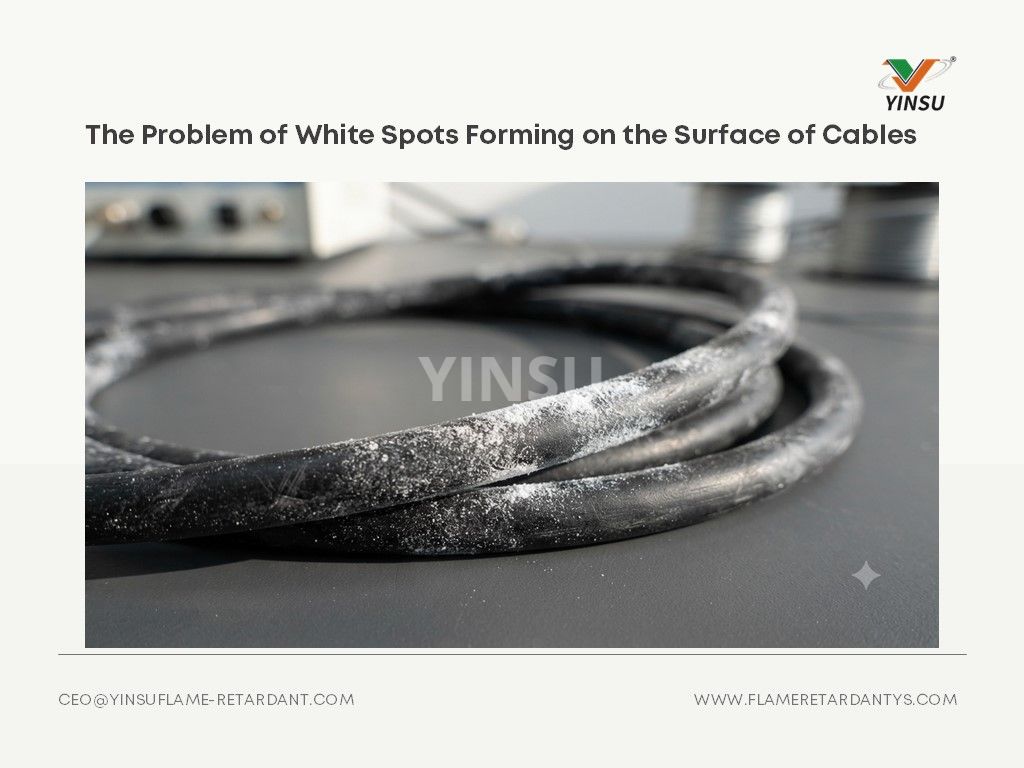
Why do I say this? Because we genuinely learned this lesson the hard way. There was a batch of TPU cables for export; they passed all random inspections before leaving the warehouse. But when the client received the goods, they said there was white frost on the surface. We didn't believe it at the time, but when we flew over to check, we were completely stunned on the spot—the entire batch had a layer of white powder on the surface, which could even be wiped off by hand. After investigating for a long time, we finally discovered that the issue wasn't the formulation itself, but rather that the "temperament" of the flame retardant didn't get along with the TPU.
To put it bluntly, TPU blooming is just incompatible substances migrating out.
Whether it's flame retardants or additives, if they have a "personality clash" with TPU and have nowhere else to go, they can only escape outward.
Reason 1: The Flame Retardant Itself Clashes with TPU (Most Common)
Conventional phosphorus-based and bromine-based flame retardants have small molecular weights and poor compatibility with TPU. Over time, they slowly crawl outward, forming white frost. This issue is even more severe in polyester-type TPU—it is inherently prone to hydrolysis, and the small-molecule oligomers produced by hydrolysis are particularly adept at "dragging" the flame retardants out with them. Later on, when our company worked on formulations for clients with high requirements, we would directly suggest switching to polyether-type TPU. Although the cost is slightly higher, it saves a tremendous amount of peace of mind.
Reason 2: Too Many and Too Diverse Additives
To achieve a good hand-feel, smooth demolding, or the right color, some formulations end up with five or six different additives. Each one might look fine on its own, but when mixed together, they interact with the flame retardant. The migration amount doesn't just add up linearly; sometimes it multiplies. I remember a formulation where after increasing calcium stearate from 0.3 parts to 0.8 parts, the flame retardancy rating remained unchanged, but the blooming time shrank from one month to just one week—excessive additives actually accelerated precipitation.
Reason 3: Processing Technology and Storage Environments Act as Catalysts
When the processing temperature exceeds 200°C, TPU begins to degrade, increasing small-molecule fragments which migrate more easily. Cooling too fast doesn't work either; the small molecules don't have enough time to be "locked" inside before escaping to the surface. Another factor is ocean freight. In the summer, temperatures inside a shipping container can reach 60–70°C. When the goods reach the client, there’s a layer of white powder on the surface—I checked that batch, and nothing went wrong in the intermediate steps; it was purely a temperature issue.

Our Solution
Later, our company, Yinsu Flame Retardant, developed our own solution called 95- MC.
The concept is simple— turn the flame retardant into a masterbatch instead of a powder.
The biggest problem with powder flame retardants is the excessive number of interfaces; the interface between each powder particle and the TPU acts as a "migration channel." 95-MC encapsulates phosphorus- and nitrogen-based flame retardants into granules within a carrier resin. This drastically reduces the powder interfaces, effectively blocking the precipitation channels. With a loading level of 32–35%, it can pass the UL94 V-0 rating, and the cost is about 30% cheaper than conventional powder systems.
To be fair, a masterbatch is not the absolute cheapest solution, but it saves hassle—you don't need to blend powders, clean equipment constantly, handle on-site dust, or worry about client complaints regarding blooming. Whether it's worth it depends on your requirements for yield rates.
A Quick Tip: Every formulation system is different, so don't just blindly copy the loading percentages. Take samples to test, and adjust only after you've run the trials.


