
- All
- Product Name
- Product Keyword
- Product Model
- Product Summary
- Product Description
- Multi Field Search

Specialized in PE, PVC, TPE, TPU and Low Smoke Zero Halogen (LSZH) wire and cable compound and materials.
In high-rise buildings, subway tunnels, new energy power stations and industrial complex scenarios, the fire safety of wires and cables is directly related to life and property and system reliability.
YINSU Flame Retardant Company provides customized flame retardant solutions for global customers, covering PE (polyethylene), PVC (polyvinyl chloride), TPE (thermoplastic elastomer), TPU (thermoplastic polyurethane) and LSZH (low smoke and halogen free) wire and cable systems to meet all safety requirements, ranging from UL94 V-0 flame retardant certification to EN 45545 fire protection for rail transportation and IEC 60754 low smoke and halogen free toxicity. All-round safety requirements.
Material Common Use Typical FR Type YINSU Flame Retardant Item No.
PE HDPE, LDPE, LLDPE, Red phosphorus, halogen free FR, PRP-950X, PE-XT-20, B-HFFR, MCA-B, WADP-10
Cross-linked PE cables, Bromine antimony masterbatch FR-ML-01, K100
Plastic insulated cables.
PVC PVC &Plastic insulated power cables, ATO alternatives T3, T30, FRP-950X, K100, ZHS, ZS, ZSB-A
Aluminum stranded wires, Zinc stannate
Prefabricated branch cables.
TPE Insulated wires, flexible cables Organic phosphorus MCA-B, WADP-10, FRP-950X, 95-MC
Shielded insulated cables
TPU Special purpose cables Organic phosphorus MCA-B, WADP-10, FRP-950X, 95-MC
Power cables for frequency converters.
Others Welcome to consult more details.


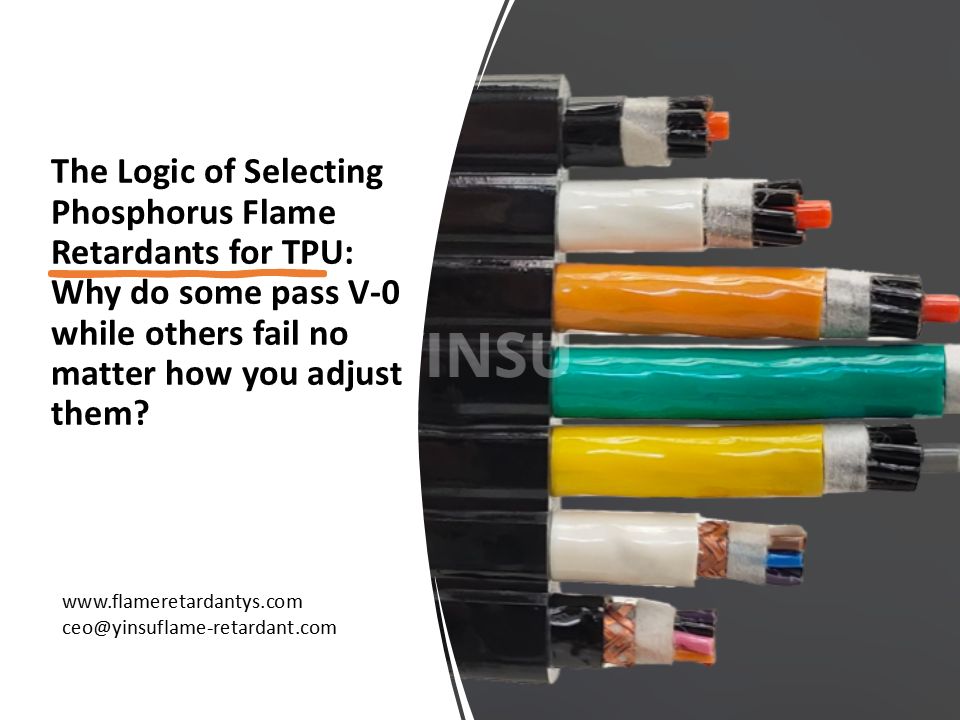
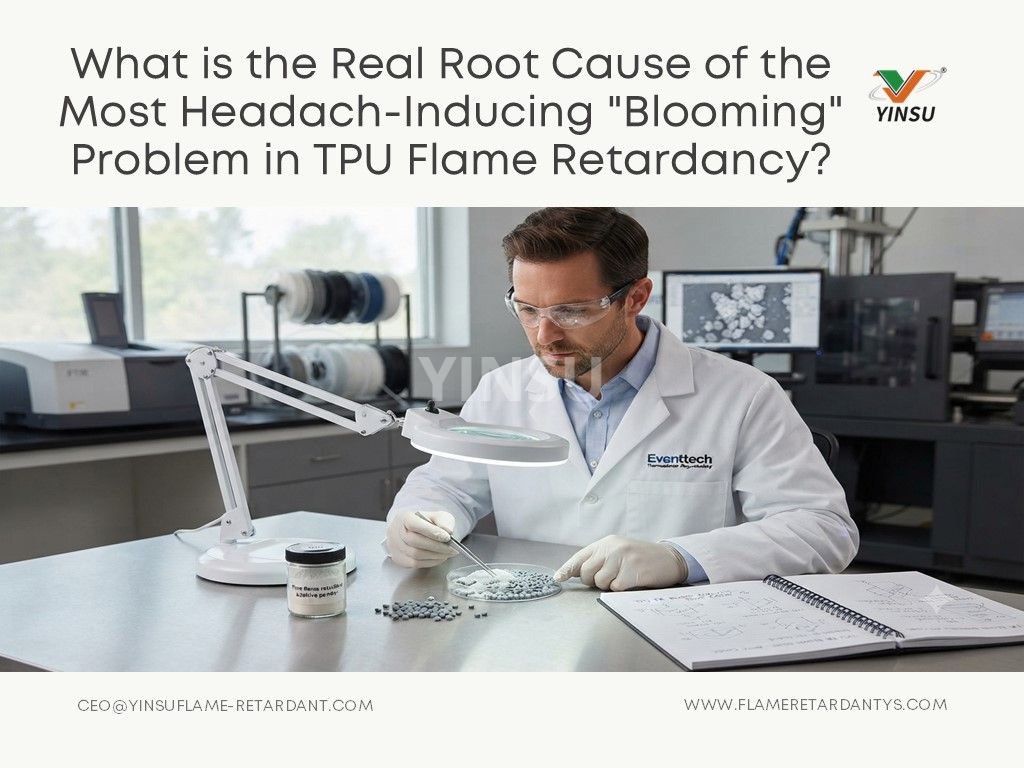
Why is it so difficult to achieve both V-0 flame retardancy, transparency, and elasticity in thin TPU films? Yin塑 analyzes the physical limits of flame retardancy in 0.15mm ultra-thin films from perspectives such as specific surface area, melt droplet effects, and processing windows, and introduces breakthrough approaches including reactive flame retardancy, nano-synergy, and precision cast film technology.
High-density polyurethane foam faces the “impossible triangle” of damping, flame retardancy, and strength. Yinsu Flame Retardant employs a dual-technology approach—“intrinsic flame retardancy (molecular incorporation of phosphorus-containing monomers) + surface armor (polysiloxane flame-retardant layer)”—to simultaneously enhance all three performance metrics, thereby avoiding the mechanical property degradation associated with traditional additive-based flame retardants. The LEFP series of microcellular foam materials is already in mass production and is being used in applications such as automotive shims and railroad sleeper pads.
Sulfur prices have surged 187% year-over-year, with solid sulfur in East China rising from 2,394 yuan per metric ton in 2025 to 6,871 yuan per metric ton in 2026. This week, the mainstream granular sulfur price at Chinese ports stood at 8,750 yuan per metric ton, down 300 yuan per metric ton from last week—a 3.31% decline. Nationwide port inventories stand at 878,400 metric tons. Although this represents a 5.25% increase from the previous week, it remains more than 63% lower year-over-year and is at a near-decade low. The global supply shortfall is approximately 5.13 million metric tons, with imports far below normal levels. Prices for phosphorus-based flame retardants, such as red phosphorus and ammonium polyphosphate, are prone to rise but not fall due to cost pass-through from sulfur. Coupled with successive price increases for bromine and antimony, the overall cost pressure on the flame retardant industry continues to climb.
When exporting polyurethane flame retardants, the regulatory frameworks—including the EU’s REACH, Southeast Asia’s TISI, and new energy aging tests—each follow different logic. Which scenarios are best suited for red phosphorus, paste-form products, and phosphorus-nitrogen synergistic systems, respectively? This article outlines the selection criteria for these three markets to serve as a reference for export-oriented manufacturers.
Polyurethane for automotive interiors must simultaneously meet three standards: FMVSS 302 flame retardancy, low misting (≤2 mg), and low odor (VDA 270 ≤3.0). The phosphorus-nitrogen synergistic system limits the flame retardant loading to 16 parts, achieves an LOI of 29–30%, and meets the V-0 rating, while also reducing the contribution of volatile compounds, providing a viable path for formulation balance.
Inorganic flame retardants such as ATH and MDH require high loading levels in TPU to achieve the required flame retardancy rating; however, high loading levels severely degrade the material’s mechanical properties and flexibility. Through nano-blending strategies—such as the physical barrier effect of nano-clay layers and the carbonization mechanism of expandable graphite—it is possible to enhance flame retardancy while reducing the amount of inorganic additives, thereby providing an alternative to phosphorus-based flame retardants for TPU.
