
- All
- Product Name
- Product Keyword
- Product Model
- Product Summary
- Product Description
- Multi Field Search

Views: 41 Author: Yinsu Flame Retardant Publish Time: 2026-05-22 Origin: www.flameretardantys.com


Boehmite – The Underestimated "High-Temperature Helper": Widening Processing Windows for High-Temperature Nylon and PBT, Replacing ATH/MDH Without Sacrificing Flame Retardancy
"Yellow smoke coming out of the extruder die means the whole batch has to be scrapped." The owner of a PA6 compounding plant in Foshan once lost 20 tons of material in three days. The culprit was the premature decomposition of conventional inorganic flame retardant ATH during high-temperature processing.
When modifying high-temperature engineering plastics (PA6, PA66, PBT) and high-temperature polyolefins, choosing a flame retardant often presents a dilemma: adding ATH or MDH keeps costs low, but even a slight increase in processing temperature leads to yellowing, foaming, and loss of mechanical properties. Without a sufficient amount, UL94 V-0 or glow-wire test cannot be passed.
Boehmite, a halogen‑free synergistic flame retardant from Yinsu Flame Retardant, is designed precisely to solve this contradiction. With a decomposition temperature exceeding 350°C and excellent endothermic dehydration capacity, it helps compounders widen the processing window, improve physical properties, and reduce overall flame‑retardant costs.
1. Synergistic Flame Retardancy Mechanism of Boehmite: Why Is It More Heat‑Resistant?
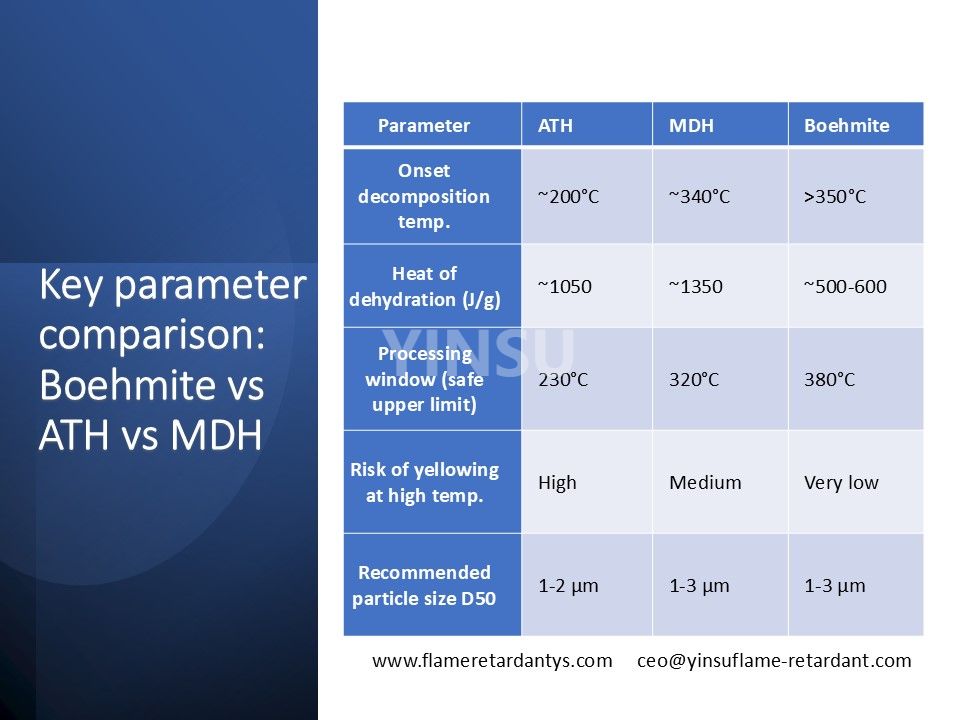
The thermal decomposition of boehmite (γ-AlOOH) occurs between 350–500°C, releasing water and forming high‑surface‑area alumina (Al₂O₃) while absorbing a large amount of heat (approx. 500–600 J/g).
In comparison:
ATH (Al(OH)₃) starts to decompose at about 200°C, releasing water vapor.
MDH (Mg(OH)₂) decomposes at about 340°C.
During extrusion or injection molding of PA6 (processing temperature 240–270°C), PBT (250–265°C), or even high‑temperature nylon (>280°C), ATH easily decomposes prematurely, generating bubbles and acid‑catalyzed degradation, leading to yellowing and rough surfaces. Although MDH is slightly more heat‑resistant, the processing window remains narrow.
The synergistic flame retardancy of boehmite is not only due to heat absorption and dilution:
Delayed decomposition – Stable during melt processing, it does not start working prematurely.
High‑temperature heat absorption – When combustion occurs, it rapidly dehydrates, cooling the material and diluting flammable gases.
Char reinforcement – The Al₂O₃ formed after dehydration can act as an acidic catalytic site, reacting with polyphosphoric acid generated from phosphorus‑based flame retardants (e.g., aluminium diethylphosphinate, ammonium polyphosphate) to form a denser aluminium‑phosphate char layer. Experiments show that adding boehmite can increase char compactness by more than 30%.
Therefore, boehmite is particularly suitable for compounding with halogen‑free flame retardant systems, maintaining V‑0 rating while improving high‑temperature processing stability.
Key parameter comparison: Boehmite vs ATH vs MDH
2. Four Core Advantages of Yinsu Boehmite: Cost Reduction, Property Retention, V‑0 Rating
Yinsu Flame Retardant’s halogen‑free synergistic flame retardant boehmite is recommended at 3–6% addition (adjustable according to polymer matrix and flame‑retardant system). The core advantages are:
Widens processing window – Tolerates short‑term exposure up to 380°C, eliminates yellowing and foaming.
Replaces part of ATH/MDH – Can replace 30% of ATH/MDH in PA6/phosphorus systems; up to 50% with optimised formulations. This reduces total filler loading, improving melt flow and mechanical properties.
Maintains or improves flame retardancy – When combined with phosphorus‑nitrogen flame retardants, easily passes UL94 V‑0 (1.6 mm).
Cost optimisation – Although the unit price of boehmite is slightly higher than that of ATH, the reduced total loading can lower the overall formulation cost by 10–25%.
Typical formulation comparison (PA6 system, parts by mass)
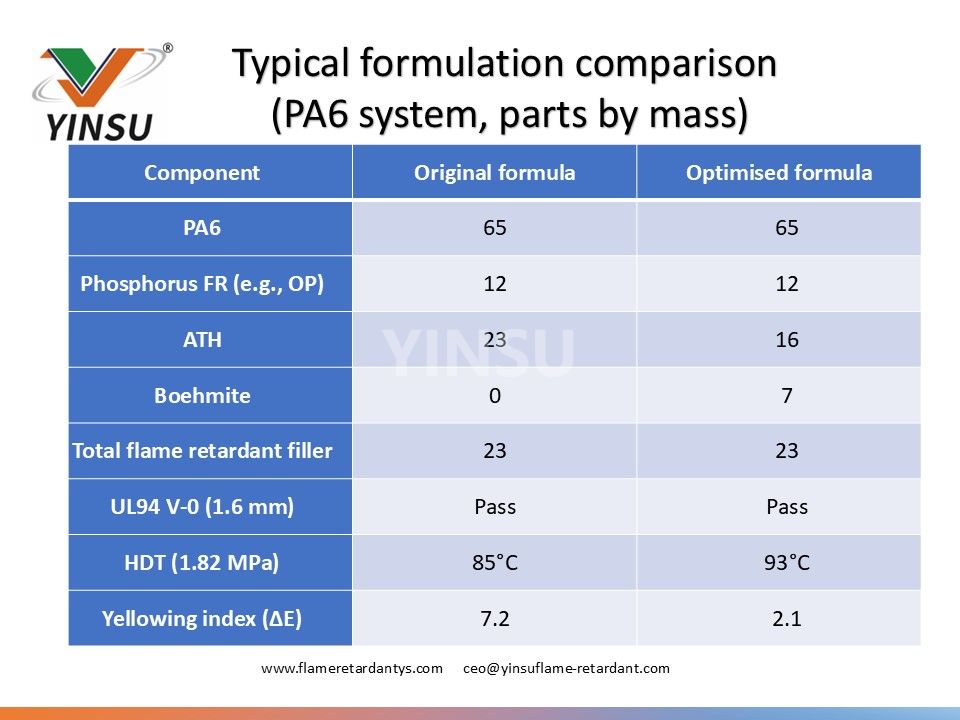
Data source: Yinsu Flame Retardant laboratory tests (typical values, for reference only).
Domestic stock available, sample delivery within 72 hours, free formulation tuning support.
3. Typical Application Example: Replacing 30% ATH in PA6 at a Foshan Compounder
Customer background: An electronic connector compounder in Shunde District, Foshan City, using a Coperion STS 35 twin‑screw extruder, produces about 500 tons per year of flame‑retardant PA6 mainly for home appliances and automotive connectors.
Original problem: The original formulation used 23% ATH together with a phosphorus flame retardant. Although it passed UL94 V‑0, during hot and humid summer conditions frequent surface yellowing and slight bubbles appeared during extrusion, and the HDT was low (85°C), limiting use in heat‑resistant parts. The reject rate was as high as 8%.
Improvement plan: Keeping total flame retardant filler loading unchanged (23 phr), 7 phr boehmite replaced an equal amount of ATH (ATH reduced from 23 to 16 phr, boehmite 7 phr).
Results:
Processing appearance: Yellowing completely eliminated, smooth and bubble‑free surface.
Flame retardancy still V‑0 (1.6 mm), with average afterflame time reduced from 5 seconds to 2 seconds.
HDT increased from 85°C to 93°C, meeting higher heat‑resistance requirements.
Tensile strength increased from 58 MPa to 63 MPa (due to less ATH, less matrix damage).
Reject rate decreased from 8% to 1.5%.
Customer feedback: "Boehmite solved a processing headache we had for two years. The reduction in reject rate alone covered the material cost. Now we can produce stably even in hot summer weather."
4. Processing Recommendations
To ensure good dispersion and synergistic effects of boehmite, follow these suggestions:
Drying – Boehmite is hygroscopic. Dry at 110–120°C for 2–4 hours before use.
Screw configuration – Use a low‑shear, medium‑to‑high dispersion screw layout (similar to ATH systems) to avoid local overheating from excessive shear.
Vacuum venting – Must be active to remove moisture and low‑molecular‑weight species, preventing bubbles.
Lubricant selection – Recommend PETS or calcium stearate; avoid acidic lubricants (EBS may cause yellowing).
Mixing sequence with phosphorus FR – Premix the phosphorus FR and boehmite before adding the base polymer to ensure uniform distribution.
Particle size – Choose boehmite with D50 = 1–3 μm for a good balance of dispersibility and flame retardant efficiency.
5. Frequently Asked Questions (FAQ)
Q1: Does boehmite affect the colour, especially for light‑coloured products?
A: High‑purity boehmite is a white powder with whiteness ≥96%, and has no significant effect on light colours. Tests show that adding 7% boehmite to PA6 increases ΔE by only 0.5.
Q2: Can boehmite be used in transparent or translucent plastics?
A: Not recommended. The refractive index of boehmite differs significantly from most resins, leading to loss of transparency. For transparent flame retardancy, liquid organophosphorus flame retardants are recommended.
Q3: What is the difference between boehmite and nanoclay?
A: Nanoclay mainly acts as a char promoter and physical barrier, without endothermic dehydration capability. Boehmite provides both endothermic dehydration and char‑synergistic effects. They can be used together.
Conclusion
Boehmite is not a completely new product, but its value in halogen‑free flame retardant modification of high‑temperature engineering plastics has long been underestimated. Thanks to its decomposition temperature >350°C, high heat absorption, and char synergy with phosphorus flame retardants, it can effectively replace 30–50% of ATH or MDH, solve the persistent problems of yellowing and foaming during high‑temperature processing, maintain UL94 V‑0 rating, and improve HDT and mechanical properties.
For engineers struggling with high‑temperature processing of nylon, PBT, or polyolefins with flame retardants, boehmite offers a new path: "no increase in loading, wider window, lower cost."
Action suggestion
Verify the effect now:
Click the button below to apply for a 250g boehmite sample + "Formulation Design Guide for Halogen‑Free Flame Retardant High‑Temperature Nylon"
Or contact the Yinsu Flame Retardant technical team for a free lab trial; we will help you optimise your existing formulation
Domestic stock, sample delivery within 72 hours, one‑on‑one online technical support
Contact:
Website: www.flameretardantys.com
Email: ceo@yinsuflame-retardant.com
Phone: +86 17278575995 (Sandy Xu)


