
- All
- Product Name
- Product Keyword
- Product Model
- Product Summary
- Product Description
- Multi Field Search

Views: 36 Author: Yinsu Flame Retardant Publish Time: 2026-05-24 Origin: www.flameretardantys.com


Today, we will provide you with an in-depth analysis of the microscopic nature of wollastonite and its advanced application logic in plastics modification, from the professional perspectives of mineral crystallography, interfacial physical chemistry, and thermodynamics.
1. Crystal Structure and Geometric Morphology
Wollastonite is not an ordinary particulate filler, but a natural inorganic microfiber.
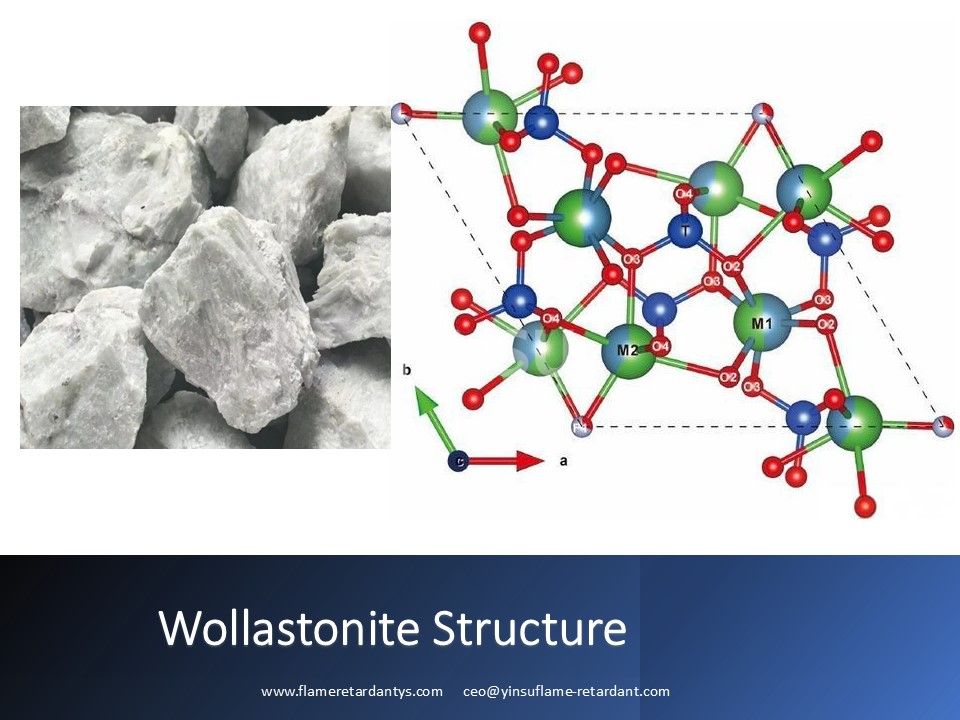
Chemical and Crystallographic Nature
Pure wollastonite is calcium metasilicate (CaSiO₃), with a theoretical composition of approximately 48.3% CaO and 51.7% SiO₂. It belongs to the chain silicates, and its crystal structure consists of silicate tetrahedron (SiO₄) chains combined with calcium ions in octahedral coordination positions arranged in parallel.
Cleavage and "Naturally Acicular"
This chain structure endows it with highly characteristic physical properties — it has two perfect cleavage planes that are nearly perpendicular (84° intersection angle). When crushed and subjected to force, it readily splits along the crystal planes, forming acicular particles.
Key Parameters
l Intrinsic tensile strength: The theoretical tensile strength of a single silicite microfiber is extremely high, reaching 2,700–4,100 MPa, which is on the same order of magnitude as that of some common glass fibers.
l Aspect ratio: Through industrial processing using specialized air-jet mills or friction mills, a high aspect ratio (HAR) can be maintained, typically ranging from 10:1 to 30:1; in contrast, conventional impact milling produces a low aspect ratio (LAR), approximately 3:1 to 5:1. The diameter of wollastonite generally used for plastic modification is approximately 3–6 μm.
2. Surface Chemical Groups and Weak Alkalinity
The chemical environment on the wollastonite surface determines the success or failure of interfacial bonding, and it is fundamentally different from silica or talc.
Broken Bonds and Silanol Groups
During the grinding process, Si-O and Ca-O bonds in the crystal lattice are forcibly broken. The unsaturated silicon and oxygen terminals on the surface rapidly react with moisture in the air to generate reactive silanol groups (Si-OH). This is the basis for its chemical modification.
The Overlooked "Alkaline" Characteristic
Unlike talc and kaolin, whose surfaces are slightly acidic or neutral, wollastonite exhibits strong weak alkalinity in water (pH as high as 9.0 ~ 11.0). This surface alkalinity originates from the presence of calcium ions. It is helpful for the stability of the polymer matrix (such as neutralizing acidic degradation products), but poses a significant challenge to surface coupling treatment.
3. Interaction Forces and Interfacial Challenges
In the polymer matrix, untreated wollastonite mainly relies on weak van der Waals forces and physical embedding to bind with the resin. When performing chemical coupling, we must face a harsh fact:
The "Silane Loss" Problem
Although wollastonite has silanol groups on its surface and appears suitable for silane coupling agents, experimental data shows that after THF (tetrahydrofuran) washing, the silane retention rate on the wollastonite surface is only 21%. Under the same conditions, kaolin (pH 7.1) has a retention rate of 96%, and E-glass (pH 9.5) is 50%.
Modification
This is because silane coupling agents (usually most stable at pH 4-5) undergo rapid, uncontrolled self-polymerization on the strongly alkaline wollastonite surface at pH 9.9, forming multilayer oligomers that are difficult to form dense covalent bonds with the mineral surface. This means that under conventional processes, silanes on the wollastonite surface are mostly "physically adsorbed" rather than "chemically grafted," and are prone to desorption under polar resins or stress conditions.

4. Special Properties to Watch in Plastics Modification
In addition to the conventional increase in modulus, wollastonite has several irreplaceable trump cards in high-end modification:
"Dimensional Stability" from Extremely Low Thermal Expansion
The linear coefficient of thermal expansion (CTE) of wollastonite is extremely low, only 6.5 × 10⁻⁶ K⁻¹. Adding HAR wollastonite to polypropylene (PP) or nylon (PA) can significantly reduce anisotropic shrinkage and warpage deformation of products (obviously superior to GF).
The Perfect Balance of Mohs Hardness
The Mohs hardness of wollastonite is 4.5 - 5. This happens to be in an engineering "sweet spot": it is much harder than talc (hardness 1), thus significantly improving scratch resistance and surface wear resistance in TPO (automotive bumpers, interiors); at the same time, it is softer than glass fiber (hardness 6-6.5), greatly reducing wear on injection molding machine screws and molds.
Nucleation and "Trans-Crystallization" Effect
Wollastonite particles exhibit strong heterogeneous nucleation in semi-crystalline polymers (such as PA6, PP). At low filler concentrations, it can change the crystalline morphology of the polymer (inducing trans-crystallization). This special microscopic crystalline structure transformation can even lead to a reduction in macromolecular chain orientation, thereby changing the fracture mechanism of the material to some extent, causing a decrease in fatigue life of uncoupled materials. Therefore, good interfacial treatment must be paired with it.
5. Recommendations for Surface Modification and Formulation Design
Based on the above physicochemical characteristics, I provide the following recommendations for your plastics modification formulation:
Precise Selection of Modifiers
Strategy for Alkaline Surfaces:
Do not blindly use conventional amino or epoxy silanes for direct dry mixing.
⚡️ Due to the low adhesion rate of silanes on its alkaline surface, it is recommended to use macromolecular compatibilizers (such as maleic anhydride grafted PP-g-MAH or POE-g-MAH), utilizing the anhydride groups to undergo strong acid-base interactions with the alkaline/polar sites on the wollastonite surface. This physical + chemical anchoring is often more effective than using silane alone in PP.
If your plastic matrix is PC, PC/ABS, PC/PBT, PBT, PET, the alkaline wollastonite will cause degradation of the material, resulting in silver streaks and discoloration. In this case, a metal-chelating macromolecule Metalign™ is needed to passivate ions and stabilize the system.
Thermosets and Engineering Plastics:
If silanes must be used (such as in nylon 66 or epoxy), it is recommended to use silane-pretreated wollastonite with a special buffer system, as they have better adaptability to weakly alkaline surfaces than conventional silanes.
Distinguishing HAR and LAR Application Scenarios
l Replacing glass fiber for strength and heat resistance (HDT): HAR wullite (aspect ratio > 15:1) must be used. During extrusion, a low-shear screw combined with side feeding (to reduce kneading) is required to prevent the valuable needle-like structure from being sheared.
l Dimensional Stability, Scratch Resistance, and Flow Promotion: Select LAR wollastonite (aspect ratio ~3:1). Granular wollastonite offers significantly lower melt viscosity than needle-shaped powders, enabling high loading while delivering excellent isotropy, low shrinkage, and high surface gloss.
Examples: Product Categories of Quarzwerke GmbH

In Summary
The value of wollastonite lies in its unique combination of "naturally acicular microfiber configuration, moderate hardness, and silanol groups in an alkaline environment." Mastering the deep mechanism of coupling agent deactivation caused by its surface alkalinity, and conducting interface design through customized macromolecular compatibilizers or specific processes, is the core secret to transforming this mineral from a "filler" into a "functional reinforcing material."


