
- All
- Product Name
- Product Keyword
- Product Model
- Product Summary
- Product Description
- Multi Field Search

Views: 35 Author: Yinsu Flame Retardant Publish Time: 2026-10-09 Origin: www.flameretardantys.com


Multifunctional PET Fabric with Excellent Flame Retardancy, Drip Resistance, UV Resistance, And Antibacterial Properties
Currently, PET is widely used in various industries—including textiles, electronics, and automotive—due to its excellent properties. However, the flammability of PET can pose safety hazards under certain conditions. When exposed to flames or high temperatures, PET ignites and exhibits severe dripping, which not only intensifies the fire but also causes serious secondary damage to the surrounding environment and people. To improve the fire safety of PET, it is necessary to impart flame-retardant and anti-dripping properties to the material.
Traditional surface treatment methods typically exhibit poor fastness. In nature, mussels demonstrate excellent adhesion due to their high content of catechol groups; these groups not only form a wide range of dynamic physical interactions but also cross-link to produce a certain amount of residual carbon, indicating that mussels hold broad application prospects for fabric surface functionalization.
Dyeing is a common finishing method for textiles; it not only imparts rich colors and patterns to textiles but also enables the development of other additional properties as needed. Porphyrins are large heterocyclic compounds derived from living organisms that play a key role not only in catalysis and energy conversion but also demonstrate unique application potential in photodynamics. Due to their excellent thermal stability and UV absorption properties, porphyrin molecules can effectively enhance the thermal stability and UV resistance of polymeric materials such as PET. In particular, hemocyanin chloride (HC), an iron-containing porphyrin and a natural pigment found in animal blood, can serve as a substitute for nitrites and synthetic dyes in meat products. The highly conjugated porphyrin rings in the HC molecular structure can generate strong interactions through π-π stacking. The presence of this physical network structure effectively restricts the movement of PET molecular chains, thereby improving its resistance to sagging. In recent years, biomacromolecules have been actively applied in the flame-retardant modification of materials, with tannic acid (TA) receiving widespread attention due to its unique chemical structure. Its effective flame-retardant properties are attributed to the char layer formed by phenolic hydroxyl groups and benzene ring structures during pyrolysis. In addition, the phenolic hydroxyl groups of tannic acid can effectively absorb ultraviolet (UV) radiation, reducing UV-induced damage to the material, while also inhibiting the growth of various bacteria, thereby playing a positive role in UV resistance and antibacterial performance.
Recently, a team led by Ren Yuanlin at Tianjin University of Technology developed a multifunctional PET fabric with excellent flame-retardant, anti-drip, UV-resistant, and antibacterial properties by combining dyeing processes with fabric finishing techniques.
First, the PET fabric was directly dyed with hemocyanin chloride (HC) to produce dyed PET fabric (HC-PET). The HC-PET was then treated with a mussel-inspired tannic acid-based flame retardant (TAPP) using an impregnation-drying-curing process to produce flame-retardant PET fabric (FR-PET).
The total heat release (THR) and peak smoke production rate (PSPR) of the fabric were reduced by 22.8% and 49.7%, respectively, while the limiting oxygen index (LOI) increased from 21% to 29.8%, demonstrating excellent flame-retardant properties. The fabric exhibited no melting droplets upon ignition, indicating superior anti-dripping performance. Furthermore, the fabric’s UV resistance and antimicrobial properties were also significantly enhanced. Therefore, this study provides a feasible method for the preparation of multifunctional PET textiles with dyeing, flame-retardant, anti-drip, UV-resistant, and antibacterial properties.
Schematic Diagram of the Preparation Process
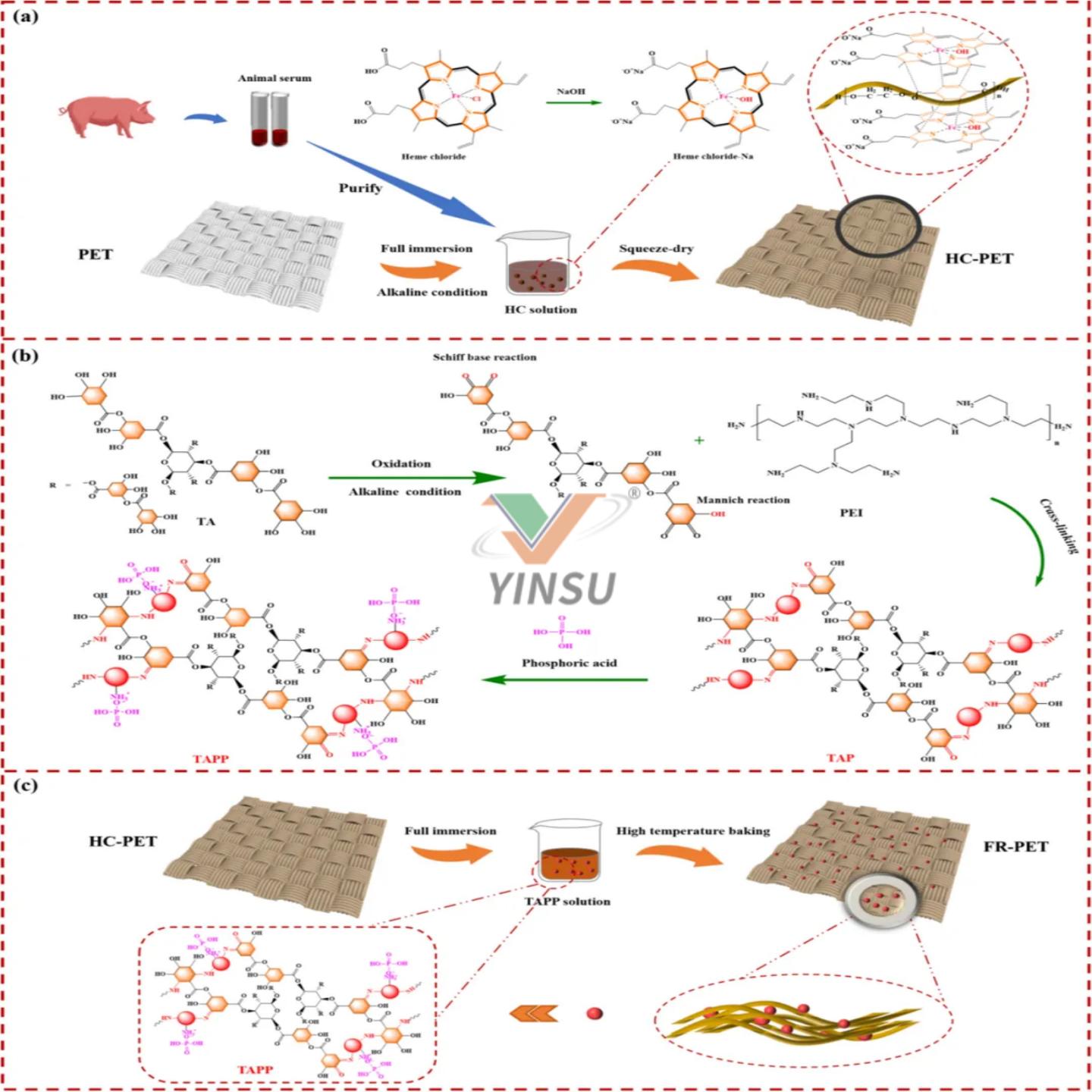
Schematic diagram of the preparation of (a) HC-PET, (b) TAPP, and (c) FR-PE.


