Study on Properties, Mechanism and Application of
Low Smoke Zero Halogen (LSZH) Materials for Aerospace Products
I. Introduction
1.1 Research Background
With the rapid development of aerospace technology, the requirements for material safety, environmental friendliness and reliability in manned spaceflight, deep space exploration and space
station construction are continuously escalating. Traditional halogen-containing flame retardant materials can no longer meet the stringent demands of the aerospace field due to their poor environmental performance and highly toxic combustion products.
Low Smoke Zero Halogen (LSZH) materials have emerged as a timely solution. Their core advantages include: no halogen gas release during combustion, extremely low smoke generation, low toxicity, weak corrosiveness, while simultaneously possessing excellent flame retardancy, mechanical strength and environmental stability. These characteristics perfectly align with the safe service requirements of aerospace products, making LSZH materials a research hotspot and key development direction in the modern aerospace materials field.
1.2 Current Research Status at Home and Abroad
International Research Status
Aerospace powerhouses in Europe and America (the United States, Russia, and the European Union) started research and development of LSZH materials earlier, with mature technical systems.
NASA in the United States launched specialized research on aerospace LSZH materials as early as the 1980s, establishing stringent standards such as SAE AS 22759 and FAR 25.853, which explicitly mandate that aerospace cables and interior materials must adopt low smoke halogen-free flame retardant systems. Aerospace enterprises such as Boeing and Airbus simultaneously introduced corporate standards (Boeing D6-51377, Airbus AIMS09-32-002), prohibiting the use of halogen-containing materials in critical components, thereby promoting the large-scale application of LSZH materials in civil aviation and aerospace fields.
In terms of material systems, three mainstream LSZH material systems have been established internationally: polyolefin-based, polyurethane-based, and polyimide-based. Among these, polyolefin-based LSZH materials are widely used for aerospace cable insulation and sheathing due to their good processability and moderate cost; polyurethane-based LSZH materials are employed for aerospace interior seals and cushioning components owing to their excellent flexibility and wear resistance; polyimide-based LSZH materials, featuring ultra-high temperature resistance (long-term 260°C), are suitable for electronic encapsulation and structural components in high-temperature zones of spacecraft.
Meanwhile, international research leads in flame retardant mechanism studies, nano-modification technology and irradiation crosslinking processes. Through synergistic modification with inorganic nano-fillers (nano SiO₂, nano montmorillonite) and phosphorus-nitrogen compound flame retardants, the flame retardant efficiency and mechanical properties of materials are significantly enhanced.
Domestic Research Status
Research on aerospace LSZH materials in China began in the 1990s. With the advancement of manned spaceflight programs, the BeiDou Navigation System and space station construction, R&D investment has continued to increase, gradually achieving the leap from technology introduction to independent innovation.
Domestic aerospace material enterprises, universities (Beihang University, Harbin Institute of Technology) and research institutes (Shanghai Cable Research Institute) have collaborated to tackle key technologies, breaking through efficient halogen-free flame retardant compounding, nano-modification, irradiation crosslinking and other critical technologies. They have developed series of aerospace LSZH materials with performance reaching international levels of comparable products.
In terms of standard system construction, China has established national military standards such as GJB 773A "General Specification for Aerospace Cables" and GJB 1709 "General Specification for Flame Retardant Materials for Military Electronic Equipment", which clearly define the flame retardant, low smoke, halogen-free and mechanical performance indicators for aerospace LSZH materials, providing the basis for material selection and quality control.
Currently, independently developed LSZH cable materials in China have been successfully applied to the Shenzhou series spacecraft, Tiangong Space Station, Chang'e lunar exploration program and Long March series launch vehicles, achieving domestic substitution of core aerospace materials.
However, compared with advanced international levels, China still has gaps in long-term stability of materials under extreme environments (high vacuum, strong radiation), ultra-high temperature LSZH materials, and low-cost efficient flame retardant systems, requiring further in-depth research.
1.3 Research Significance
The safety of aerospace products is the core prerequisite for the success of space missions. As a key component of aerospace safety materials, the research and application of LSZH materials have important practical significance and strategic value:
-
Enhancing Aerospace Product Safety: LSZH materials produce no halogen toxic gases and low smoke during combustion, effectively avoiding personnel poisoning and asphyxiation as well as equipment corrosion damage during fires, thereby reducing space mission risks;
-
Meeting Extreme Environment Service Requirements: Excellent high-low temperature resistance, radiation resistance and aging resistance adapt to the complex service environments inside and outside spacecraft cabins, ensuring long-term stable material service;
-
Promoting Domestic Substitution of Aerospace Materials: Breaking through foreign technology monopolies, achieving independent control of high-performance LSZH materials, reducing aerospace equipment manufacturing costs, and enhancing the core competitiveness of China's aerospace industry;
-
Practicing Green Aerospace Concepts: Halogen-free, low-toxicity and environmentally friendly characteristics align with green manufacturing and sustainable development requirements in the aerospace field, promoting high-quality development of the aerospace industry.
1.4 Research Content
The main research contents of this paper include:
-
Definition, classification and core characteristics of LSZH materials;
-
Flame retardant and smoke suppression mechanisms of LSZH materials (condensed phase, gas phase, synergistic flame retardancy);
-
Core standards and key performance indicator requirements for LSZH materials in the aerospace field;
-
Typical application scenarios and technical requirements of LSZH materials in aerospace products;
-
Bottleneck problems and optimization directions of aerospace LSZH materials;
-
Future R&D trends for high-performance aerospace LSZH materials.
II. Definition, Classification and Core Characteristics of LSZH Materials
2.1 Definition
Low Smoke Zero Halogen (LSZH) materials refer to polymer and composite materials that contain no halogen elements (fluorine, chlorine, bromine, iodine), generate extremely low smoke during combustion, and do not release corrosive toxic gases such as hydrogen halides, while simultaneously possessing excellent flame retardant properties. Their core connotation includes two essential elements: "halogen-free" and "low smoke":
-
Halogen-Free: The total halogen content in the material is ≤0.5% (mass fraction), with no hydrogen halide gases such as HCl and HBr released during combustion, avoiding corrosion and poisoning of personnel and equipment;
-
Low Smoke: The smoke density during material combustion is extremely low, with light transmittance ≥60% (IEC 61034-2 standard), reducing smoke obstruction of vision and improving emergency response efficiency.
2.2 Classification
According to the type of matrix resin, aerospace LSZH materials are mainly divided into four categories: polyolefin-based, polyurethane-based, polyimide-based, and epoxy-based, with significant differences in characteristics and applicable scenarios:
-
Matrix Resin: Polyethylene (PE), Ethylene-Vinyl Acetate Copolymer (EVA), Polypropylene (PP) and their blends;
-
Flame Retardant System: Primarily inorganic flame retardants such as aluminum hydroxide (ATH) and magnesium hydroxide (MH), compounded with red phosphorus and phosphorus-nitrogen flame retardants;
-
Core Characteristics: Low density, good processability, high flexibility, low cost, excellent weather resistance; long-term temperature resistance -60°C~125°C, suitable for aerospace cable insulation and sheathing, lightweight structural components;
-
Typical Products: Aerospace crosslinked polyolefin LSZH cable compounds, EVA-based LSZH sealing gaskets.
Polyurethane-Based LSZH Materials
-
Matrix Resin: Thermoplastic Polyurethane (TPU), Castable Polyurethane (CPU);
-
Flame Retardant System: Reactive phosphorus-nitrogen flame retardants, intumescent flame retardants (IFR);
-
Core Characteristics: High elasticity, high wear resistance, excellent low-temperature toughness, oil and corrosion resistance; long-term temperature resistance -40°C~100°C, suitable for aerospace interior cushioning components, seals, flexible pipelines and cable sheathing;
-
Typical Products: Aerospace seat cushioning polyurethane, LSZH polyurethane sealant.
Polyimide-Based LSZH Materials
-
Matrix Resin: Polyimide (PI), Polyetherimide (PEI);
-
Flame Retardant System: Inherent flame retardancy (molecular chain contains imide rigid structure), no additional flame retardants required;
-
Core Characteristics: Ultra-high temperature resistance (long-term 260°C, short-term 500°C), excellent mechanical strength, radiation resistance, aging resistance, low smoke and halogen-free; suitable for high-temperature zone structural components, electronic component encapsulation, and high-temperature cable insulation of spacecraft;
-
Typical Products: Aerospace high-temperature structural PI sheets, LSZH polyimide films.
Epoxy-Based LSZH Materials
-
Matrix Resin: Bisphenol A epoxy resin, phenolic epoxy resin;
-
Flame Retardant System: Phosphorus flame retardants, nitrogen flame retardants, inorganic nano-filler compounding;
-
Core Characteristics: High bonding strength, small curing shrinkage, chemical corrosion resistance, excellent flame retardant properties; long-term temperature resistance -50°C~180°C, suitable for aerospace electronic component encapsulation, composite matrix, and structural component bonding;
-
Typical Products: Aerospace electronic encapsulation LSZH epoxy, carbon fiber/epoxy LSZH composites.
2.3 Core Characteristics
Aerospace LSZH materials must simultaneously satisfy five core characteristics: flame retardant safety, low smoke and low toxicity, mechanical stability, environmental adaptability, and processing feasibility, as detailed below:
Flame Retardant Performance
Flame retardant performance is the core indicator of aerospace LSZH materials, requiring compliance with UL94 V-0 rating, FAR 25.853 vertical burning, and GJB 1709 flame retardant Class A requirements, meaning materials extinguish immediately upon removal of flame, with no sustained combustion or dripping ignition phenomena. Limiting Oxygen Index (LOI) ≥30%, with some high-temperature scenario materials requiring LOI ≥35%, ensuring difficult combustion in enclosed spaces and inhibiting flame spread.
Low Smoke and Low Toxicity Performance
-
Low Smoke: Combustion smoke density (light transmittance) ≥60% (IEC 61034-2), Smoke Density Rating (SDR) ≤50, reducing smoke obstruction and toxicity hazards;
-
Low Toxicity: Combustion gas toxicity rating reaches TB level (low toxicity), with no release of highly toxic gases such as hydrogen halides and hydrogen cyanide, meeting astronaut safety requirements inside spacecraft cabins.
Mechanical Properties
Aerospace materials must withstand launch vibrations, on-orbit micrometeoroid impacts and extreme temperature difference stresses. LSZH materials require excellent mechanical strength and toughness: tensile strength ≥10 MPa, elongation at break ≥150%, impact strength ≥20 kJ/m², hardness (Shore A) 80~90, balancing strength and flexibility to avoid cracking and deformation during service.
Environmental Adaptability
Adapting to the extreme service environments of spacecraft:
-
High-Low Temperature Resistance: Long-term stability at -65°C~125°C, with high-temperature zone materials resistant to 260°C, no brittle cracking at low temperatures and no softening or deformation at high temperatures;
-
Radiation Resistance: Withstanding high-energy particle radiation (γ rays, electron beams), with mechanical performance retention rate ≥80% after radiation, no degradation, discoloration or embrittlement;
-
Aging Resistance: Performance degradation ≤20% after thermal-oxidative aging and UV aging, ensuring long-term on-orbit service (15~20 years) stability and reliability;
-
Low Volatility: Mass loss rate (TML) ≤1% in high vacuum environments, Collected Volatile Condensable Material (CVCM) ≤0.1%, avoiding volatile contamination of precision instruments.
Processing and Compatibility
Possessing good extrusion, injection molding, compression molding and bonding processing properties, suitable for large-scale production of aerospace components; simultaneously exhibiting good compatibility with metals, carbon fibers, glass fibers and other materials, usable for composite preparation and structural component bonding, meeting the lightweight and integrated design requirements of aerospace products.
III. Core Standards and Performance Requirements for LSZH Materials in the Aerospace Field
Aerospace products impose requirements on LSZH materials far exceeding civilian applications, requiring simultaneous compliance with national military standards (GJB), aerospace industry standards (SAE, FAR), and corporate proprietary standards, with core focus on five dimensions: flame retardancy, low smoke, halogen-free, mechanical properties, and environmental adaptability.
3.1 Core Standard System
Domestic Standards
-
GJB 773A-2000 "General Specification for Aerospace Cables": Specifies the flame retardant, low smoke, halogen-free, high-low temperature resistance, and radiation resistance requirements for LSZH insulation/sheathing materials used in aerospace cables;
-
GJB 1709-1993 "General Specification for Flame Retardant Materials for Military Electronic Equipment": Clarifies the flame retardant rating (Class A), smoke density, toxicity rating and mechanical performance indicators for LSZH materials used in aerospace electronic equipment;
-
GJB 2485-1995 "Spacecraft Material Vacuum Outgassing Test Method": Standardizes the volatile testing methods for LSZH materials under high vacuum, requiring TML ≤1% and CVCM ≤0.1%;
-
HB 5470-1991 "Test Methods for Combustion Performance of Aviation Non-Metallic Materials": Specifies the vertical burning and horizontal burning test methods for aerospace interior LSZH materials.
International Standards
-
SAE AS 22759 "Standard for Aerospace Insulated Wire": The core American standard for aerospace cables, requiring LSZH materials to satisfy -65°C~200°C temperature resistance, UL94 V-0 flame retardancy, and halogen-free low smoke requirements; -
FAR 25.853 "Combustion Performance of Aircraft Interior Materials": An internationally mandatory civil aviation standard, requiring aerospace interior materials to self-extinguish within 12 seconds in vertical burning tests, with no sustained combustion or dripping;
-
IEC 60332-3 "Cable Bunch Combustion Test": International cable flame retardant standard, requiring aerospace LSZH cables to pass Class A bunch combustion testing;
-
IEC 61034-2 "Cable Combustion Smoke Density Test": Specifies the testing method requiring LSZH material smoke light transmittance ≥60%.
3.2 Key Performance Indicator Requirements
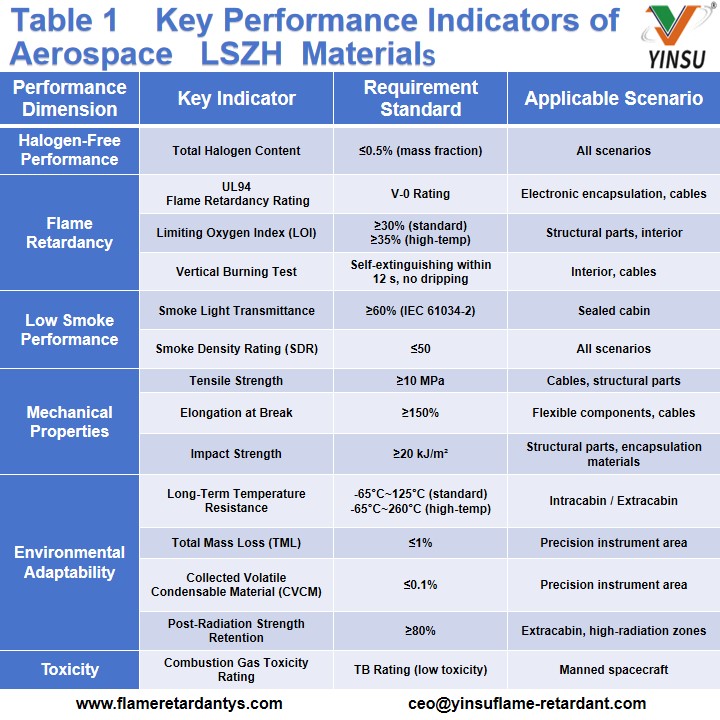
Combining aerospace standards and service requirements, the core performance indicators of LSZH materials are shown in Table 1:
3.3 Differentiated Requirements for Aerospace Scenarios
Manned Spacecraft (Spaceships, Space Stations)
-
Core Requirements: Low toxicity priority, flame retardancy secondary, extreme low smoke; combustion gases contain no hydrogen cyanide or hydrogen halides, light transmittance ≥70%, meeting astronaut life safety requirements;
-
Applicable Materials: Polyurethane-based LSZH interiors, polyolefin-based LSZH cables, low-toxicity epoxy encapsulation materials.
Unmanned Spacecraft (Satellites, Probes)
-
Core Requirements: Flame retardancy priority, low smoke adaptation, high stability; focusing on suppressing equipment damage caused by fires, with higher requirements for radiation resistance and vacuum resistance, TML ≤0.5%;
-
Applicable Materials: Polyimide-based LSZH structural components, epoxy-based LSZH encapsulation materials, crosslinked polyolefin cables.
Launch Vehicles
-
Core Requirements: High temperature resistance, flame retardancy, low smoke, lightweight; structural components resistant to -65°C~180°C, cables must withstand launch vibration and high temperatures, density ≤1.5 g/cm³;
-
Applicable Materials: Carbon fiber/epoxy LSZH composites, EVA-based LSZH cable sheathing, high-temperature resistant polyimide films.
IV. Typical Applications of LSZH Materials in Aerospace Products
Leveraging their excellent comprehensive properties, LSZH materials have been widely applied in four core fields of aerospace products: cable systems, interior structures, electronic encapsulation, and composite materials, becoming a key support for aerospace safety.
4.1 Aerospace Cable Insulation and Sheathing
Aerospace cables are the "neural blood vessels" of spacecraft, distributed throughout cabins inside and outside, with complex service environments, representing the field with the largest consumption and most mature application of LSZH materials.
Application Requirements
-
Insulation Layer: High-low temperature resistance, radiation resistance, high insulation, low smoke and halogen-free, flame retardant; long-term temperature resistance -65°C~125°C, breakdown strength ≥20 kV/mm;
-
Sheathing Layer: Wear resistance, oil resistance, aging resistance, flame retardant, low smoke and halogen-free, high flexibility; withstanding launch vibration and micrometeoroid impact, elongation at break ≥200%.
Material Selection and Application
-
Insulation Layer: Crosslinked polyolefin (XLPE) based LSZH materials (EVA/ATH/red phosphorus system), temperature resistant to 125°C, with excellent insulation performance, certified by GJB 773A, used for Shenzhou spacecraft and space station control cables;
-
Sheathing Layer: Thermoplastic polyurethane (TPU) based LSZH materials, highly wear-resistant, highly elastic, oil-resistant, adapting to complex extracabin environments, used for launch vehicle bodies and satellite external cables;
-
High-Temperature Cables: Polyimide (PI) based LSZH insulation materials, temperature resistant to 260°C, used for electronic cables around spacecraft engines and in high-temperature zones.
4.2 Aerospace Interiors and Structural Components
Aerospace cabin interiors (seats, decorative panels, sealing gaskets, cushioning components) and lightweight structural components must balance lightweight design, flame retardancy, low smoke and low toxicity, and mechanical stability, with LSZH materials being the preferred choice.
Interior Materials
-
Seat Cushioning: Polyurethane-based LSZH foam materials, density ≤0.5 g/cm³, highly elastic, low smoke and low toxicity, meeting FAR 25.853 flame retardant requirements, used for manned spacecraft astronaut seats;
-
Interior Decorative Panels: Polyolefin-based LSZH sheets, flame retardant V-0 rating, low smoke, aging resistant, lightweight and easy to process, used for space station cabin interiors;
-
Sealing Gaskets/Strips: EVA/rubber blended LSZH materials, oil resistant, high-low temperature resistant, highly elastic, used for cabin doors and window seals to prevent gas leakage.
Lightweight Structural Components
-
Satellite Brackets/Housings: Carbon fiber/epoxy-based LSZH composites, tensile strength ≥500 MPa, density ≤1.2 g/cm³, flame retardant V-0 rating, radiation resistant, achieving the unity of lightweight and high strength;
-
Instrument Mounting Boards: Glass fiber reinforced polyimide-based LSZH materials, temperature resistant to 200°C, mechanically stable, low smoke and halogen-free, used for precision instrument mounting and fixation in spacecraft.
4.3 Aerospace Electronic Component Encapsulation
Spacecraft electronic components (chips, circuit boards, connectors) must operate stably for long periods in high vacuum, strong radiation, and extreme temperature difference environments. Encapsulation materials require flame retardant, low smoke, low volatility, high insulation, and radiation resistance properties, with LSZH epoxy resin being the mainstream choice.
Application Requirements
-
Flame Retardant: UL94 V-0 rating, preventing fires caused by circuit short circuits;
-
Low Volatility: TML ≤0.5%, CVCM ≤0.05%, avoiding volatile contamination of chips and circuit boards;
-
Radiation Resistance: No significant performance degradation after γ-ray radiation;
-
Bonding Strength: ≥15 MPa, ensuring firm bonding between components and circuit boards.
Material Selection and Application
Phosphorus-nitrogen compound flame retardant epoxy resins are adopted, with nano SiO₂, montmorillonite and other inorganic fillers added to enhance flame retardant efficiency and radiation resistance. This material achieves V-0 flame retardant rating, light transmittance ≥60%, TML ≤0.3%, and has been applied to BeiDou navigation satellites and Chang'e probe electronic component encapsulation, effectively ensuring the safety and stability of electronic systems. 4.4 Aerospace Composite Matrix Materials
The demand for lightweight design in aerospace promotes the widespread application of composite materials. LSZH resins (epoxy, polyimide) serve as composite matrix materials, combined with carbon fibers and glass fibers to prepare high-strength, lightweight, flame retardant and low smoke aerospace structural components.
Carbon Fiber/Epoxy LSZH Composites
The matrix adopts halogen-free flame retardant epoxy resin, with carbon fiber as the reinforcement. The composite material has density ≤1.2 g/cm³, tensile strength ≥600 MPa, flame retardant V-0 rating, and aging resistance, used for launch vehicle fairings, satellite structural cylinders, and space station cabin components, achieving 30%~50% weight reduction, while satisfying flame retardant safety requirements.
Glass Fiber Reinforced Polyimide LSZH Composites
The matrix is polyimide LSZH resin, with glass fiber as the reinforcement. The composite material is temperature resistant to 250°C, mechanically stable, low smoke and halogen-free, and radiation resistant, used for high-temperature zone structural components and engine peripheral components of spacecraft, adapting to extreme high-temperature service environments.
V. Bottleneck Problems and Optimization Directions of Aerospace LSZH Materials
5.1 Existing Bottleneck Problems
Difficulty in Balancing Flame Retardant Efficiency and Mechanical Properties
Traditional LSZH materials rely on high loading (50%~65%) of inorganic flame retardants (ATH, MH) to achieve flame retardancy, but large amounts of inorganic fillers reduce material mechanical strength, flexibility and processing performance, causing materials to become brittle, prone to cracking, and difficult to extrude and mold, making it hard to meet the high strength and high toughness requirements of aerospace applications.
Insufficient Long-Term Stability Under Extreme Environments
Existing LSZH materials in high vacuum, strong radiation, and long-term extreme temperature difference environments are prone to performance degradation, aging cracking, and volatile precipitation. For example, polyolefin-based LSZH materials show elongation at break reduction ≥30% after γ-ray radiation; polyurethane-based LSZH materials are prone to brittle cracking at -65°C low temperatures, affecting long-term on-orbit service reliability.
Obvious Shortcomings in High-Temperature Flame Retardant Performance
In aerospace high-temperature zones (engine periphery, atmospheric re-entry components), temperatures reach 200°C~500°C. Ordinary LSZH materials (polyolefin, polyurethane) have insufficient temperature resistance, are prone to softening and decomposition at high temperatures, and lose flame retardant effectiveness; high-temperature resistant LSZH materials such as polyimide are prohibitively expensive (5~10 times the cost of ordinary materials), making large-scale application difficult.
Smoke Suppression Efficiency and Low Toxicity Performance to be Improved
Some LSZH materials still have relatively high smoke density during combustion (light transmittance <60%), with toxic gas (CO, NOx) release exceeding standards, unable to meet the extreme low smoke and low toxicity requirements of manned spacecraft. Meanwhile, problems such as nano-filler agglomeration and uneven flame retardant dispersion result in poor smoke suppression stability.
Prominent Contradiction Between Cost and Large-Scale Production
High-performance LSZH materials (polyimide, nano-modified epoxy) have high raw material prices, complex synthesis processes, and low production efficiency, resulting in high material costs that constrain their large-scale application in mid-to-low-end aerospace products (such as small satellites and launch vehicle auxiliary components).
5.2 Optimization Directions
Development of Efficient Low-Loading Flame Retardant Systems
Research and develop phosphorus-nitrogen-silicon synergistic flame retardants, nano flame retardants, and reactive flame retardants to reduce flame retardant loading (30%~40%), balancing high flame retardant efficiency with excellent mechanical properties:
-
Nano Flame Retardants: Nano red phosphorus, nano montmorillonite, nano SiO₂, with loading ≤5% significantly enhancing flame retardant and mechanical properties;
-
Reactive Flame Retardants: Introducing phosphorus and nitrogen elements into polymer molecular chains to achieve inherent flame retardancy, avoiding flame retardant migration and precipitation.
Extreme Environment Stabilization Modification
Through irradiation crosslinking, nano-compositing, and surface coating technologies, enhance the radiation resistance, high-low temperature resistance, and aging resistance of LSZH materials:
-
Irradiation Crosslinking: Utilizing electron beam irradiation to form three-dimensional network structures in polymer molecular chains, enhancing material temperature resistance, radiation resistance, and mechanical strength;
-
Nano-Compositing: Adding nano TiO₂ and nano ZnO to enhance material UV aging and radiation stability;
-
Surface Coating: Applying high-temperature resistant and radiation resistant coatings to isolate extreme environmental erosion.
Low-Cost Development of High-Temperature Resistant LSZH Materials
-
Develop high-temperature resistant polyolefin and modified polyurethane materials, improving temperature resistance to 180°C~200°C through molecular chain rigidification design, at a cost of only 1/3 that of polyimide;
-
Optimize polyimide synthesis processes, adopting low-cost monomers (such as pyromellitic dianhydride replacing some high-priced monomers) to reduce production costs and promote large-scale application.
Smoke Suppression and Low Toxicity Performance Enhancement
-
Research and develop intumescent smoke suppression flame retardants, promoting the formation of denser char layers during material combustion to inhibit smoke generation, improving light transmittance to ≥70%;
-
Optimize formulations to reduce the release of toxic gases such as CO and NOx, achieving combustion toxicity TA rating (non-toxic), meeting the extreme safety requirements of manned spacecraft.
Green Low-Cost Large-Scale Production
-
Adopt efficient production processes such as melt blending and reactive extrusion, simplifying processes, improving production efficiency, and reducing energy consumption;
-
Recycle and reuse production scraps from aerospace materials, achieving circular utilization and reducing raw material costs;
-
Develop bio-based LSZH materials (such as bio-based polyurethane and epoxy), balancing environmental protection and low cost, promoting the development of green aerospace materials.
VI. Conclusions and Outlook
Through the study of the properties, mechanisms and applications of LSZH materials for aerospace products, the following core conclusions are drawn:
-
Low Smoke Zero Halogen (LSZH) materials , with their core characteristics of halogen-free low toxicity, low smoke flame retardancy, mechanical stability, and environmental adaptability, perfectly match the safe service requirements of aerospace products in enclosed spaces and extreme environments. They have become the preferred safety materials for aerospace cables, interior structures, electronic encapsulation, and composite materials; -
The flame retardant and smoke suppression of LSZH materials result from the coupling of multiple mechanisms: condensed phase (heat absorption, char formation, dilution), gas phase (radical capture, inert dilution), and synergistic smoke suppression. Efficient flame retardant system design is the key to balancing flame retardancy and mechanical properties;
-
LSZH materials in the aerospace field must satisfy stringent standards such as GJB, SAE, and FAR, with core focus on five dimensions: flame retardancy, low smoke, halogen-free, mechanical properties, and environmental adaptability. The differentiated requirements for manned/unmanned spacecraft and launch vehicle scenarios are significant;
-
Current aerospace LSZH materials still face bottlenecks including difficulty in balancing flame retardancy and mechanical properties, insufficient extreme environment stability, high-temperature performance shortcomings, and high costs, constraining their further large-scale application;
-
Through the development of efficient flame retardant systems, extreme environment modification, low-cost development of high-temperature resistant materials, and smoke suppression and low toxicity enhancement, existing technical bottlenecks can be effectively broken through, promoting the high-quality application of LSZH materials in the aerospace field.
With the continuous advancement of manned spaceflight, deep space exploration, space station construction and other aerospace projects, the requirements for high performance, high stability, low cost, and green development of LSZH materials will further escalate. The future R&D and application of aerospace LSZH materials will present the following trends:
-
High Performance: Focusing on ultra-high temperature resistance (260°C+), extreme low smoke and low toxicity, ultra-high mechanical strength, and ultra-long life (20+ years), developing new-generation LSZH materials adapted to extreme missions such as deep space exploration and manned lunar landing;
-
Multi-Functional Integration: Achieving multi-functional integration of flame retardancy, low smoke, radiation resistance, thermal conductivity, electrical conductivity, and lightweight design, meeting the integrated and intelligent design requirements of aerospace products;
-
Green and Low-Cost: Bio-based LSZH materials, recycled materials, and efficient low-energy production processes become R&D hotspots, promoting green and low-carbon development of aerospace materials;
-
Intelligence: Developing self-healing, flame retardant warning, and environment-sensing intelligent LSZH materials, enhancing the service safety and reliability of aerospace products;
-
Domestic Substitution and Autonomy: Further breaking through foreign technology monopolies, achieving full-chain autonomous control of high-end LSZH materials, core flame retardants, and key production equipment, supporting the high-quality development of China's aerospace industry.
As the "guardian" of aerospace safety, the technological progress of LSZH materials will continue to safeguard aerospace engineering.


