
- All
- Product Name
- Product Keyword
- Product Model
- Product Summary
- Product Description
- Multi Field Search

Views: 45 Author: SANDY XU--YINSU FLAME RETARDANT Publish Time: 2026-06-08 Origin: www.flameretardantys.com


Weekly Report: Antimony Market Sentiment Weak, Prices Continue to Fall (May 29 – June 5)
I. Market Overview
Overseas antimony prices traded in the range of USD 25,500–26,500 per tonne this week, showing similar trends to the domestic market. The core constraints remain weak demand and a strong wait-and-see sentiment in the market. Currently, bearish sentiment dominates overseas markets, and sellers' increased willingness to sell at low prices has further pressured the price center. Potential changes have emerged on the supply side. Although Thailand’s raw material exports to China in April were only about 1,751 physical tonnes, a sharp drop from the previous export volume of 5,000–9,000 physical tonnes, imports from Myanmar have not yet shown a significant decline, suggesting that the impact of the reduction may be delayed and gradually appear in May and subsequent months. At the same time, incremental supply from Africa deserves continued attention and may partially offset forward supply. Considering the supply-demand game, it is expected that overseas antimony prices will maintain a weak and downward trend in the short term.
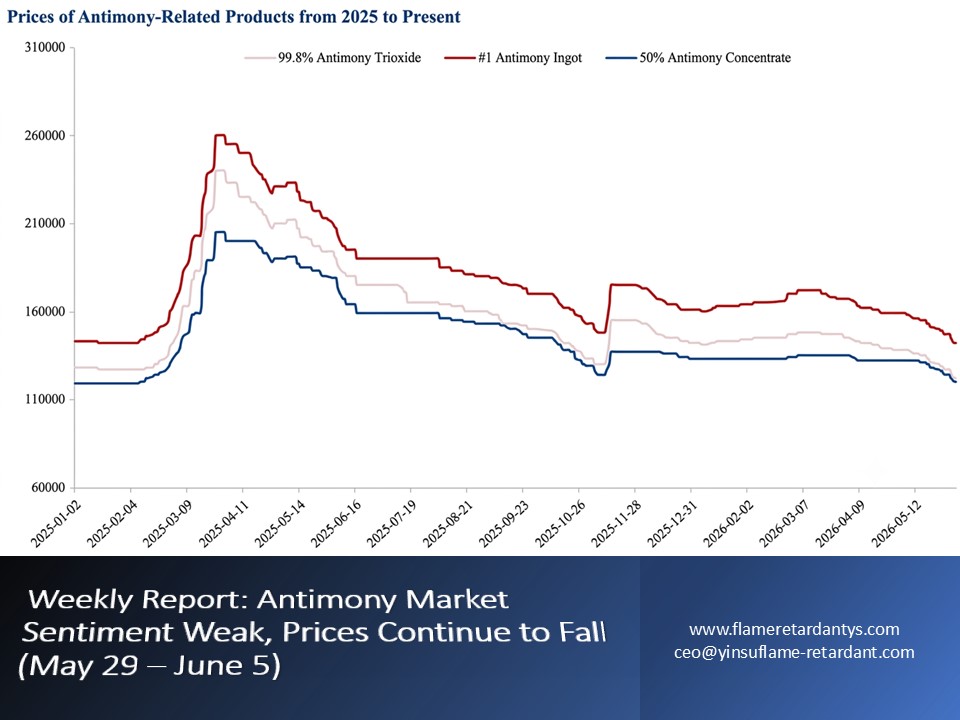
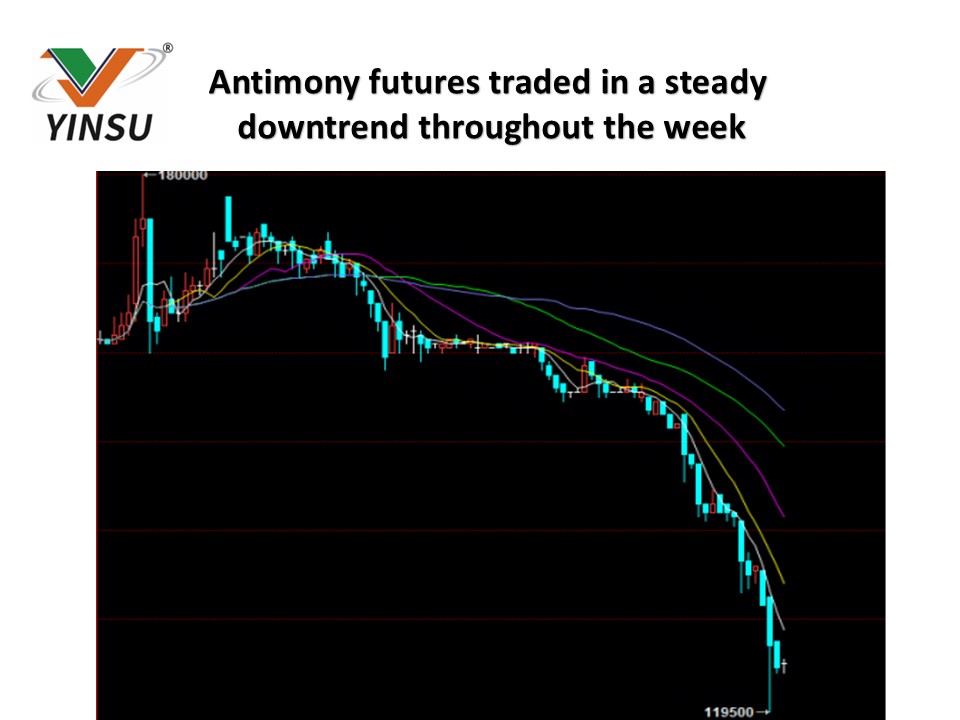
Domestic antimony market continued its decline this week, with low market sentiment. The Zhonglianjin platform showed an overall downtrend throughout the week, breaking below 120,000 yuan/t at one point, a level significantly lower than the spot market. Although the price difference attracted slightly more active purchases than usual, the platform’s pick-up system (direct withdrawal from warehouses, single lot of about 21 tonnes) showed that activity at low prices remained limited. Although spot pricing is not yet anchored to this platform price, the continued weakness of the platform has reinforced bearish market expectations, potentially lowering overall price support levels and suppressing downstream procurement willingness. Under the combined effect of the "buy on a rising market" mentality and weak demand, the decline has been further amplified. Meanwhile, although supply has shown active contraction, there is no sign of improvement in demand. Procurement in flame retardants and photovoltaic glass remains weak, but attention can be paid to overseas orders for ethylene glycol antimony and antimony masterbatch. On the spot front, due to the sharp correction on the platform, antimony ingot quotes have become extremely chaotic. Taking No. 1 antimony ingot as an example, high-end quotes hold at 150,000 yuan/t, mainstream quotes are stuck at 140,000–145,000 yuan/t, and low-end quotes have appeared at 135,000 yuan/t, forming a huge gap from the platform price below 120,000 yuan/t. 99.8% antimony trioxide has been adjusted to around 122,000 yuan/t accordingly. Overall, continued drag from demand remains the core issue, and antimony prices are likely to remain under pressure and correct downward in the short term.
II. Summary of Customs Data from Other Countries
Thailand Customs’ import/export data for April 2026 shows: Thailand imported about 7,674.7 physical tonnes of antimony raw materials, exported about 6,061.0 physical tonnes, with a net retention of about 1,613.7 physical tonnes in Thailand; imported about 427.3 tonnes of antimony trioxide, exported about 681.7 tonnes, net export of about 254.4 tonnes; imported only 42.3 tonnes of antimony ingot (mostly from Japan and China), exported as high as 1,001.8 tonnes, net export of about 959.5 tonnes, of which the United States alone took 920 tonnes, accounting for over 92%. Product breakdown: Thailand’s antimony raw material imports are highly dependent on Myanmar (7,653.7 physical tonnes, 99.8%), with negligible amounts from South Africa and Oman. Export destinations are dispersed: China (1,751.3 physical tonnes), Myanmar (re-exports, 2,204.9 tonnes), Cambodia (1,409.5 tonnes), Laos (650.2 tonnes), Vietnam (273.9 tonnes), Pakistan (110.2 tonnes), Indonesia (325.3 tonnes), South Korea (260.9 tonnes), India (90 tonnes), etc. Antimony trioxide exports are highly concentrated in the United States; imports from other countries are almost negligible.
III. Downstream Sector Analysis
Photovoltaic Glass: According to the data, as of Thursday this week, the national daily melting capacity of photovoltaic glass was 75,585 tonnes, continuing a decreasing trend. The market is weak on both supply and demand sides, with prices diverging and moving downward. Supply continues to contract, with capacity utilization at 56.11% (down 0.83% MoM). Industry kiln shutdown/reduction has reached 8,195 tonnes/day, with expectations for further reduction. Demand continues to decline, leading companies are cutting prices to grab orders, intensifying market competition. Although there are expectations of volume release from domestic centralized projects, project start delays coupled with export tax rebate adjustments have suppressed exports. High inventories keep module prices in a bottoming phase. In terms of inventory, sample enterprise inventories edged up to 3.0199 million tonnes (56.82 days of inventory, +0.23% MoM). Shipments are acceptable due to concentrated deliveries by some companies, but without further production cuts, inventories are still under upward pressure. Profitability continues to deteriorate, with weekly net profits for 2.0mm/3.2mm glass falling deeply to -759 yuan/tonne and -529 yuan/tonne respectively. It is expected that next week, the price of 2.0mm glass will temporarily stabilize in the range of 7.8–8.5 yuan/square meter, but further new lows cannot be ruled out under fierce competition. Future attention should focus on the implementation of production cuts after the PV exhibition, downstream module stocking pace, and the operating pressure of various enterprises.
Bromine: According to data, as of Thursday this week, the market continued its weak and volatile trend under weak supply and demand. Trading was light, with the transaction center shifting down to the range of 35,500–37,000 yuan/tonne. On the supply side, production steadily recovered as temperatures rose in production areas. Although early rainfall temporarily slowed the pace of bromine extraction from seawater, overall supply increased steadily, with manufacturers’ inventories accumulating modestly and no pressure to dump. Cost-side support came from stronger sulfur prices, coupled with geopolitical disturbances in the Middle East leading to expectations of lower import arrivals. Sellers still had intentions to support prices, but actual negotiations gradually loosened. However, it is rumored that there is an expected growth in flame retardant imports, while domestic spot supply remains generally loose. Demand continued to be weak; operating rates of brominated flame retardants, pharmaceuticals, and pesticide intermediates remained low. Terminal orders were not being transmitted smoothly. Downstream maintained low inventory strategies, only making small just-in-time replenishment purchases while continuously pressing prices. No concentrated replenishment willingness was evident, and intermediaries were generally bearish and holding cash. On balance, the market has fallen into a deep game between "producers supporting prices" and "demand pressing prices." Under the two-way pull of clear supply increments and insufficient demand support, short-term prices are steady but weak. Future attention should be focused on the progress of import arrivals and substantial improvement in downstream end-user orders.
IV. Forecast for Antimony Prices in the Coming Period
Based on the current supply-demand fundamentals and market sentiment, antimony prices are expected to maintain a weak and downward trend in the short term. No substantial recovery in demand is seen, with procurement in flame retardants and photovoltaic glass remaining weak. Downstream generally holds a wait-and-see attitude of "buy on a rising market," and there is no willingness to replenish inventories in a concentrated manner. On the supply side, although there are potential contraction factors such as reduced raw material exports from Thailand and delayed imports from Myanmar, incremental supply from Africa is gradually increasing, and domestic social inventories as well as port inventories are still at relatively high levels. Therefore, supply pressure is unlikely to ease significantly in the short term. Moreover, the Zhonglianjin platform price has already fallen below 120,000 yuan/tonne. Although spot prices have not fully followed suit, the continued weakness on the platform will reinforce bearish expectations and suppress downstream purchasing activity. It is expected that over the next 1–2 weeks, domestic spot prices for No. 1 antimony ingot will likely trade under pressure in the range of 135,000–145,000 yuan/tonne, and a further test of the 130,000 yuan/tonne level cannot be ruled out. Downstream users are advised to purchase as needed, control inventory risks, and monitor the pace of overseas raw material arrivals and the implementation of production cuts in the photovoltaic glass industry.


