
- All
- Product Name
- Product Keyword
- Product Model
- Product Summary
- Product Description
- Multi Field Search

Views: 36 Author: Yinsu Flame Retardant Publish Time: 2026-06-30 Origin: www.flameretardantys.com


Flame-Retardant Waterborne Polyurethane: Additive or Reactive?
A Formulation Engineer's Practical Comparison
Formulation engineers working with waterborne polyurethane (WPU) often face the same challenge: clients demand coatings that are eco-friendly, soft, highly transparent, and yet must pass UL 94 V-0, preferably with low smoke and no dripping. But WPU has an inherent limiting oxygen index (LOI) of only 17–19%—it burns readily in air.
How do you make WPU "fireproof"? Currently, two mainstream approaches exist: additive-type flame retardancy and reactive-type flame retardancy. Which one to choose? How to choose? This article skips the theory and directly compares the core differences, latest advances, and practical formulation tips for both routes.

Reactive-type flame retardancy: During the WPU synthesis stage, flame-retardant elements such as phosphorus and nitrogen are incorporated into the polyurethane molecular chain via copolymerization. The flame retardant is "grown" into the polymer chain—no migration, no extraction, and excellent durability. Typical examples include DOPO derivatives and phosphorus-containing polyols.
Before diving into the two schemes, it's essential to understand a core concept—phosphorus-nitrogen synergism.
Phosphorus-based flame retardants generate phosphoric acid and polyphosphoric acid during combustion, promoting surface dehydration and char formation on WPU to create a dense carbon layer that insulates heat and oxygen. Nitrogen-based flame retardants decompose upon heating to release non-combustible gases such as ammonia and nitrogen, diluting oxygen and swelling the char layer. Combined, the char layer becomes thicker, denser, and more stable—yielding far higher flame-retardant efficiency than either element alone.
This is why phosphorus-nitrogen pairing has become the "standard configuration" in WPU flame-retardant formulations—whether additive or reactive, effective systems almost invariably rely on phosphorus-nitrogen synergy.
The biggest advantage of additive-type systems is "plug and play." Blend the flame-retardant powder into the WPU emulsion, keep the process unchanged, and the barrier to entry is low.
But the problems are equally obvious: poor compatibility. Most flame-retardant powders are hydrophobic, while WPU emulsions are water-based—they simply don't mix. Direct blending leads to uneven dispersion, emulsion stratification, or even catastrophic coagulation. Even if a film is formed, the flame retardant may migrate and bloom on the surface over time, causing whitening and declining flame-retardant performance.
However, additive-type flame retardants have seen significant breakthroughs in recent years. The team of Wang Quanjie and Duan Baorong at Yantai University designed a water-soluble nitrogen-phosphorus additive-type flame retardant (N-P), solving the compatibility issue. At just 8% loading, the LOI of WPU increased from 20.2% to 27.3%, achieving UL 94 V-0 with complete suppression of burning drips. Cone calorimetry showed total smoke release reduced by over 60%.
This demonstrates: additive-type is not unworkable—the key is selecting "water-soluble" or "emulsion-compatible" products.

Key reminder: When inorganic powders (ATH, MDH) exceed 15% loading in WPU, film transparency drops significantly and flexibility deteriorates—a pitfall many engineers have fallen into. If the client demands transparency and tactile feel, prioritize water-soluble phosphorus-nitrogen systems or reactive-type solutions.
Reactive flame retardants are chemically bonded into the WPU molecular chain—no migration, no extraction, and permanently stable flame-retardant performance.
Again, from the work of Wang Quanjie and Duan Baorong's team—they synthesized a reactive flame retardant PHED containing a dual-DOPO structure. At 12% loading, LOI increased from 21.2% to 28.6%, UL 94 improved from no rating to V-0, with no burning drips. A team from East China University of Science and Technology used DOPO-HQ for reactive modification, achieving an LOI of 35.35% at only 3% loading.
Reactive flame retardants also offer a hidden advantage: they do not sacrifice mechanical properties and may even improve them. After PHED participated in WPU hard-segment construction, hard-segment content increased and hydrogen bonding was enhanced, leading to improved mechanical properties.
But the shortcomings of reactive-type are equally clear: complex synthesis process, high cost, and not all WPU formulations can "accommodate" reactive monomers.
Differences Between Polyether-Type and Polyester-Type WPU
Formulation engineers must note: polyester-type WPU chars more readily than polyether-type. Polyester segments contain ester bonds that undergo cyclization more easily upon heating, forming aromatic structures that are more favorable to the charring reactions of phosphorus-nitrogen flame retardants. Therefore, the same phosphorus-nitrogen flame-retardant system typically performs better in polyester-type WPU than in polyether-type. If your WPU emulsion is polyether-based, you may need to increase flame-retardant loading or optimize the phosphorus-nitrogen ratio.

Its limiting oxygen index (LOI) is only approximately 18.5%, allowing it to sustain combustion in ambient air. During burning, the foam first melts and collapses, forming a pool fire, followed by vigorous combustion. Throughout the entire process, large quantities of smoke and toxic gases are released.
The flame-retardant strategy for waterborne polyurethane can be extended to solvent-based polyurethane systems. The following two formulations have been experimentally validated in PU foam and PU leather.
1. PU Foam: Encapsulated Red Phosphorus + Phosphorus-Based Flame Retardant
Rigid polyurethane foam (RPUF) is used in building insulation, refrigerator insulation, and other fields with extremely high flame-retardant requirements.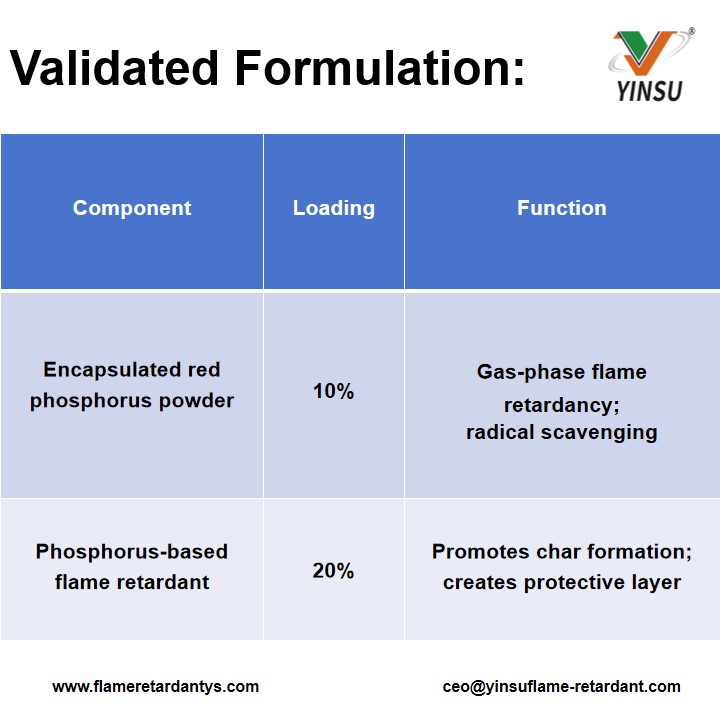

Red phosphorus releases phosphorus-based radical scavengers in the gas phase, interrupting the combustion chain reaction. The phosphorus-based flame retardant promotes surface dehydration and char formation in the condensed phase. The synergy creates a dense char layer over 70 mm thick, effectively blocking heat and oxygen. Encapsulated red phosphorus solves the problems of poor compatibility with PU matrix, moisture absorption, and processing ignition hazards associated with ordinary red phosphorus.
2. PU Leather: Phosphorus-Based Flame Retardant + Nitrogen-Based Flame Retardant
PU leather flame-retardant requirements go beyond flame-retardant rating to include low smoke, no extraction, no yellowing, and soft hand feel.

When used alone, phosphorus-based flame retardants may release phosphine (PH₃) gas at high temperatures. The addition of nitrogen-based flame retardants precisely solves this problem—the phosphorus-nitrogen synergistic system not only suppresses PH₃ release but also significantly enhances char formation and smoke suppression.
Why is this formulation more practical?
Flexible loading: 10–20% adjustable according to specific product requirements
No extraction: Good compatibility between phosphorus and nitrogen flame retardants; no migration during long-term use
Low smoke, low toxicity: Halogen-free system; no hydrogen halide release during combustion
Minimal hand-feel impact: Less impact on softness compared to inorganic fillers like ATH/MDH
When to Prioritize Additive-Type?
Budget-limited, simple process priority
Existing mature WPU emulsion formulation; no desire to change synthesis route
Moderate flame-retardant requirements (e.g., LOI ≥ 27%, UL 94 V-0 sufficient)
Key selection principle: Prioritize "water-soluble" or "emulsion-compatible" additive-type flame retardants; avoid direct blending of ordinary hydrophobic powders.
When is Reactive-Type Worthwhile?
High demands for flame-retardant durability (long-term no extraction, no migration)
Requirements for extremely high flame-retardant ratings (LOI ≥ 30%)
Strict requirements for mechanical property retention
Products targeting high-end markets (exports, automotive-grade, electronics, etc.)
In-house WPU emulsion development capability; willingness to invest in synthesis
The Third Route: Synergistic Blending. This is not an either/or choice. In practical formulations, reactive-type as the base (ensuring fundamental flame retardancy and no migration) + additive-type for enhancement (further improving flame-retardant rating and smoke suppression) often yields the best results. Specific recommendation: introduce phosphorus via reactive-type (5–8% loading), then blend with 2–3% nitrogen-based synergist (e.g., MCA), maintaining a total phosphorus-nitrogen ratio around P:N = 1:2.
Misconception 1: "Higher loading means better flame retardancy." In WPU systems, excessive flame-retardant loading leads to decreased emulsion stability and degraded mechanical properties. The optimal loading for N-P type flame retardants is 8%; beyond that, performance becomes unstable. Every system has a "golden loading point" that must be determined experimentally.
Misconception 2: "Reactive-type is always better than additive-type." Reactive-type is indeed more stable, but if your WPU formulation has an inherently fragile emulsification system, forcibly introducing reactive monomers may cause emulsification failure—more harm than good. There is no absolute good or bad in technology; only suitability matters.
Statistics show that approximately 80% of fire deaths are caused by smoke and toxic gas asphyxiation. Thus, the development direction for WPU flame retardancy is increasingly clear—halogen-free, smoke suppression, and multi-functionalization.
Specific trends include: developing high-efficiency halogen-free flame retardants with low loading and high phosphorus/nitrogen content; synergistic systems containing multiple flame-retardant elements; inorganic nano flame retardants (combining flame retardancy and smoke suppression).
Also noteworthy are the bio-based and intelligent directions. One study used chitosan (biomass-derived) to modify WPU, increasing the 700°C char yield from 0.7% to 32.7% and achieving an LOI of 35.4%. Another team developed an intelligent fire-resistant WPU coating with both self-warning and active fire-extinguishing functions.
Returning to the original question: Flame-retardant waterborne polyurethane—additive or reactive?
The answer is—it depends on your formulation system, cost budget, and performance targets. Additive-type has a low barrier and quick results, but choosing the wrong product leads to failure. Reactive-type is a one-time fix, but with high cost and barrier. The smartest approach is to first understand the "temperament" and type (polyether or polyester) of your WPU emulsion, then prescribe the right remedy. Where conditions permit, phosphorus-nitrogen synergistic blending often captures the best of both worlds.
However, for most formulation engineers, the biggest frustration is not "not knowing how to choose" but "having chosen, yet still needing to compound it yourself"—the ratios between different flame retardants, compatibility, dispersion, every step is a potential pitfall.
Yinsu Flame Retardant has been deeply engaged in the polyurethane flame-retardant field for many years, developing mature single-component flame-retardant products for different application scenarios including WPU, PU foam, and PU leather. You don't need to compound it yourself, don't need to worry about compatibility—just add and use.
For PU foam, we offer encapsulated red phosphorus flame-retardant series (FRP-950X, etc.) with low loading and excellent char formation; when combined with ADP, char thickness can exceed 70 mm. For PU leather and coatings, we have modified MCA (MCA-B) with excellent dispersion, no extraction, and good resin compatibility—direct addition achieves V-0 rating. For systems requiring higher temperature resistance, WADP-10 modified organophosphorus flame retardant has a thermal decomposition temperature exceeding 350°C, with anti-yellowing and no extraction properties, suitable for TPU and other high-temperature processing scenarios.
No need to struggle with compounding yourself—just choose the right product, add it, and use it.


