
- All
- Product Name
- Product Keyword
- Product Model
- Product Summary
- Product Description
- Multi Field Search

Views: 35 Author: Yinsu Flame Retardant Publish Time: 2026-05-20 Origin: www.flameretardantys.com


Why are aluminum hydroxide and magnesium hydroxide – seemingly "cheap" – actually making your formulation more expensive?
A cable plant technical manager once did the math: they used aluminum hydroxide (ATH) for their low-smoke halogen-free flame-retardant cable. The purchase price was indeed low. But to reach V0 rating, they had to add 60 phr, which forced extrusion speed down by 15%, plus they had to spend extra money on lubricants and toughening agents. In the end, the total cost was nearly 20% higher than using a high‑efficiency flame retardant.
Cheap is sometimes the most expensive.
1. The trap of low‑cost fillers: you think you're saving money – how much are you really spending?
Many compounding plants and cable manufacturers have a fixed mindset: ATH or magnesium hydroxide (MDH) costs only a few hundred dollars per ton, so just add more. They blindly increase loading to pass flame tests.
But reality often tells a different story:
Extruder torque alarms, line speed drops → lower output, higher energy consumption.
Rough surface, poor impact strength → higher reject rate, customer complaints.
To improve flow and mechanical properties, they are forced to buy lubricants and toughening agents → skyrocketing auxiliary material costs.
Don't do the math – you might be shocked.
Real case: An East China cable plant
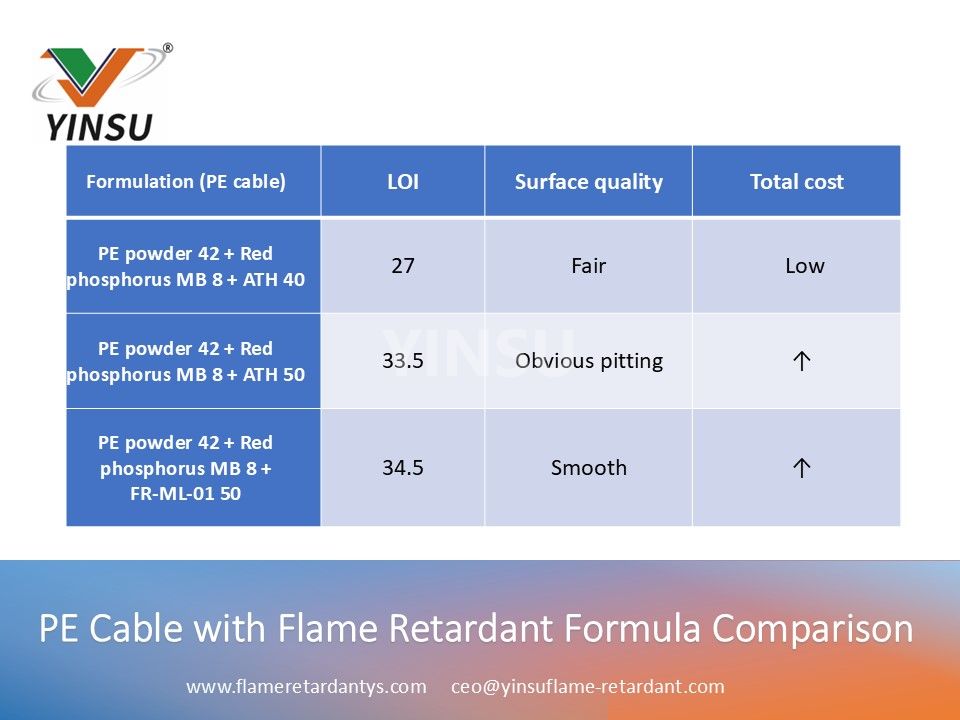
When producing low‑smoke halogen‑free flame‑retardant PE cable sheath, they initially used 40 phr of ATH – the LOI was only 27, barely passing V2. They then increased ATH to 50 phr and added 8 phr of red phosphorus masterbatch. LOI finally rose to 33.5, and the formulation passed the combustion test.
But new problems appeared: because of the high ATH loading, the cable surface had fine pitting, making inkjet marking unclear. The customer rejected the goods. They tried different lubricants and coupling agents – after two months of struggle, the surface quality remained unstable, with a reject rate as high as 15%.
Later, they replaced 50 phr of ATH with an equal amount of Mg‑Al coprecipitated flame retardant (Yinsu FR‑ML‑01), keeping the red phosphorus masterbatch unchanged. The LOI increased further from 33.5 to 34.5. Moreover, the cable surface became smooth, pitting disappeared completely, and the product passed customer acceptance on the first try.
Importantly, FR‑ML‑01 has a lower density, so the overall formulation cost was 8% lower than the high‑loading ATH formulation.
This is the hidden cost of "cheap" raw materials: they make you spend more elsewhere.
2. Technical principle: why do ATH/MDH make the formulation "more expensive"?
The flame‑retardant mechanism of ATH and MDH is straightforward: when heated to around 200 °C (ATH) or 340 °C (MDH), they decompose, releasing water vapor that dilutes oxygen and absorbs heat. The resulting metal oxide layer also provides some insulating effect.
However, to achieve effective flame retardancy (e.g., LOI ≥27), a loading of 40–60 phr is typically required. High loading brings three major side effects:
Poor flowability: melt viscosity soars, extrusion torque is high, line speed low. An extruder that normally produces 10 t/day may only produce 8.5 t/day – a direct 15% loss in capacity.
Poor mechanical properties: weak interface between particles and polymer leads to lower impact strength and elongation at break. Cable sheaths are prone to cracking when bent.
Surface defects: particle agglomeration causes pitting, blooming, affecting insulation and appearance.
Moreover, many engineers overlook smoke density. Although ATH produces less smoke than halogenated flame retardants, its smoke density is still higher compared to nano‑layered flame retardants. For applications like rail transit and marine vessels where smoke density is a hard requirement, using ATH can simply disqualify the product.
3. FR‑ML‑01: 40 phr equivalent to 5 phr of ATO, half the smoke density, at 1/15 the cost
Yinsu FR‑ML‑01 is a Mg‑Al coprecipitated layered double hydroxide (LDH). Through coprecipitation, magnesium and aluminum are uniformly distributed on a nano‑scale, producing a synergistic flame‑retardant effect.
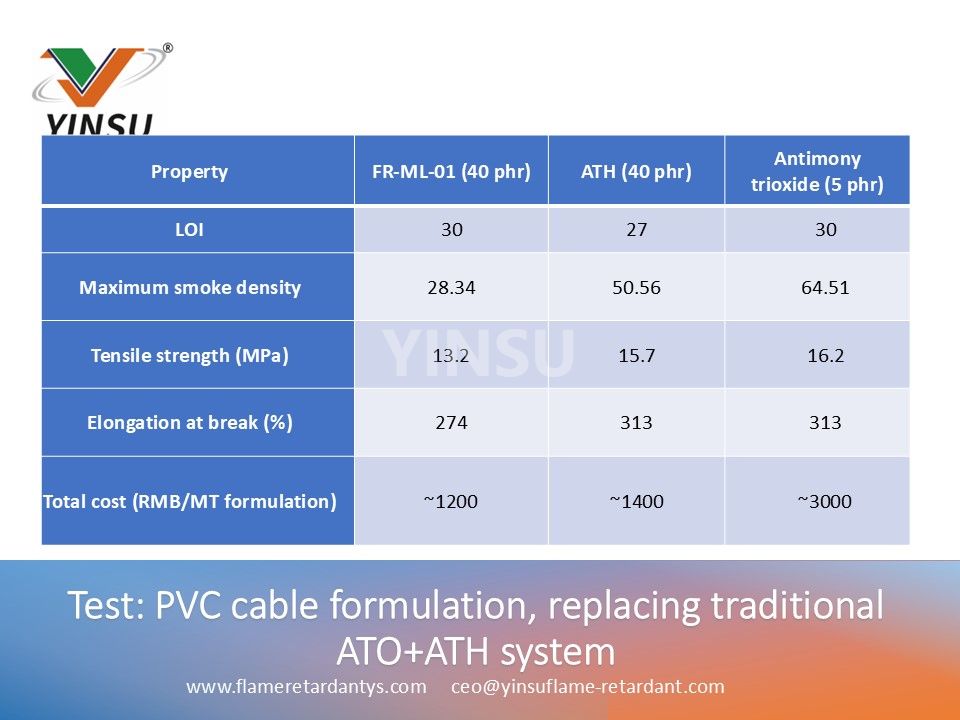
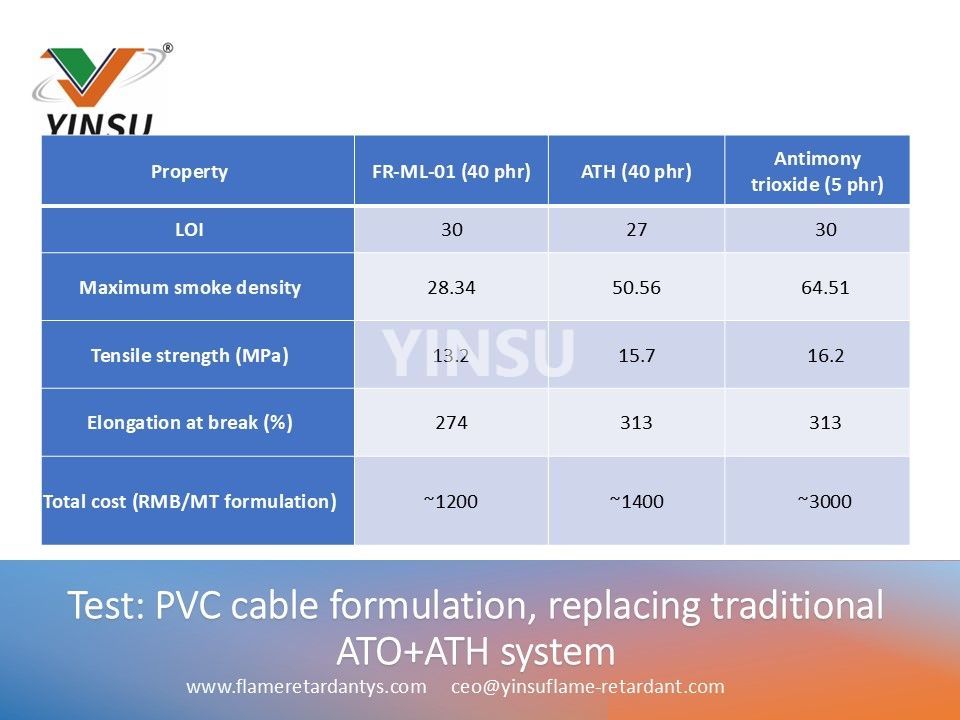
Actual test data (PVC cable formulation, replacing traditional ATO+ATH system):
Key conclusions:
Flame retardant efficiency: 40 phr of FR‑ML‑01 gives the same LOI as 5 phr of ATO, much higher than the same loading of ATH.
Low smoke: smoke density is only 56% of ATH and 44% of ATO – perfect for low‑smoke halogen‑free standards.
Cost advantage: total cost of FR‑ML‑01 is about 1/15 that of an ATO system. Even compared with ATH, because loading can be reduced and auxiliary additives lowered, the total cost is lower.
4. Extended applications: not only PVC, but also PE cables – can be combined with red phosphorus or composite antimony
FR‑ML‑01 works not only as a replacement for ATO+ATH in PVC, but also performs excellently in PE cables.
4.1 Combined with red phosphorus masterbatch for PE cables
Test data (shown above):
PE powder 42 + Red phosphorus MB 950X (8 phr) + FR‑ML‑01 (50 phr) → LOI = 34.5, smooth surface, passes Class C bunched flame test.
Compared with the traditional "ATH + red phosphorus" formulation, FR‑ML‑01 increases LOI by 1 point and completely eliminates surface pitting. This is because the Mg‑Al layered structure forms a more compact char layer during combustion, synergizing with red phosphorus.
4.2 Combined with composite antimony T3 for PVC cables
If you are concerned about the powder loading of FR‑ML‑01 and wish to further reduce it, you can also blend FR‑ML‑01 with Yinsu's composite antimony flame retardant T3.
T3 is a high‑efficiency alternative to antimony trioxide, offering good dispersion and high retention of mechanical properties. Tests show:
In a PVC formulation, 30 phr FR‑ML‑01 + 5 phr T3 gives LOI of 29, smoke density 40% lower than a pure ATH formulation, and total cost 25% lower than an ATO system.
Summary: FR‑ML‑01 does not work alone. It can be flexibly combined with Yinsu's red phosphorus series (FRP‑950X) and composite antimony series (T3) to achieve the optimal solution for different polymers and cost targets.
5. Production tips: using FR‑ML‑01 – just pay attention to these three details
Many customers, new to nano‑layered flame retardants, worry about dispersion. In fact, as long as you follow a few points, processing is smoother than with ATH.
5.1 Pre‑dispersion is key
Mix FR‑ML‑01 with the resin powder in a high‑speed mixer for 3–5 minutes before adding plasticizers or liquid additives.
Common pitfall: Never add all powders and liquids together into the mixer – this can cause agglomeration and surface pitting.
5.2 Moisture control
Factory moisture content ≤0.5%; under normal conditions no drying is needed. If warehouse humidity is high, dry at 80 °C for 1–2 hours.
5.3 Processing temperature
Suitable for normal PVC processing range (160–190 °C) and PE cable range (170–200 °C). Avoid exceeding 220 °C, otherwise the layered structure may decompose prematurely.
Quick troubleshooting table
6. Conclusion: calculate the "hidden cost" – escape the high‑loading trap
Back to the original question: why do ATH/MDH, with their low unit price, often end up being more expensive in use?
Because the real cost is not just the raw material purchase price. It also includes:
Loss of processing efficiency (extrusion speed down 15%, capacity wasted)
Increased reject rate (surface defects, poor mechanical properties)
Extra auxiliary material costs (lubricants, toughening agents)
Failure to meet smoke density requirements for high‑end markets
Yinsu FR‑ML‑01, using nano‑scale Mg‑Al coprecipitation technology, provides a balanced answer:
40 phr loading gives LOI of 30, half the smoke density.
Total cost is only 1/15 that of an ATO system, and 8–15% lower than an ATH formulation.
Flexible combinations: with red phosphorus masterbatch for PE cables (LOI 34.5), or with composite antimony T3 for PVC cables – even lower cost.
A technical manager at a Fujian cable plant said after the trial: "I used to think ATH was cheap. Now I see it clearly – efficiency is what really makes something cheap."
Call to action
If you are struggling with flame retardancy for PVC cables, PE cables, pipes, or profiles – costs stuck too high, smoke density failing, persistent surface problems –
For website readers: [Click to download the FR‑ML‑01 technical datasheet and formulation guide] (link)
For social media readers: Send "MgAl" in a private message, and we will send you a free sample plus one‑on‑one formulation optimization advice.
Guangzhou Yinsu Flame Retardant New Material Co., Ltd.
Tel: +86‑17278575996
Website: www.flameretardantys.com
More than 200 cable and plastic compounding companies have already adopted FR‑ML‑01 in mass production, with average total cost reduction of 12%. Your next formulation can be one of them.


