
- All
- Product Name
- Product Keyword
- Product Model
- Product Summary
- Product Description
- Multi Field Search

Specialized in PE, PVC, TPE, TPU and Low Smoke Zero Halogen (LSZH) wire and cable compound and materials.
In high-rise buildings, subway tunnels, new energy power stations and industrial complex scenarios, the fire safety of wires and cables is directly related to life and property and system reliability.
YINSU Flame Retardant Company provides customized flame retardant solutions for global customers, covering PE (polyethylene), PVC (polyvinyl chloride), TPE (thermoplastic elastomer), TPU (thermoplastic polyurethane) and LSZH (low smoke and halogen free) wire and cable systems to meet all safety requirements, ranging from UL94 V-0 flame retardant certification to EN 45545 fire protection for rail transportation and IEC 60754 low smoke and halogen free toxicity. All-round safety requirements.
Material Common Use Typical FR Type YINSU Flame Retardant Item No.
PE HDPE, LDPE, LLDPE, Red phosphorus, halogen free FR, PRP-950X, PE-XT-20, B-HFFR, MCA-B, WADP-10
Cross-linked PE cables, Bromine antimony masterbatch FR-ML-01, K100
Plastic insulated cables.
PVC PVC &Plastic insulated power cables, ATO alternatives T3, T30, FRP-950X, K100, ZHS, ZS, ZSB-A
Aluminum stranded wires, Zinc stannate
Prefabricated branch cables.
TPE Insulated wires, flexible cables Organic phosphorus MCA-B, WADP-10, FRP-950X, 95-MC
Shielded insulated cables
TPU Special purpose cables Organic phosphorus MCA-B, WADP-10, FRP-950X, 95-MC
Power cables for frequency converters.
Others Welcome to consult more details.
![[Weekly Melamine Review]: Upstream-Downstream Dynamics Lead To Flexible Adjustments in Company Quotations (August 7, 2026–August 13, 2026)](http://ikrorwxhnnrili5q-static.micyjz.com/cloud/pqBprKkqlrSRplpmorijjq/0817-Figure-1-Chart-Showing-Price-Trends-for-Major-Domestic-Melamine-Markets.jpg)




The current downturn in the melamine market provides a short-term cost advantage for downstream flame retardant manufacturers, but concurrent weakness on the demand side may partially offset this benefit. Companies are advised to take advantage of the current raw material price window to optimize their procurement strategies, while closely monitoring the pace of demand recovery in end-user industries such as building materials and cables.
ADM Flame Retardant for PU LeatherThose of you working on flame retardancy for PU leather know the drill—Adding flame retardants is easy; the real challenge is ensuring performance isn’t compromised afterward. Too much flame retardant makes the leather stiff and reduces its softness, leading to cu
Polyurethane for automotive interiors must simultaneously meet three standards: FMVSS 302 flame retardancy, low misting (≤2 mg), and low odor (VDA 270 ≤3.0). The phosphorus-nitrogen synergistic system limits the flame retardant loading to 16 parts, achieves an LOI of 29–30%, and meets the V-0 rating, while also reducing the contribution of volatile compounds, providing a viable path for formulation balance.
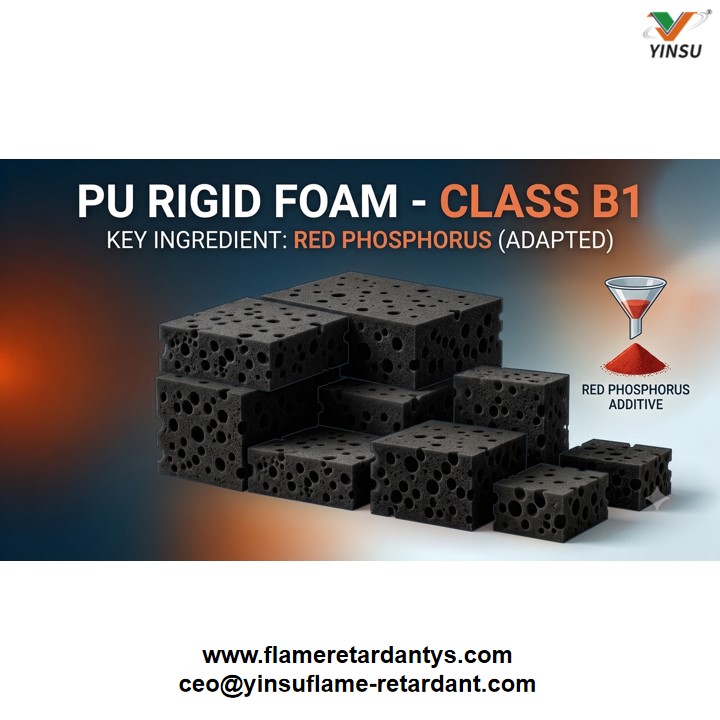
For Class B1 rigid foam insulation boards, adding 10–14 parts of red phosphorus flame retardant can reduce the FIGRA value to below 100 W/s while maintaining a closed-cell rate of over 87%. Compared to aluminum hydroxide-based systems, this results in annual savings of approximately $20,000 to $30,000 in flame retardant costs. Silver-coated red phosphorus is available in both powder and paste forms, making it suitable for both manual and continuous production lines.
Why does TPE flame retardancy always get stuck at V-2? Three main culprits: plasticizers are inherently flammable, the multiphase system lacks synergy, and flame retardants tend to migrate and bloom. A comprehensive analysis of TPE/TPU flame retardant selection challenges and processing pitfalls to avoid.
Waterborne Polyurethane Flame Retardancy: Additive or Reactive?This article compares the core differences and practical formulation approaches of both routes, presenting measured data for PU foam (encapsulated red phosphorus + ADP) and PU leather (ADP + MCA). Yinsu Flame Retardant offers single-component polyurethane flame retardants—no need for self-compounding; simply add directly to achieve V-0 compliance.
