Limitations and Process Adaptation of Red Phosphorus in Class B1 PU Rigid Foam Formulations
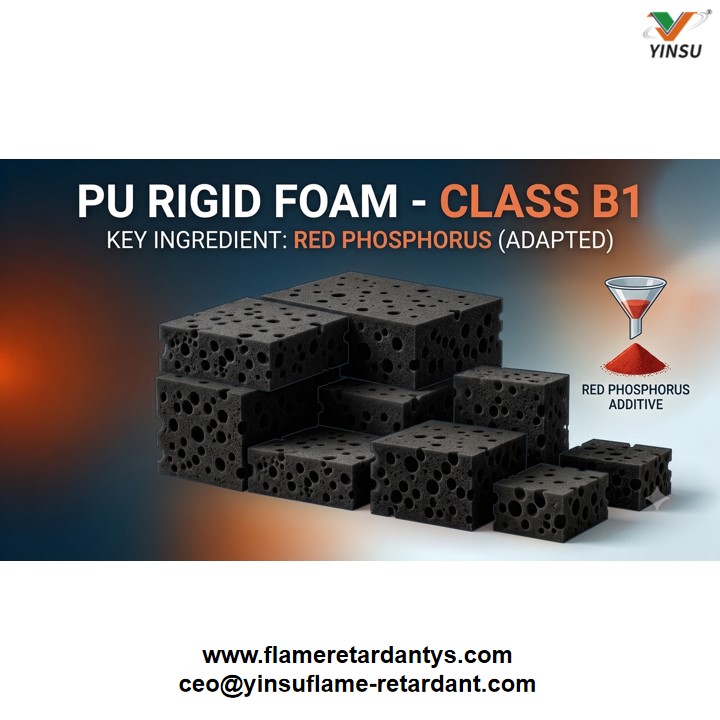
For formulators of Class B1 rigid foam, the biggest fear isn’t “failing the test,” but rather “passing the test only to see the closed-cell rate drop.” If the closed-cell rate drops from 90% to 82% and the thermal conductivity rises from 0.022 to over 0.026—the product may meet the flame-retardant requirements, but its thermal insulation performance suffers. Under the GB 8624-2023 framework, the core indicators for Class B1 are FIGRA ≤ 120 W/s and THR600s ≤ 7.5 MJ. These figures are the minimum requirements, but the real challenge lies in formulation cost, cell quality, and long-term process stability.
The value of red phosphorus can be summed up in a single sentence: its flame-retardant efficiency per unit mass is far higher than that of aluminum hydroxide or expanded graphite. In a typical pipe insulation formulation (100 parts polyether, MDI index 1.05, 2.5 parts water-blown foam), aluminum hydroxide requires 35–45 parts just to come close to Class B1 standards, whereas red phosphorus can reduce the FIGRA to below 100 W/s with only 10–14 parts.
This difference is directly reflected in the foam cell structure. In aluminum hydroxide systems, due to excessively high solids content, the closed-cell rate drops from 90% to below 82%, and the thermal conductivity rises from 0.022 to over 0.026; in red phosphorus systems, even at 12 parts, the closed-cell rate remains above 87%, with the thermal conductivity increasing by only 0.001–0.002. Based on an annual production of 2,000 metric tons of panels, the red phosphorus solution can save approximately 150,000–200,000 yuan in flame retardant costs alone compared to the aluminum hydroxide system. This is the practical benefit of choosing the right flame retardant.
However, red phosphorus faces two specific challenges in rigid foam systems that must be addressed at the process level.
Challenge 1: As soon as red phosphorus is added, the foaming rate becomes irregular.
Trace amounts of phosphoric acid on the surface of red phosphorus lower the pH of the polyol mixture. When the pH falls below 5.5, the milky-white phase shortens, the foam rises unevenly, and a noticeable density gradient appears in the final product. Silver-coated red phosphorus uses an inorganic-organic composite coating to isolate surface acids, maintaining the pH of the polyol mixture at 6.0–6.8—essentially the same as when no flame retardant is added. If you are still using uncoated red phosphorus, it is recommended to add 0.3–0.5 parts of triethanolamine or Dabco 33LV as a buffer during the polyol premixing stage. Note: One foaming technician once added 0.3 parts more triethanolamine than specified, which extended the milky-white phase by 12 seconds and resulted in a finished product density 7% lower than the design value—causing the mixture to deviate at both ends.
Challenge 2: Red phosphorus is denser than polyols and sinks to the bottom when left to stand for a long time.
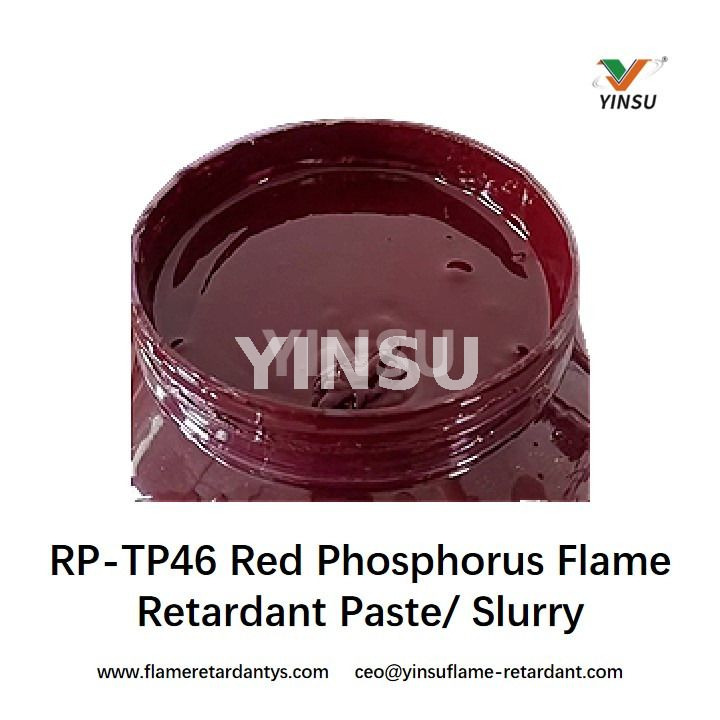
The true density of red phosphorus is approximately 2.3 g/cm³, while that of polyols is only 1.0–1.1 g/cm³; this significant difference leads to noticeable settling during prolonged storage. The silver-plasticized red phosphorus composite flame retardant pre-disperses red phosphorus micropowder in a liquid phosphate ester carrier, with a viscosity of 8,000–12,000 mPa·s at 25°C, exhibiting shear thinning. In a static mixer on a continuous production line, the paste can be thoroughly mixed with the polyol within 30 seconds; during batch manual formulation, the paste can be directly pumped and metered, avoiding human errors of ±3–5% associated with powder weighing.
Recommended formulation range: Based on 100 parts of polyether polyol, the recommended addition level for coated red phosphorus powder or paste-form flame retardant is 10–15 parts. At levels below 10 parts, the FIGRA value in SBI testing fluctuates significantly (uneven cell structure, random results); at levels above 15 parts, foam brittleness increases, and adhesion strength to the substrate decreases. We recommend first preparing a 12-part sample and conducting a preliminary SBI test in accordance with GB/T 20284. If the FIGRA value is >120 W/s, increase the dosage to 13–14 parts, or add 1–2 parts of melamine polyphosphate (MPP) to achieve synergy with the gas source. The advantage of this approach is that it eliminates trial-and-error testing; data-driven decision-making allows you to identify the optimal point with minimal waste of raw materials.
Formulation Recommendations: Based on 100 parts of polyether polyol, the recommended addition level for coated red phosphorus powder or paste-type flame retardants is 10–15 parts. At levels below 10 parts, the FIGRA value in SBI testing fluctuates significantly (uneven cell structure, random results); at levels above 15 parts, foam brittleness increases and adhesion strength to the face material decreases. It is recommended to first prepare a sample with 12 parts and conduct a preliminary SBI test according to GB/T 20284. If the FIGRA value exceeds 120 W/s, increase the dosage to 13–14 parts, or add 1–2 parts of melamine polyphosphate (MPP) to achieve synergy with the gas source. The advantage of this approach is that it avoids trial-and-error testing; instead, data-driven decision-making allows you to identify the optimal point with minimal waste of raw materials.
For exports to the EU, note the smoke density requirements for B-s1,d0 in EN 13501-1. While the carbonization mechanism of red phosphorus suppresses flame spread, if the carbon layer is too dense, it may produce CO rather than CO₂ under thermal radiation, leading to a decrease in light transmittance. Silver-coated red phosphorus controls the rate of phosphorus release to maintain a porous structure in the char layer rather than a glassy state. In the EN ISO 5659-2 smoke density test, the Ds(4) value can typically be kept below 350, which is well below the s1 class threshold of ≤600.
To summarize:
When using red phosphorus to produce Class B1 rigid foam, both the cost advantage and cell quality are well-established; the key lies in selecting the right coating form and dosage. Using existing formulations, start with 12 parts as a baseline and determine the parameters using data from 1–2 batches of SBI testing—this is far more efficient than trial-and-error formulation in the lab. For coating red phosphorus powder and paste-type flame retardants, Yinsu offers corresponding product forms to suit both batch manual production lines and continuous large-scale production lines. If you need samples or process recommendations, please contact Yinsu’s flame retardant technology team.


