
- All
- Product Name
- Product Keyword
- Product Model
- Product Summary
- Product Description
- Multi Field Search

Views: 28 Author: YINSU FLAME RETARDANT Publish Time: 2026-05-30 Origin: www.flameretardantys.com


EPS vs. XPS: Key Differences in Production, Performance, and Applications
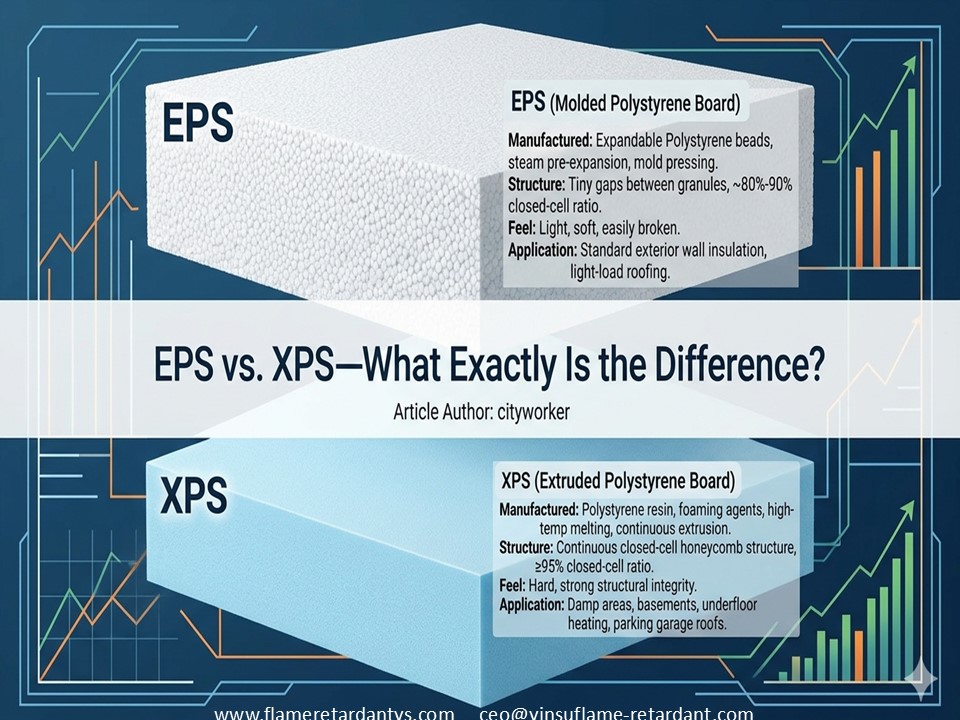
EPS and XPS are two organic insulation materials widely used in construction engineering. They are commonly found on job sites, but are often mixed up or confused. In fact, they differ significantly in production process, performance, cost, and suitable applications.
I. Production Process
EPS (Expanded Polystyrene) – also known as molded polystyrene board – is produced from expandable polystyrene beads through pre-expansion with steam, mold pressing, curing, and cutting. The process is simple and fast.
XPS (Extruded Polystyrene) – also known as extruded polystyrene board – is produced from polystyrene resin with blowing agents and additives, through high-temperature melting and continuous extrusion. It forms a continuous, integrated structure with higher density.
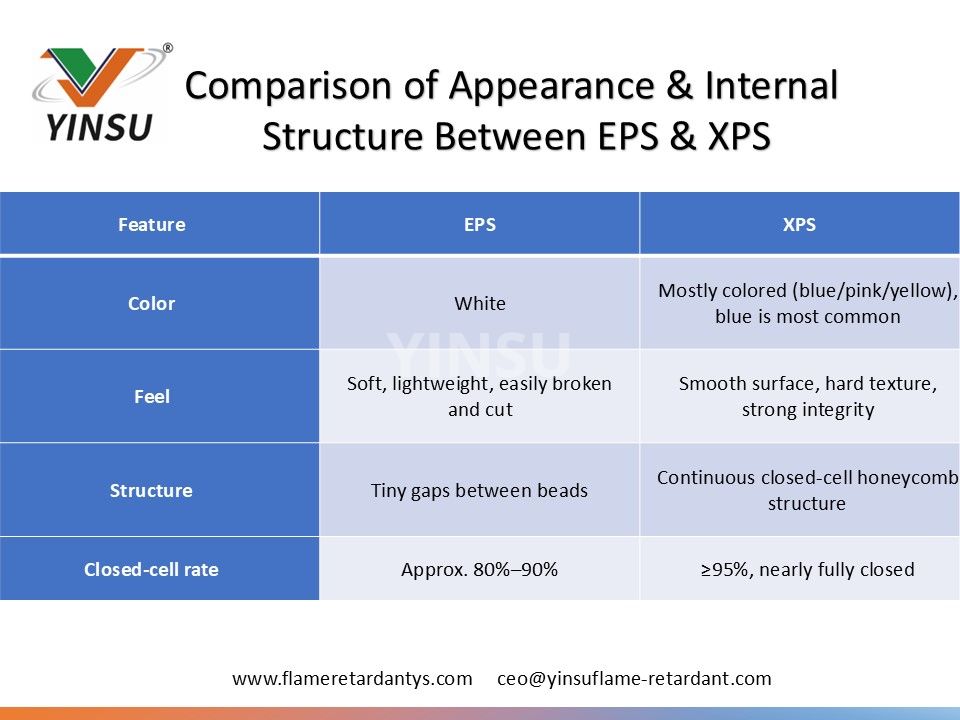
II. Appearance and Internal Structure
III. Performance Comparison
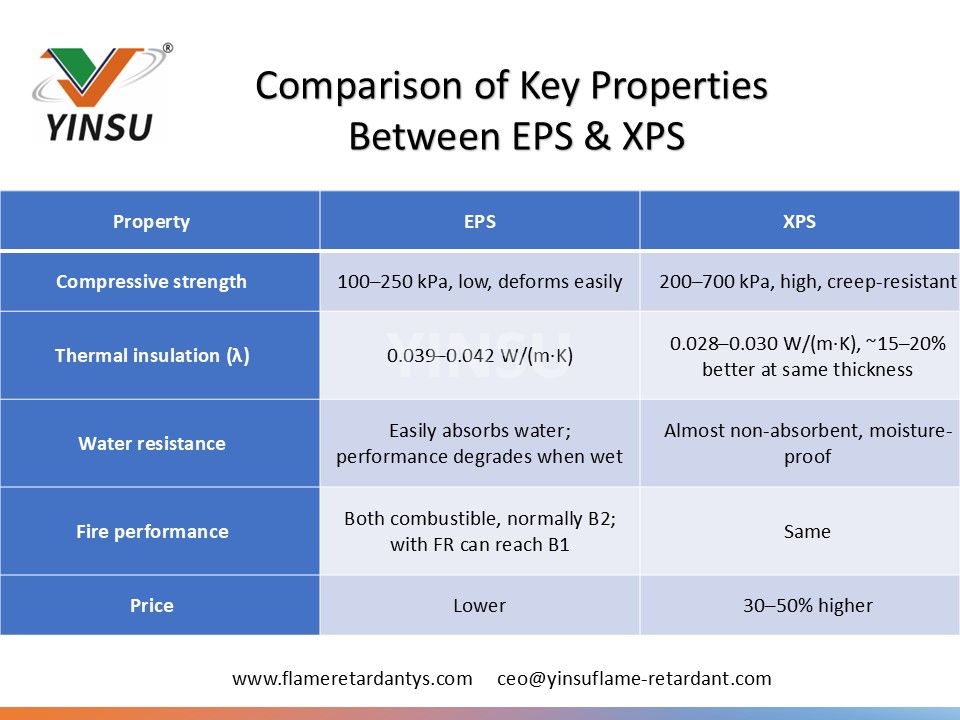
Compressive strength
EPS: 100–250 kPa – relatively low, deforms easily under load, suitable for non-load-bearing or light-load areas.
XPS: 200–700 kPa – high strength, creep-resistant, can bear long-term loads on floors, roofs, basement side walls.
Thermal insulation
EPS: thermal conductivity 0.039–0.042 W/(m·K) – average efficiency.
XPS: thermal conductivity 0.028–0.030 W/(m·K) – about 15–20% more efficient than EPS at the same thickness.
Water resistance & water absorption
EPS: tiny gaps between beads make it prone to water absorption; insulation performance drops significantly when wet, and it tends to powder.
XPS: almost no water absorption; moisture-proof and anti-permeation, suitable for damp environments.
Fire performance
Both are combustible organic materials, normally Class B2. With flame retardants, they can achieve Class B1 (difficult to ignite). Both must be used with fire barrier strips and protective surface layers; fire safety cannot rely on the material alone.
Cost
XPS is 30–50% more expensive than EPS.
IV. Application Recommendations
Choose EPS for general dry environments or ordinary buildings where cost-effectiveness is prioritized, such as: external wall insulation (dry conditions, cost-sensitive), lightweight roof insulation, interior wall insulation, soundproofing fills, or masonry walls requiring good breathability.
Choose XPS for damp or high-durability areas, such as: basements, bathrooms, roofs (wet/water-exposed areas), floor insulation, underfloor heating, parking lot roofs (high compressive strength required), cold storage,冷链 buildings, long-term submerged or high-humidity environments.
Overall, XPS offers better performance and wider application scope, but at a higher price. During construction, beware of substitution with inferior materials or using EPS as XPS.
V. Flame Retardant Comparison
Both flame-retardant XPS and EPS boards are based on polystyrene and are inherently combustible organic materials. Their standard fire rating is Class B2, and flame retardants (halogenated or non-halogen systems) are needed to achieve Class B1. They share the same flame-retardant mechanism and are both trending toward environmentally friendly halogen-free solutions. Regardless of their flame-retardant rating, they must be used with fire barrier strips and protective surface layers as part of a complete system – material alone cannot serve as a fire barrier.
In terms of application, both are widely used in building exterior walls, roofs, and floor insulation projects, and must meet the same fire code requirements. The core safety logic is the same: material flame retardancy only slows combustion; true fire safety depends on the complete insulation system construction, not the material alone.


