
- All
- Product Name
- Product Keyword
- Product Model
- Product Summary
- Product Description
- Multi Field Search

Specialized in PE, PVC, TPE, TPU and Low Smoke Zero Halogen (LSZH) wire and cable compound and materials.
In high-rise buildings, subway tunnels, new energy power stations and industrial complex scenarios, the fire safety of wires and cables is directly related to life and property and system reliability.
YINSU Flame Retardant Company provides customized flame retardant solutions for global customers, covering PE (polyethylene), PVC (polyvinyl chloride), TPE (thermoplastic elastomer), TPU (thermoplastic polyurethane) and LSZH (low smoke and halogen free) wire and cable systems to meet all safety requirements, ranging from UL94 V-0 flame retardant certification to EN 45545 fire protection for rail transportation and IEC 60754 low smoke and halogen free toxicity. All-round safety requirements.
Material Common Use Typical FR Type YINSU Flame Retardant Item No.
PE HDPE, LDPE, LLDPE, Red phosphorus, halogen free FR, PRP-950X, PE-XT-20, B-HFFR, MCA-B, WADP-10
Cross-linked PE cables, Bromine antimony masterbatch FR-ML-01, K100
Plastic insulated cables.
PVC PVC &Plastic insulated power cables, ATO alternatives T3, T30, FRP-950X, K100, ZHS, ZS, ZSB-A
Aluminum stranded wires, Zinc stannate
Prefabricated branch cables.
TPE Insulated wires, flexible cables Organic phosphorus MCA-B, WADP-10, FRP-950X, 95-MC
Shielded insulated cables
TPU Special purpose cables Organic phosphorus MCA-B, WADP-10, FRP-950X, 95-MC
Power cables for frequency converters.
Others Welcome to consult more details.
![[Weekly Bromine Review]: Downstream Buyers Stock Up Ahead of the Holiday; Market Trends Upward (September 18–24, 2026)](http://ikrorwxhnnrili5q-static.micyjz.com/cloud/ppBprKkqlrSRmlpokjmpjp/0928-Figure-1-Chart-Showing-Trends-in-the-Main-Domestic-Bromine-Markets-Unit-yuanmetric-ton.jpg)




This week, bromine prices rose to 40,000 yuan per metric ton. Cost-side support for bromine-based flame retardants has strengthened, and low industry inventories combined with suppliers’ reluctance to sell have solidified the price floor. Pre-holiday stockpiling has driven essential restocking, but downstream buyers are reluctant to purchase at high prices, limiting the scale of concentrated restocking. Overall, the bromine-based flame retardant market is expected to consolidate at high levels next week in line with bromine prices. Prices are likely to remain stable rather than fall, though upside potential will be constrained by downstream acceptance.
FPC, FFC, and electronic potting compounds—uneven flame retardancy in ultra-thin coatings, component contamination, and failure due to high temperatures during reflow soldering are the three major challenges in flame retardancy for electronic adhesives. Yinsu’s YS-F22B ultra-fine halogen-free flame retardant (comparable to Clariant OP930), with a D95 particle size of ≤10 μm, is hydrolysis-resistant, non-migrating, and does not contaminate components. It achieves UL94 V-0 compliance at low loading levels and is suitable for high-end electronic adhesive applications such as FPCs, FFCs, electronic potting compounds, and label adhesives.
Flame Retardancy Achieved, but Performance Compromised—The Number One Challenge in Epoxy FormulationsPassed the Flame Retardancy Test, but Performance Crashed—The Number One Challenge in Epoxy FormulationAnyone who formulates epoxy knows that the biggest fear in flame-retardant modification isn’t th
Antimony prices have completed a V-shaped bottoming-out and rebound, with No. 1 antimony ingots rising from 90,000 yuan per metric ton to 100,000 yuan per metric ton, while antimony trioxide has risen in tandem. Refineries are becoming increasingly reluctant to sell, leading to a sharp decline in low-priced supply. Yinsu Flame Retardants offers antimony-free and low-antimony solutions, such as the composite antimony substitute FR-03 and the magnesium-aluminum layered flame retardant HAM-300V, to mitigate the impact of raw material price fluctuations on formulation costs.
Yinsu flame-retardant, ceramicized ablation-resistant agents YS-TCG5 and YS-TCG6 are specifically designed for high-temperature vulcanized silicone rubber and liquid silicone rubber systems. Upon exposure to fire, they rapidly form a dense ceramic layer that withstands ablation from flames exceeding 1,000°C for 30 minutes without burning through. They are widely used in fire-resistant cables, new energy battery protection, and architectural fire-resistant seals, among other applications. These products comply with RoHS and REACH environmental requirements and contribute to the advancement of high-end fire-resistant materials.
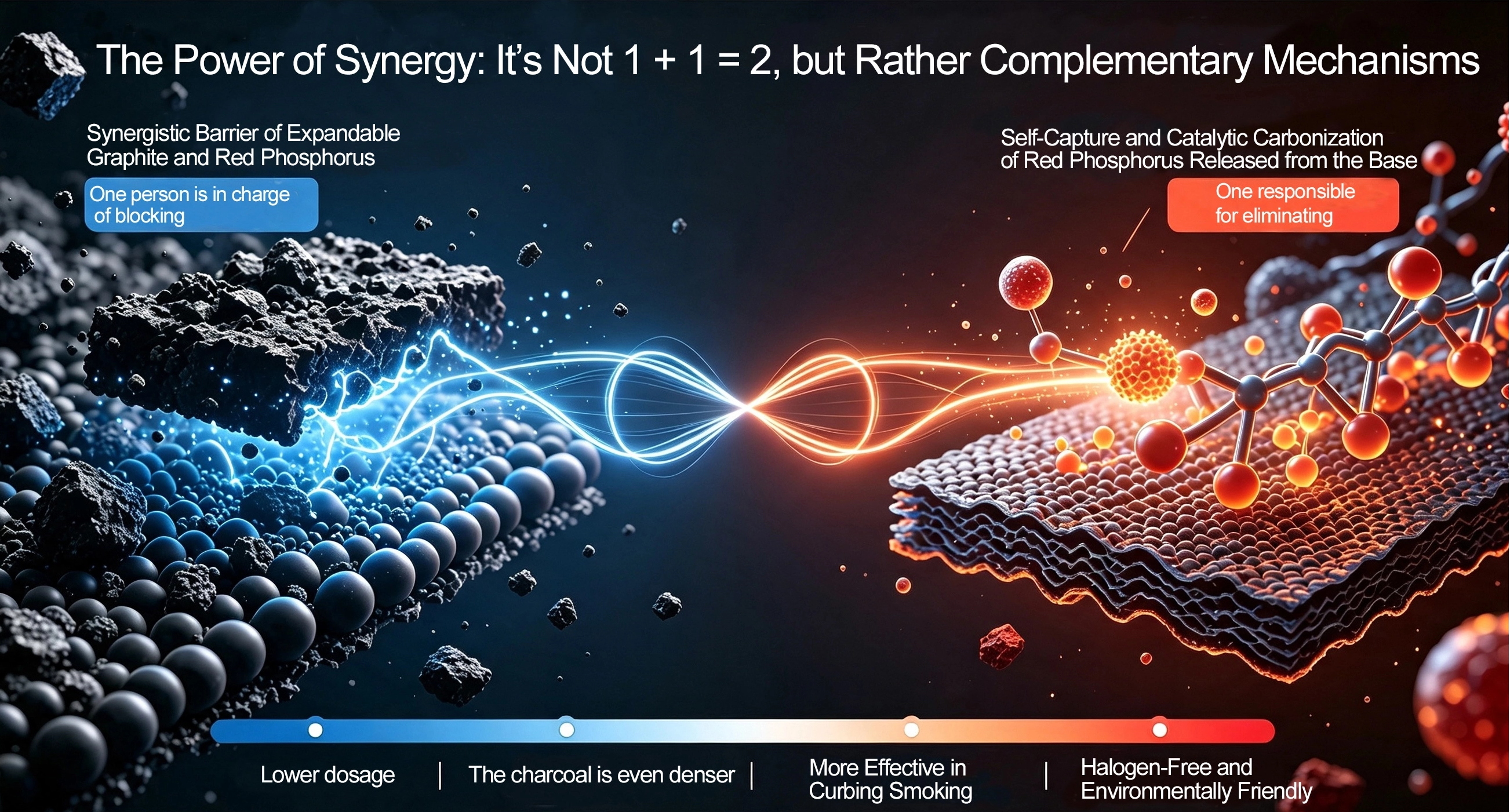
When the physical barrier provided by expandable graphite meets the chemical flame retardancy of red phosphorus, rubber flame retardancy finally breaks free from its “reliance on halogens” and moves toward “high-efficiency synergy.”
