- All
- Product Name
- Product Keyword
- Product Model
- Product Summary
- Product Description
- Multi Field Search

Views: 39 Author: yinsu flame retardant Publish Time: 2026-08-01 Origin: www.flameretardantys.com


A Technological Inflection Point in Rubber Flame Retardancy:
A Synergistic Breakthrough Combining Expandable Graphite and Red Phosphorus
I. Industry Background: Halogen-Free Formulation Is Not an Optional Choice—It Is a Must
The flame-retardant modification of rubber materials is undergoing a profound paradigm shift.
Traditional halogenated antimony flame retardant systems have long dominated the market due to their highly effective flame-retardant properties. However, as global environmental regulations continue to tighten—with directives such as RoHS, REACH, and WEEE imposing increasingly strict restrictions on halogens—halogen-free formulations have evolved from a “trend” to a “necessity.”
The problem is that alternatives are hard to come by.
Although metal hydroxides (ATH, MDH) are environmentally friendly, their typical loading levels often exceed 50 wt%, which severely compromises the mechanical and processing properties of rubber. While intumescent flame retardants (IFRs) are relatively efficient, their dispersion and compatibility in rubber systems have long been a major challenge for the industry.
It is against this backdrop that the combination of expandable graphite and red phosphorus is redefining the technical boundaries of rubber flame retardancy.
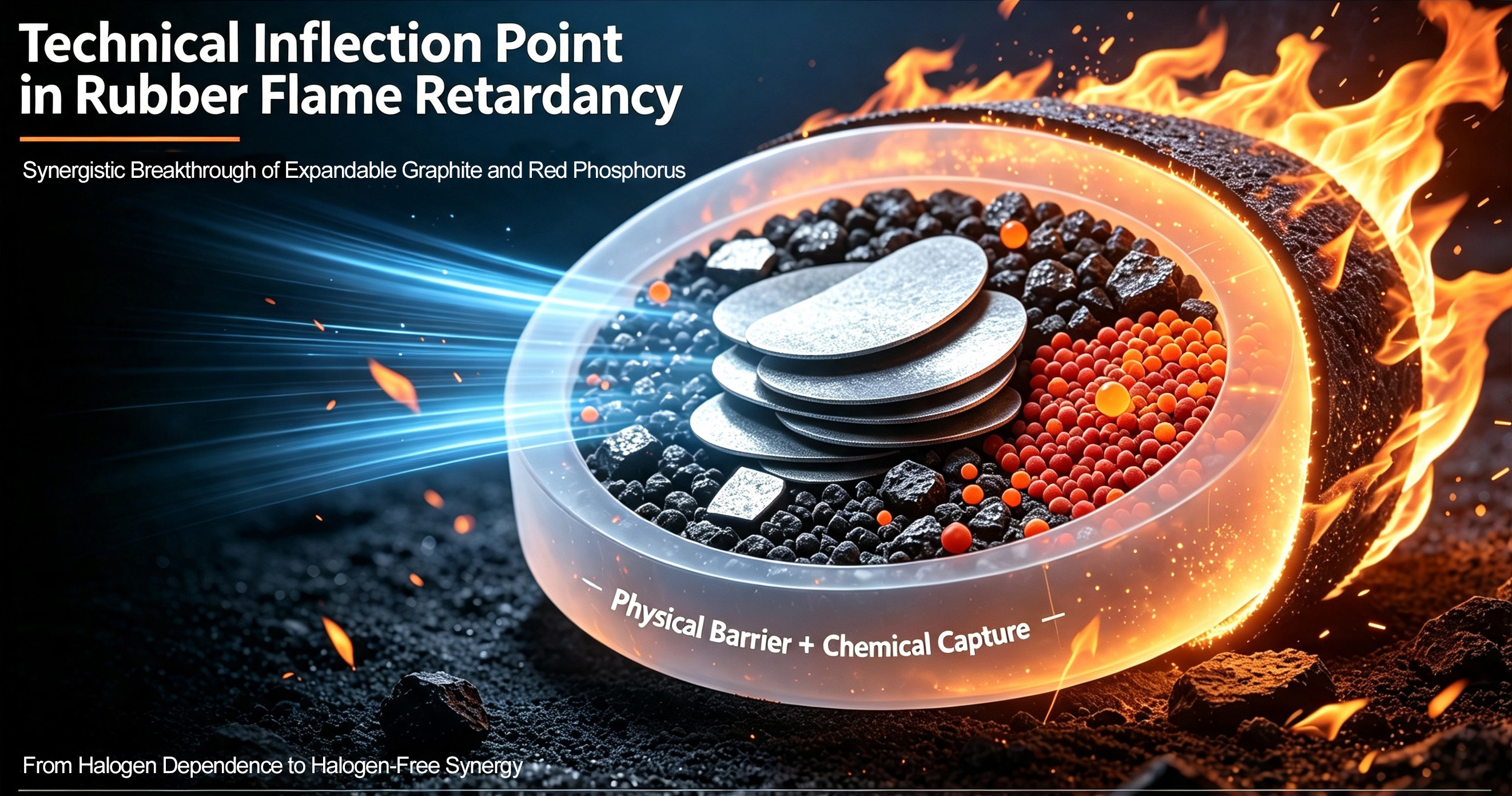
II. Expandable Graphite: The Underrated “Physical Barrier” Revolution
The flame-retardant mechanism of expandable graphite is entirely different from that of traditional flame retardants.
When the temperature rises to approximately 150–300°C, the acid groups intercalated between the graphite layers decompose upon heating, releasing non-flammable gases. This causes the graphite to expand instantaneously along the C-axis to hundreds of times its original volume, forming a worm-like, porous carbon layer. This is not a chemical reaction, but rather a sudden change in physical structure.
The expanded graphite carbon layer possesses an extremely high specific surface area and thermal stability; it will not burn even when temperatures reach 900°C. It acts like a giant “thermal blanket” covering the material’s surface, simultaneously fulfilling three functions: thermal insulation—preventing heat transfer to the internal substrate; oxygen isolation—blocking oxygen from contacting combustible materials; and smoke suppression—inhibiting the release of combustible volatiles and the generation of smoke.
Research data indicates that adding 20 parts of expandable graphite, 4 parts of zinc borate, and 6 parts of ammonium polyphosphate to EPDM can achieve a limiting oxygen index (LOI) of 28.3%, meeting the criteria for flame-retardant materials. In SBR, when expandable graphite is blended with synergists, the LOI increases from 19.5% to 28.5%, the peak heat release rate decreases by 69.9%, and the total smoke release decreases by 48.1%.
Expandable graphite is not without its drawbacks. As the addition level increases, the mechanical properties of the rubber decline rapidly. This is precisely the focus of current technological breakthroughs—introducing functional groups through chemical grafting, improving interfacial bonding through surface modification, and achieving precise control through self-assembly techniques. More cutting-edge breakthroughs stem from chemical bonding technology, which uses mechanical ball milling to induce chemical bonding between expandable graphite and red phosphorus, thereby simultaneously enhancing both flame retardancy and thermal conductivity at low addition levels.
III. Red Phosphorus: The Transformation from a “Headache” to a “Precision Weapon”
The flame-retardant mechanism of red phosphorus involves the combined action of both the gas-phase and solid-phase mechanisms.
Gas-phase mechanism: When heated, red phosphorus decomposes to produce PO· radicals, which efficiently capture H· and OH· radicals in the combustion chain reaction, thereby breaking the combustion chain.
Condensed-phase mechanism: At high temperatures, red phosphorus oxidizes to form phosphoric acid and polyphosphoric acid, creating a glass-like coating on the material’s surface that isolates oxygen and catalyzes dehydration and carbonization.
The core advantage of red phosphorus lies in its high efficiency—an addition level of just 5%–15% is sufficient to achieve UL94 V-0 rating, with an oxygen index of 28.5 or higher. Compared to metal hydroxides, which often require addition levels of 50% or more, red phosphorus has a much smaller impact on the mechanical properties of rubber. At the same time, red phosphorus is halogen-free, low-smoke, and low-toxicity, complying with RoHS and REACH requirements.
The problems with traditional red phosphorus are also significant: it readily absorbs moisture and releases highly toxic phosphine gas; its dust is flammable and explosive; it has poor compatibility with rubber; and its color limits its application in light-colored products.
Microencapsulation technology systematically addresses these issues—by coating the surface of red phosphorus particles with a dense polymer shell, it significantly enhances safety (raising the oxidation temperature to over 300°C and effectively suppressing phosphine release), improves compatibility, enhances moisture resistance, and ensures long-term product stability. Whitening coating technology takes this a step further, changing the color from reddish-purple to grayish-white or even white, thereby opening the door to applications in light-colored products.
The true value of microencapsulated red phosphorus lies in its synergistic flame-retardant effects—it works in concert with metal hydroxides to form a more stable and dense char layer, and when blended with nitrogen-based carbonizing agents, it creates a highly efficient “phosphorus-nitrogen” intumescent flame-retardant system.
IV. The Power of Synergy: When Expandable Graphite Meets Red Phosphorus
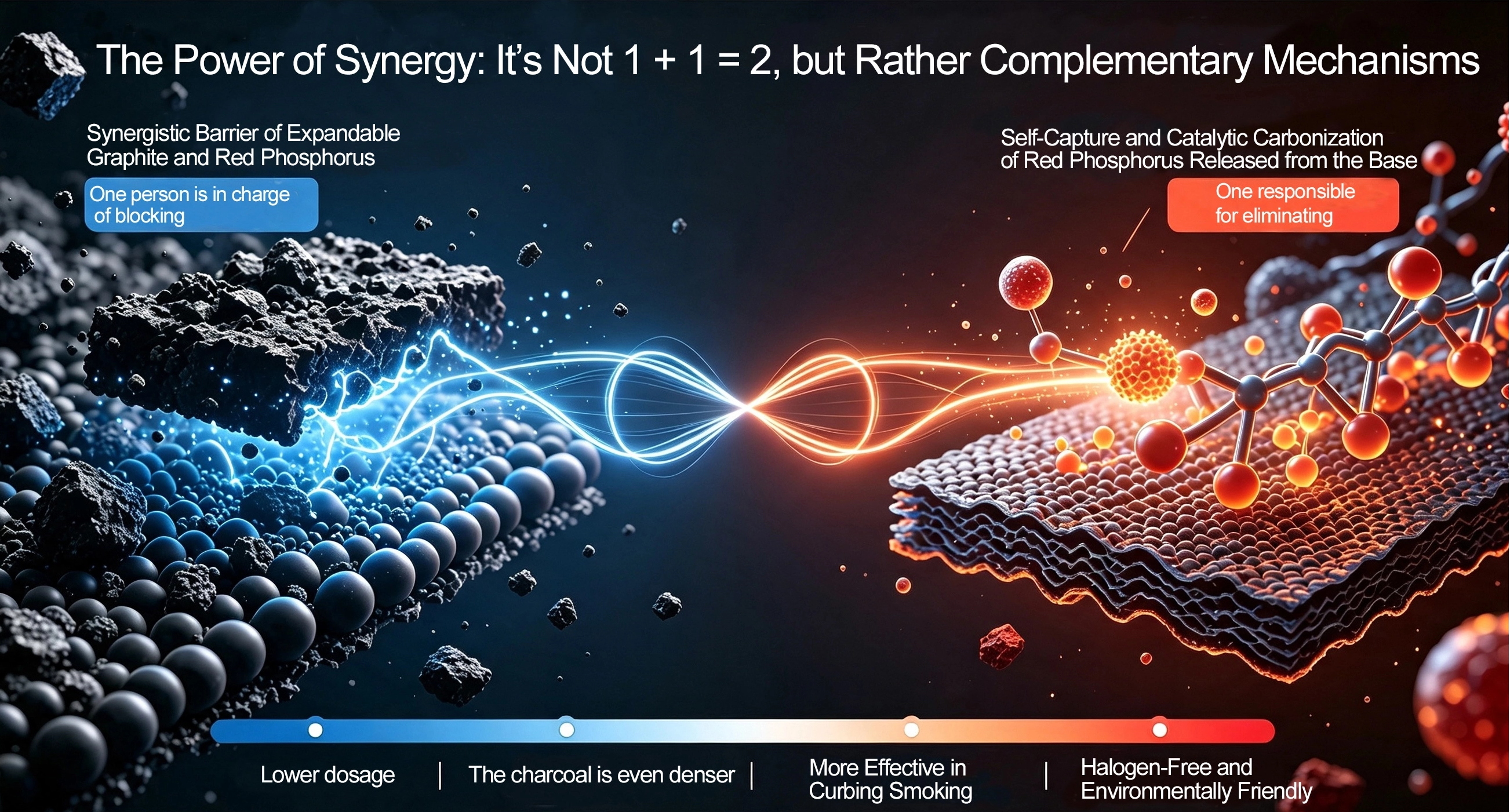
The synergy between expandable graphite and red phosphorus is not simply a matter of “1 + 1 = 2,” but rather a combination of complementary and additive mechanisms.
Expandable graphite creates a barrier through physical expansion—providing thermal insulation, oxygen isolation, and smoke suppression. Red phosphorus cuts off the fire source through chemical flame retardation—interrupting chain reactions in the gas phase and promoting charring in the condensed phase. One is responsible for “blocking,” while the other is responsible for “extinguishing.” The two are complementary rather than overlapping, resulting in a significant synergistic effect.
Research data from recent years has fully demonstrated the power of this combination:
A combination of microencapsulated expandable graphite and microencapsulated red phosphorus requires only 8 wt% in EVA to achieve UL-94 V-0 compliance, whereas conventional expandable graphite requires 20 wt% to achieve the same result. Ultrasound-assisted surface enrichment technology takes this a step further, achieving UL-94 V-0 compliance with just 3.86 wt% of the EG/MRP composite flame retardant. Chemical bonding technology uses mechanical ball milling to deposit red phosphorus onto expandable graphite; just 7 wt%** is sufficient to enable polypropylene composites to achieve V-0, with a 69.8% reduction in peak heat release rate, while simultaneously improving thermal conductivity by 30% and impact resistance by 24.5%.
Lower loading levels: Only 10–30% is needed to achieve the same flame-retardant rating, far lower than the 50%+ required for metal hydroxides
Denser char formation: The char layer combines the high thermal stability of graphite with the density achieved through red phosphorus-catalyzed char formation
Significant smoke suppression: The combination of these two properties further reduces smoke density
Halogen-free and environmentally friendly: The entire system is halogen-free and complies with RoHS and REACH
V. Future Outlook: From “Blending” to “Design”
The synergy between expandable graphite and red phosphorus is evolving from “physical mixing” to “molecular design.”
Expandable graphite is transitioning from a simple “filler” to a “functional component”—chemical grafting introduces new functions, surface modification optimizes interfacial bonding, and nanoscale restructuring enhances dispersibility. Red phosphorus is evolving from a “hazardous material” into a “precision flame-retardant weapon”—microencapsulation addresses safety concerns, whitening overcomes color limitations, and ultra-fine grinding improves dispersion.
Chemical bonding technology represents the cutting-edge direction—establishing chemical bonds between expandable graphite and red phosphorus through methods such as mechanical ball milling to create a truly “integrated” functional filler that simultaneously achieves highly efficient flame retardancy, enhanced thermal conductivity, and maintained mechanical properties at extremely low loading levels.
The concept of directional flame retardancy is also gaining traction—by designing a thermal conductivity gradient between the material’s surface and interior layers, the flame retardant migrates preferentially to the surface and accumulates there when heated, precisely delivering its effect where needed. This approach holds promise for further reducing the required addition level and improving efficiency.
Rubber flame retardancy is undergoing a technological inflection point, shifting from “halogen dependence” to “halogen-free synergy.”
Expandable graphite and red phosphorus—one builds a barrier through physical expansion, while the other cuts off the fire source through chemical flame retardancy. Combined, they are redefining the upper limit of efficiency in rubber flame retardancy.
From simple physical compounding to ultrasonic-assisted surface enrichment, and on to integrated chemical bonding designs—this technology is evolving from “functional” to “highly effective,” and from an “alternative” to the “optimal solution.”
For rubber engineers, this is not merely about replacing flame retardants; it is about rethinking the very concept of “flame retardancy” itself—flame retardancy does not necessarily require “extinguishing” the fire; sometimes, “blocking” it is more effective than “extinguishing” it. Furthermore, flame retardancy does not have to come at the expense of performance; through synergy, it is possible to achieve “both.”
This is the true appeal of technology.