
- All
- Product Name
- Product Keyword
- Product Model
- Product Summary
- Product Description
- Multi Field Search

Views: 52 Author: Yinsu Flame Retardant Publish Time: 2026-04-12 Origin: www.flameretardantys.com


Red Phosphorus + Synergist: Can 1+1 Really Be Greater Than 2?
In the world of engineering plastics formulation, red phosphorus flame retardant is a familiar face. High efficiency and low cost make it a "basic option" for many when designing flame retardant solutions. However, in recent years, more and more engineers have found that relying solely on red phosphorus is becoming increasingly difficult.
Customer requirements are getting tougher: thin-wall designs, high CTI, light-colored products, use of recycled materials... each new demand challenges the boundaries of traditional formulations. So people start to wonder: can we add something else to red phosphorus to get better results and lower costs?
This idea sounds appealing, but in practice, there are plenty of pitfalls.
I. Where Does Red Phosphorus Alone Fall Short?
Let's first talk about a few persistent problems when using red phosphorus by itself.
The first is the trade-off between addition level and physical properties. To achieve V0 with red phosphorus, the addition level cannot be too low. But once you add too much, impact strength drops, and the surface quality deteriorates. Especially in glass fiber reinforced systems, more red phosphorus tends to cause fiber blooming, harming both appearance and strength.
The second is color limitation. Red phosphorus itself has a color. It's not a big issue for dark-colored parts, but it becomes a headache for light-colored products: color matching is difficult, batch-to-batch color variation is hard to control, and some light-colored applications simply rule out red phosphorus.
The third is cost volatility. The price of red phosphorus raw materials is not fixed. If a formulation depends solely on it, the cost follows the raw material market, leaving little resilience against price fluctuations.
Putting these issues together, formulators know very well that relying on red phosphorus alone is no longer sufficient in many cases.
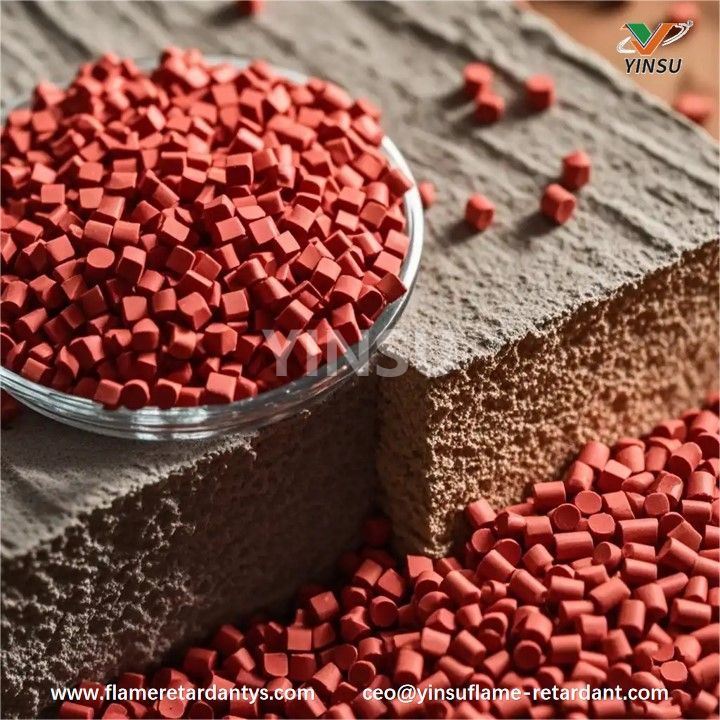
II. What Does Synergistic Combination Actually Solve?
The idea of synergistic combination is essentially "finding a helper." Use a small amount of synergist to replace part of the red phosphorus, reducing the red phosphorus addition level while maintaining the V0 rating.
This logic does solve several practical problems.
For example, in glass fiber reinforced nylon, adding too much red phosphorus severely reduces impact strength and easily causes fiber blooming. By replacing a portion of the red phosphorus with a nitrogen-based synergist, the red phosphorus dosage can be reduced by two or three percentage points while maintaining the same flame retardancy rating. Impact strength and surface gloss both improve. The effect is not necessarily "double," but it turns a formulation that was "barely usable" into one that is "easy to work with."
Another example is cost. The unit price of a synergist may be higher than that of red phosphorus, but when the red phosphorus dosage decreases, the overall formulation cost can actually go down. Add to that the yield improvement from better physical properties, and the total cost equation often becomes favorable.
There is also a benefit that is easily overlooked: synergistic combinations make the formulation more robust against fluctuations. When the price of red phosphorus raw material rises, the formulator can adjust the synergist proportion rather than passively absorbing the cost impact.
III. Synergy Is Not Simply "1+1"
Of course, while synergistic combination sounds simple, many have stumbled when putting it into practice.
The biggest pitfall is compatibility. You can't just add any synergist. Its particle size, decomposition temperature, and processing window must all match the red phosphorus and the substrate. If the choice is wrong, you may encounter blooming, yellowing, processing instability, or even reduced flame retardant efficiency. Some formulators try a range of synergists and find the results worse than using red phosphorus alone, precisely because compatibility was not handled properly.
Another common issue is mismatched application scenarios. Different applications require different synergistic paths. For cable materials, which emphasize smoke suppression and flexibility, combining red phosphorus with metal hydroxides or phosphorus‑nitrogen synergists works well. For electronic components that demand high CTI and surface gloss, combining red phosphorus with nitrogen-based or organic phosphorus synergists is more appropriate. Taking a synergy solution designed for cables and applying it to electronic parts will likely lead to problems.
Thus, the value of synergistic combination is not in the arithmetic "1+1," but in giving formulators more room to maneuver. Red phosphorus shifts from being the "only option" to being the "core component," and formulation flexibility increases.
IV. From "Competing on Addition Level" to "Competing on Combination"
In recent years, a clear trend in the flame retardant industry is that everyone is moving from "competing on addition level" to "competing on combination."
In the past, formulation thinking was often: "Which flame retardant works well? Add it in." Now things are different. Customer requirements are more detailed, and a formulation based on a single flame retardant is increasingly unable to meet all demands. Synergistic combination is not just "icing on the cake" but a "necessary path" in many scenarios.
Rather than internal competition over addition levels, it is better to focus on combination. By properly pairing red phosphorus with suitable synergists, you can not only maintain the flame retardancy rating but also balance physical properties, cost, and processability within a more reasonable range.
V. Whether 1+1 Is Greater Than 2 Depends on How You Add
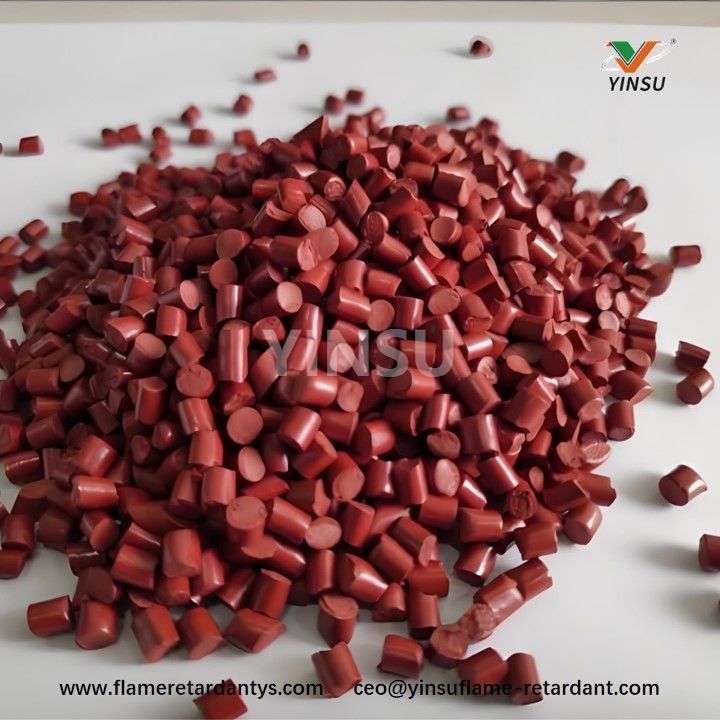
In the end, there is no standard answer for red phosphorus synergistic combination. Different materials, different applications, and different processing conditions all call for different synergy paths.
But one thing is certain: red phosphorus's inherent high flame retardant efficiency is its foundation, and synergists are the "seasonings" that help bring out that foundation in the right way. A good formulation is not about "adding more," but about "adding correctly."
When red phosphorus is no longer the only choice in a formulation, and when synergistic combination gives formulators more flexibility, the design of flame retardant solutions truly moves from "passive response" to "active optimization."
In the field of red phosphorus flame retardants, Yinsu Flame Retardant Company has been deeply engaged for 22 years. Over these two decades, we have faced all kinds of materials, all kinds of operating conditions, and all kinds of "difficult" flame retardancy requirements. Whether for PA, PE, PET, ABS, PP, or rubber and foam materials, Yinsu has targeted red phosphorus flame retardant solutions. More importantly, we are accustomed to "formulating with the problem in mind." Based on the customer's specific application, processing conditions, and performance requirements, we provide customized flame retardant solutions. We don't just sell a product and walk away; we work alongside engineers to fine‑tune the formulation until it is in its most practical state.


