
- All
- Product Name
- Product Keyword
- Product Model
- Product Summary
- Product Description
- Multi Field Search

Views: 45 Author: Yinsu Flame Retardant Publish Time: 2026-04-10 Origin: www.flameretardantys.com


Can Red Phosphorus Flame Retardant Really Not Suitable for High-Gloss Components?
Spend enough time in the engineering plastics industry, and you'll notice an interesting phenomenon. Whenever red phosphorus flame retardancy is mentioned, many people's first reaction is "it can only be used for internal parts."
The reason is not hard to understand. Anyone who has used it knows that components made with conventional red phosphorus masterbatch often have a surface that feels somewhat rough. Either it looks hazy, or there are pockmarks, and achieving a high gloss level is difficult. It works fine for internal parts like connectors and coil bobbins, but when it comes to applications with strict surface requirements, such as appliance housings, automotive interiors, and high-end electronic components, red phosphorus is often the first to be ruled out.
Over time, an unspoken "rule of thumb" has formed in the industry. To achieve high flame retardancy, you must accept a matte finish. To get a smooth surface, you should avoid red phosphorus.
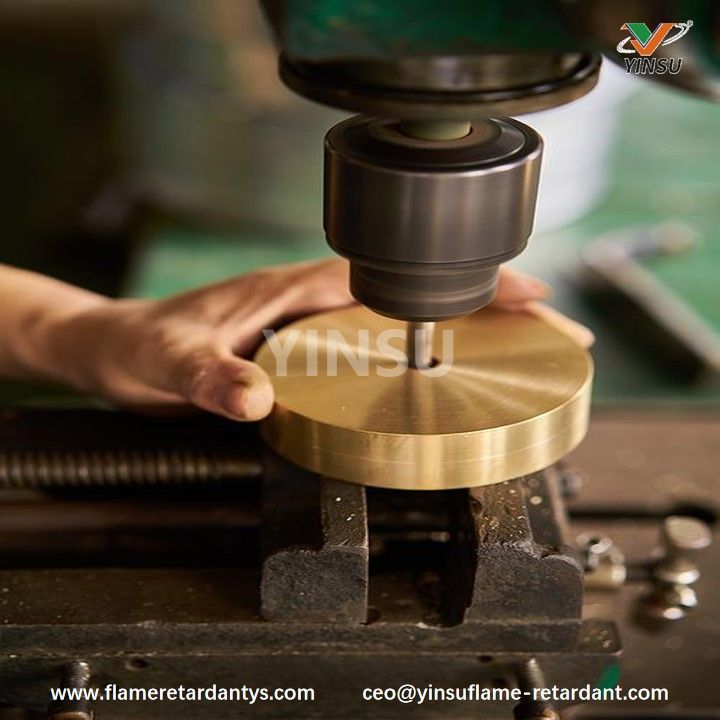
Where does this impression actually come from?
I. The Surface Issue is Essentially a Particle Size Issue
The root cause of surface defects in red phosphorus applications is actually not complicated. It comes down to particle size.
Conventional red phosphorus masterbatches, limited by coating technology and dispersion techniques, often have relatively coarse particle sizes, and the particles vary significantly in size. During injection molding, coarse particles tend to protrude on the component surface. This is especially noticeable in thin-walled parts and high-gloss surfaces, where even slight graininess is amplified.
To make matters worse, conventional red phosphorus masterbatches typically require relatively high addition levels to meet flame retardancy standards. As the addition level increases, the "presence" of coarse particles becomes stronger, making surface defects more apparent. The result is that while the flame retardancy rating is achieved, the appearance suffers.
Thus, engineers often face a dilemma: prioritize high flame retardancy or good appearance? This choice has become one of the most troublesome pain points in applying red phosphorus.
II. Is It Really an Either-Or Choice?
In fact, whether red phosphorus can achieve a smooth surface depends not on "if" but on "how."
Red phosphorus naturally has high flame retardant efficiency, which is its inherent advantage. However, translating this advantage into a usable solution requires not simply increasing the quantity but treating each red phosphorus particle properly.
The real turning point comes from the refined upgrading of coating technology. When the coating layer is sufficiently dense, the particle size is fine enough, and the particle size distribution is concentrated enough, the performance of the red phosphorus masterbatch undergoes several noticeable changes:
First, ultra-fine particle size. When the particle size reaches the 2500-mesh level, the particle dimensions are already far below the limit of human visual resolution. During injection molding, these micron-level particles disperse evenly within the matrix, no longer making their "presence felt" on the surface.
Second, low addition level. The emergence of high-content coated red phosphorus masterbatches significantly increases the effective concentration of red phosphorus. A flame retardancy grade that previously required a 20% addition level can now be achieved with around 3% to 5%. As the addition level decreases, the impact on surface quality naturally diminishes significantly.
Third, more uniform dispersion. Ultra-fine particle size brings not only invisibility but also uniform distribution. With uniform dispersion, the risks of localized enrichment and particle agglomeration are greatly reduced, naturally improving surface smoothness.
Through these three steps, the appearance of red phosphorus flame retardant products has moved far beyond the "barely acceptable" level.
III. Different Scenarios Require Different Solutions
Of course, appearance requirements also come in layers. Different application scenarios have vastly different demands for surface smoothness, and the red phosphorus flame retardant solution must be tailored accordingly.
For instance, cable sheathing materials have relatively moderate surface smoothness requirements. The focus is more on flexibility, aging resistance, and flame retardant stability. In such scenarios, the key is achieving good dispersion and coating, ensuring the sheath surface is smooth and free from graininess while maintaining a soft feel.
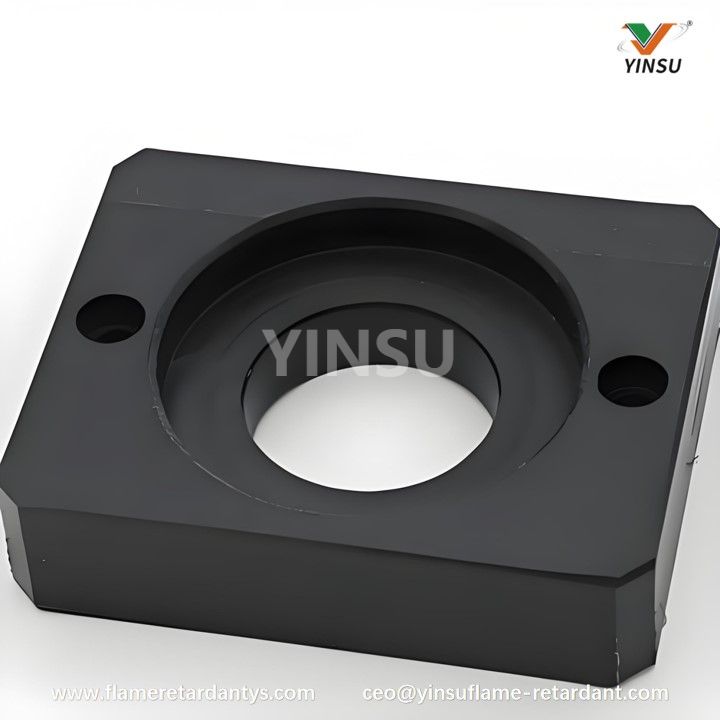
However, "appearance-centric" components like appliance housings, electronic brackets, and automotive interior parts have much stricter requirements. The surface must be not only smooth but also free from fiber blooming, pockmarks, and flow marks. This requires the red phosphorus masterbatch itself to possess characteristics like ultra-fine particle size, high content, and low addition levels, while also having good compatibility with the base material and a wide processing window. Only by controlling these details can components be made that are both flame retardant and aesthetically pleasing.
Additionally, color is another easily overlooked point. Red phosphorus masterbatch itself has a color. While this is not a major issue for dark-colored components, for light-colored or color-matched products, the impact on hue needs to be considered. This is why some manufacturers develop both red and black masterbatches, targeting different base color requirements to minimize post-processing color adjustment hassle.
IV. Stop Judging Red Phosphorus by Old Impressions
Ultimately, the impression that "red phosphorus can only yield a matte finish" is a remnant of an older technological era.
In the days when coating technology was immature, particle size control was imprecise, and addition levels couldn't be reduced, red phosphorus indeed couldn't deliver good appearance. But technology moves forward, and materials evolve with it.
When red phosphorus flame retardant achieves ultra-fine particle size, high content, and low addition levels, and when the coating layer is dense enough and dispersion uniform enough, it can fully deliver excellent appearance while maintaining high flame retardant efficiency.
So, the next time someone asks "can red phosphorus be used for high-gloss components," the answer can be: yes, but you need to choose the right solution.
Flame retardancy and appearance have never been naturally opposed. What is truly opposed is using outdated technology to solve new problems.
In the application of red phosphorus flame retardants, what truly makes it possible to achieve both flame retardancy and good appearance is Yinsu Flame Retardant's high-content coated red phosphorus flame retardant. Through ultra-fine particle size control (achievable down to 2500 mesh) and high-content coating technology (coated red phosphorus content >80%), Yinsu's coated red phosphorus masterbatch achieves UL94 V0 flame retardancy rating at extremely low addition levels while maintaining a smooth, pitting-free product surface. Whether it's balancing flexibility and flame retardancy for cable sheathing materials, or meeting the high-gloss appearance requirements for engineering plastics like PA and HIPS, Yinsu offers targeted product grades to match. Red and black masterbatch options are available, simplifying the color adjustment process, truly moving red phosphorus flame retardant solutions from "functional" to "user-friendly."


