
- All
- Product Name
- Product Keyword
- Product Model
- Product Summary
- Product Description
- Multi Field Search

Views: 38 Author: Yinsu Flame Retardant Publish Time: 2026-11-05 Origin: www.flameretardantys.com


Why Does Flame-Retardant PE Cable Still Drip at 25% Loading?
When formulating flame-retardant PE, the most frustrating part isn't how fast it burns. PE has a Limiting Oxygen Index (LOI) of 17-18, almost identical to PP. But if you take a formulation that passes V-0 on a 1.6mm PP specimen and switch it to PE, the cotton underneath will inevitably catch fire.
Most people treat this as a "loading problem." If it fails, the reflex is to add 3 parts. Still fails? Add 5 more. Push it to 25%, and the specimen finally self-extinguishes, but the cotton still ignites.
The direction is wrong from the start. PE's real trouble lies in dripping.
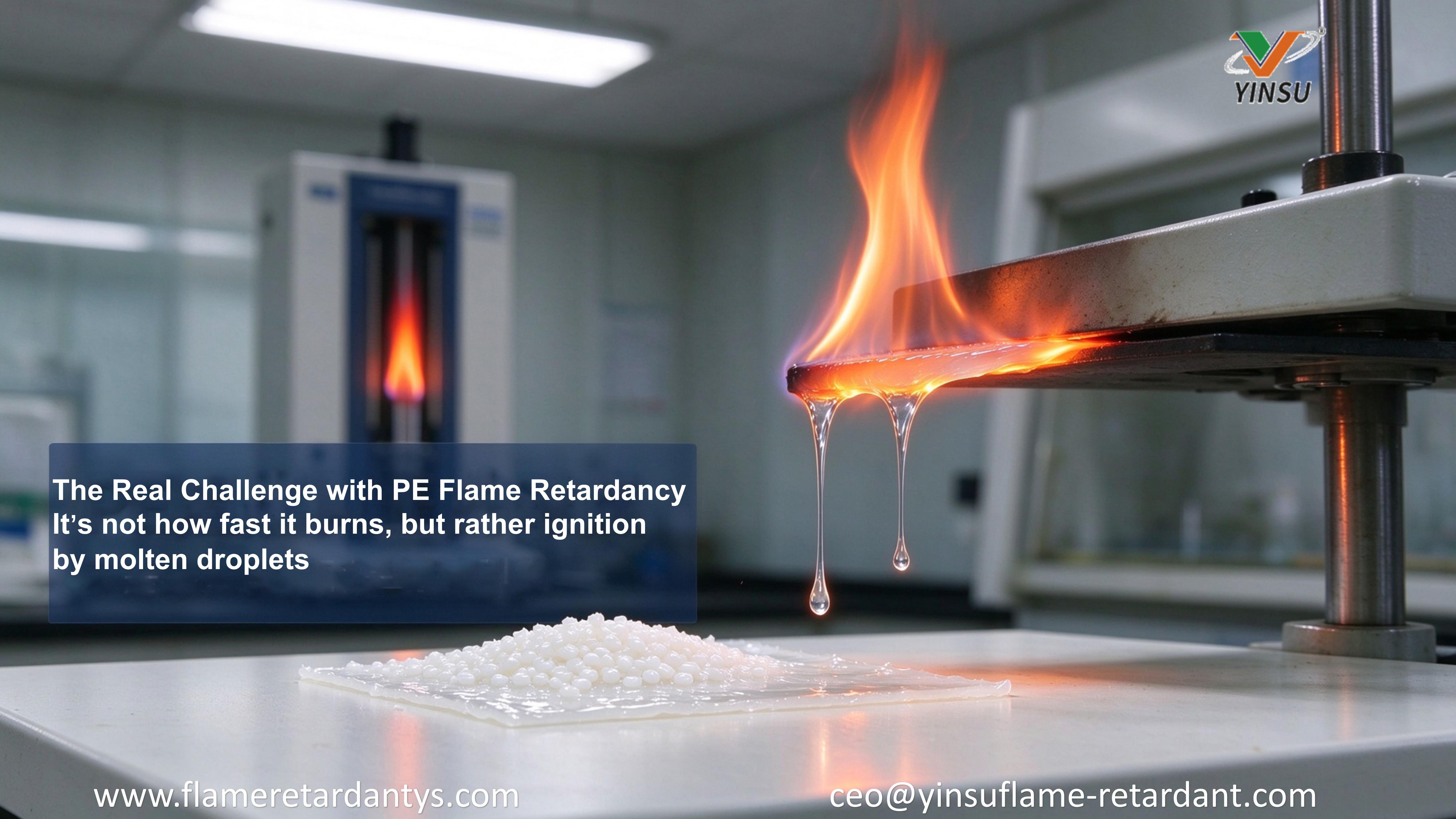
Why Can't It Stop Dripping Even at 25%?
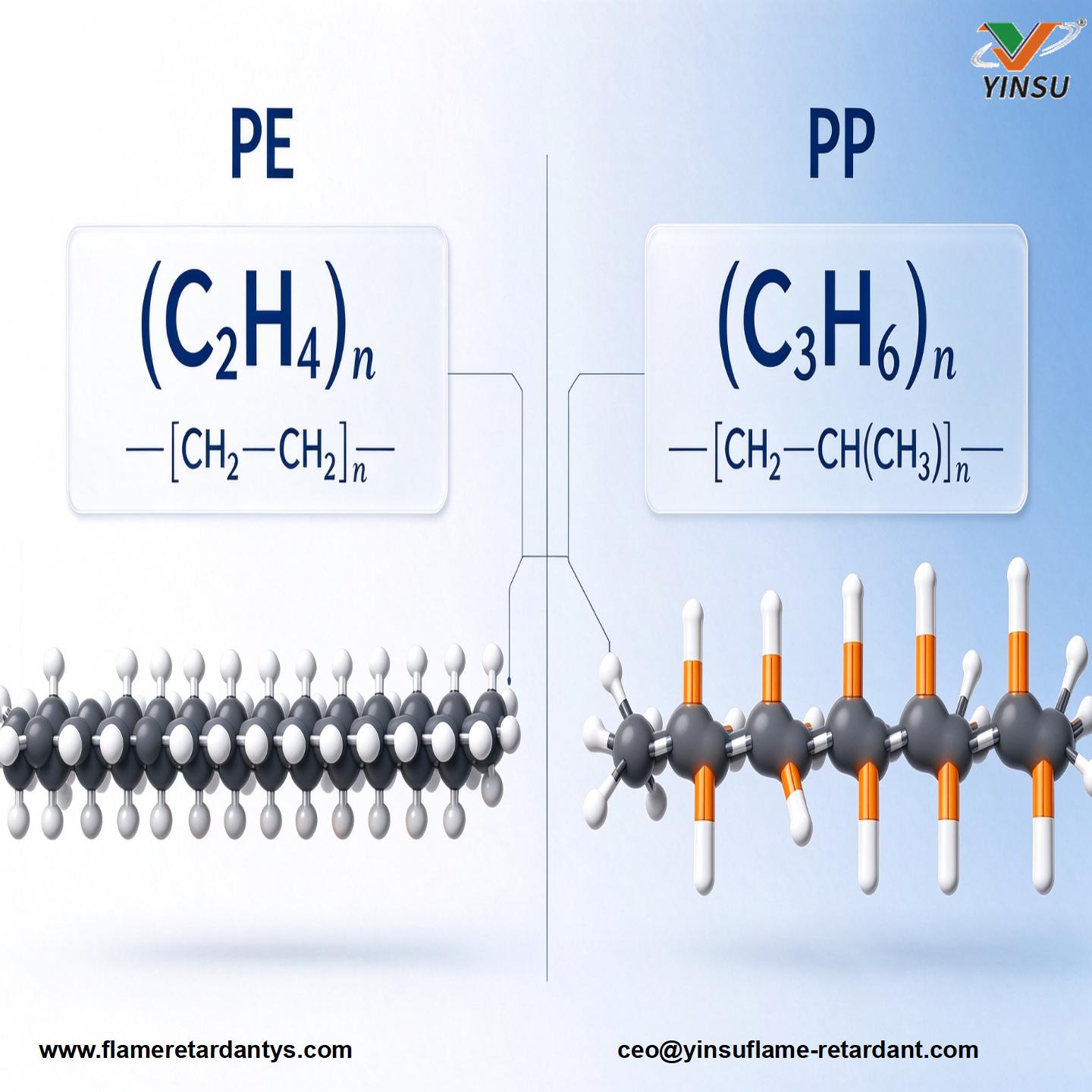
PE is a pure, straight-chain alkane. Its backbone carries only C-C and C-H bonds. During pyrolysis, the chain scission products are almost entirely combustible gases, leaving very little solid char. Without a char layer to hold things together, the melt flows downward like water, and the flame follows the drips.
PP at least has tertiary carbons on its backbone, allowing crosslinking during pyrolysis to form some char. PE has no such sites. That's why in halogen-free systems, PP might pass at 20-30% loading, while PE on a hydroxide route needs to be stuffed up to 50-60%.
Even if you try to force charring, it's hard to build a solid structure. Dehydrated PE lacks aromatic structures to condense into, so the char skeleton remains loose. Phosphorus chemistry can handle the gas phase, but the condensed-phase half has to be propped up by synergists.
There's also a hidden trap that's easily overlooked: PE is highly crystalline. When you add 20 parts of flame retardant, most of it gets pushed out of the crystalline regions. You calculate for 20 parts, but the effective concentration doing the actual work might only be a dozen. This is why it still drips at 25%.
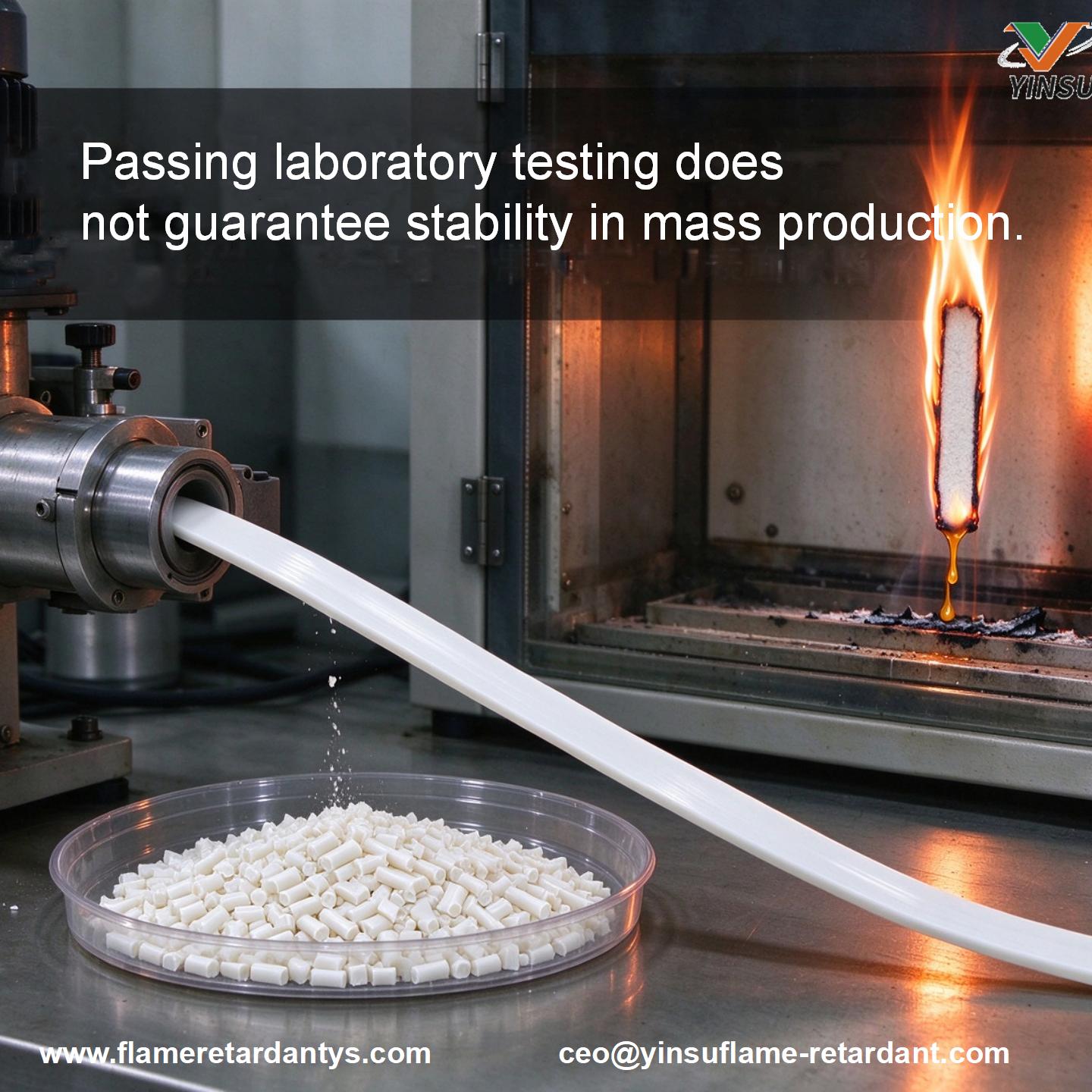
The Formulation "Debt" Paid by the Production Line
Adding 5 parts in the lab is easy, but the line pays a much higher price. When MFR (Melt Flow Rate) drops from 2 to 0.5, extruder torque maxes out, and output plummets. The operator lowers the temperature to compensate, but plasticization suffers. The strands become rough, break, and generate dust at the pelletizer.
Change the Order: Stop the Drip, Build Char, Add Loading Last
Don't obsess over loading first. Change the sequence, and the formulation comes to life:
Step 1: Stop the dripping. Increase melt strength, or form a crust early in the burn that holds the melt in place.
Step 2: Build the char. Balance the acid, gas, and carbon sources to give the char layer thickness and insulation.
Step 3: Talk about loading. Every part added now hits the target instead of just diluting the system.
Look at the magnitude differences across routes:
Bromine-Antimony: 10-20% loading, restricted by halogens.
Halogen-Free P/N or Hydroxides: 50-60% loading, possible for light colors, but requires high filling.
Microencapsulated Red Phosphorus: Only 3-5% loading, dark colors only, but solves the magnitude issue.
When selecting, first check the customer's color and halogen-free requirements. Once those two are set, the loading magnitude is decided. Doing it backwards will almost certainly result in rework.
FAQ: Common Pitfalls for Engineers
Q: Does more flame retardant always mean better performance in PE?
A: No. Past the system's capacity, the excess migrates to the surface (blooming), and the effective concentration drops. In PE, blooming often starts above 25%, causing the flame rating to drop on retest.
Q: Can a PP formulation be used directly on PE?
A: No. PE lacks tertiary carbons, chars poorly, and has lower melt strength. It usually needs 5-10 parts more to match.
Q: If 1.6mm passes, will 2.0mm definitely pass?
A: It's the other way around. Passing at 2.0mm doesn't guarantee 1.6mm; thin walls dissipate heat faster and hold less melt, making them more prone to dripping. Always test the thin-wall sample before submitting.
Q: Why do PE cable compounds need 60% loading?
A: Hydroxides rely purely on endothermic decomposition and dilution, which is inefficient. To reach 1.6mm V-0 in LDPE, the physical limit is around 60%. That's the mechanism, not a poorly optimized formulation.
To choose your route, measure three things: wall thickness, base resin grade, and color requirement.
For dark parts, choose FRP-950X (microencapsulated red phosphorus); for white pipes/profiles, go with PE-XT-141; if halogen-free and electrical properties are critical, look at B-HFFR. If you're unsure, send these three parameters over, and the YINSU technical team will draft a starting formulation for you, with samples shipped directly.


