
- All
- Product Name
- Product Keyword
- Product Model
- Product Summary
- Product Description
- Multi Field Search

Views: 38 Author: Yinsu Flame Retardant Publish Time: 2026-09-26 Origin: www.flameretardantys.com


When Burned Individually, They Hold Up, But When Burned in Bundles, They Burn Right Through
—the Problem Isn’t with The Material Itself, But with The Very Concept of “bundling.”

Engineers developing flame-retardant formulations for cables often encounter this situation: a single cable easily passes the V-0 standard in a vertical burn test, but in a bundled burn test (GB/T 18380 or IEC 60332-3), the flame races up the entire bundle, and the char height exceeds the limit, resulting in an immediate failure. Even after repeatedly adjusting the dosage of the primary flame retardant and achieving a LOI of over 30, the results still show no improvement.
Where does the problem lie? The reason is that single-cable burning and bundle burning assess two entirely different aspects.
Single-Cable Burning vs. Bundle Burning: The Difference Between an Introductory Test and the Ultimate Challenge
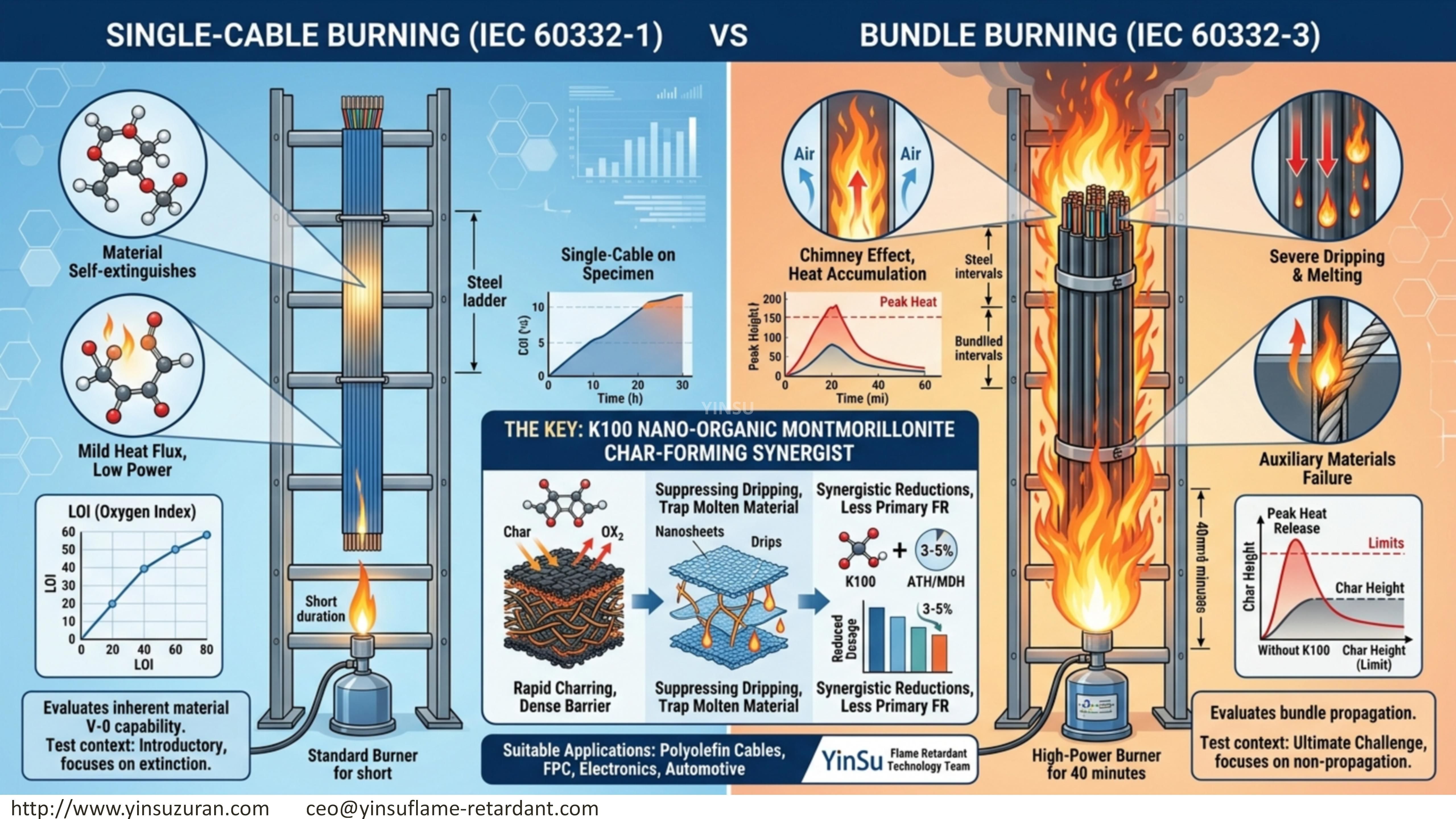
Single-cable burning (IEC 60332-1/GB/T 18380.12) is the most basic cable flame-retardant test—a single cable is fixed vertically, and a standard flame is applied from the bottom to see if it can self-extinguish. This test evaluates the material’s inherent self-extinguishing capability. The test conditions are relatively mild, with low flame power and low heat flux. Passing the single-cable test only indicates that the material itself “can self-extinguish”; it does not guarantee that a cable bundle will also self-extinguish.
Bundle burning (IEC 60332-3/GB/T 18380.33-36), on the other hand, involves bundling multiple cables at specified intervals, securing them vertically on a steel ladder, and applying a high-power flame from the bottom for a continuous 40-minute burn. A single 3.5-meter-long cable specimen is bound into a tight bundle, and the flame is applied from the bottom upward. The test does not assess “whether the material can be extinguished,” but rather whether the entire cable bundle will become a pathway for flame spread in a real fire scenario.
The core differences between the two tests are:

Bundle burning is classified into four categories—A, B, C, and D—based on the volume of non-metallic materials contained in each meter of cable. Category A has the strictest requirements (7 L/m of non-metallic volume, with a fire duration of 40 minutes), and the requirements decrease in that order. For the acceptance inspection of trunk cable projects, a bundle burning test report corresponding to the applicable category must be provided.
What Exactly Makes Bundled Cable Fire So Challenging?
Many people think that a bundled cable fire is simply “multiple cables burning together,” but it’s actually far more complex than that. Based on failure cases, the main challenges lie in three areas:
The chimney effect and heat accumulation. When cables are tightly bundled, they form a vertical channel during combustion, allowing the flame to spread rapidly upward along this path. When a single cable burns, the flame is isolated and heat dissipates easily; however, when multiple cables burn in a bundle, they release heat simultaneously, resulting in a heat release rate far greater than the sum of individual cables. As a result, the enclosure temperature can easily exceed 100°C. While a single cable may be extinguished, a bundle may not be.
Dripping and char layer integrity. Bundled combustion often results in severe melting and dripping at the bottom, a continuous charred channel in the middle, and “false self-extinguishment” in the unburned upper section—where the flame is temporarily lifted by airflow but reignites immediately upon increased ventilation. In the case of a single wire, combustion ends once the molten droplets fall; in a bundle, however, the molten droplets carry the flame downward, causing the bottom to remain exposed to the fire, and the entire bundle cannot be preserved. If the jacket, after forming a shell, cannot act as “armor” to prevent the flame from spreading upward, the test will generally fail.
Auxiliary materials hold the test back. In many cases of failed bundle burning tests, the problem lies not with the insulation sheath, but with the filling rope, wrapping tape, or overwrap tape. Ordinary PP rope has an oxygen index of only 18–20; the flame races upward along the filling rope, directly burning through the entire cable bundle. No matter how effective the flame retardancy of the primary material is, if the auxiliary materials are not flame-retardant, it is equivalent to providing a “ladder” for the flame.
The core contradiction lies in this: single-wire burning tests “whether the flame can be extinguished,” while bundle burning tests “whether the entire bundle can withstand the fire without propagation.” The former relies solely on the material itself, while the latter depends on charring and drip resistance.
Why Are Charring Agents Key to Bundled Combustion?
For bundled combustion to be successful, the flame-retardant system must rapidly form a complete, dense char layer during combustion. This char layer must insulate against heat and block oxygen, encapsulate molten material to prevent dripping, and cover the filler cord and auxiliary materials to prevent them from becoming pathways for the flame.
The role of charring agents is to provide effective support to the primary flame retardant.
Yinsu Flame Retardant K100 nano-organic montmorillonite is a char-forming synergist prepared using intercalation modification technology. By modifying montmorillonite with a special intercalant, the interlayer spacing can reach 3.0 nm. After intercalation into the molten material, it completely dissociates into individual layers and disperses uniformly throughout the matrix.
The three key roles of K100 in bundle burning:
Rapid charring to form a dense barrier layer. During combustion, K100 forms a dense carbon barrier layer on the material’s surface, providing excellent thermal insulation and oxygen isolation. This carbon layer is not a loose accumulation but a continuous network interwoven from layered structures—the flame cannot penetrate it, and heat cannot transfer through it.
Suppressing dripping to prevent flame spread. One of the greatest risks in bundle burning is dripping that ignites materials below. During combustion, K100’s nanosheets form a cross-linked network structure that firmly traps molten material, significantly reducing dripping. With dripping controlled, the flame cannot spread downward via molten droplets.
Synergistic effects reduce the required dosage of primary flame retardants. When K100 is used in combination with primary flame retardants such as ATH, MDH, and APP, an addition of just 3–5% is sufficient to achieve excellent synergistic flame retardancy and shape retention. The charring agent shares part of the flame-retardant burden, allowing for a reduced dosage of primary flame retardants and minimizing the loss of physical properties.

Formulation Approach for Synergistic Cable Bundle Burning
The primary flame retardant is responsible for “extinguishing the fire,” while K100 is responsible for “char formation” and “drip prevention”—both are indispensable.
Taking low-smoke, halogen-free polyolefin cables as an example, a typical synergistic formulation approach is:
Primary flame retardant system (combined with ATH/MDH or phosphorus-nitrogen-based compounds) + K100 char-forming synergist (3–5%) + other synergistic components
K100 is uniformly dispersed in the matrix through melt intercalation. During combustion, the nanolayers migrate to the surface to form a char shell, effectively isolating heat and combustible gases and reducing the heat release rate. Research data indicates that adding nano-montmorillonite can reduce the peak heat release by 40%. The char height can be controlled below 1.5 m, reliably meeting Class A bundle burning requirements.
Suitable material systems: Polyolefin flame-retardant cable compounds such as PE, EVA, PP, and PVC. Used in synergy with primary flame retardants such as ATH, MDH, and APP.
One-sentence summary: Single-strand burning depends on the material; bundled burning depends on the system. Passing the single-strand test is merely meeting the minimum standard; passing the bundle test is where true expertise lies. K100 is designed to help the primary flame retardant handle the “bundle” challenge—forming a dense char layer, trapping molten drips, and blocking flame spread, ensuring the entire cable bundle withstands a 40-minute fire.
If you need samples or technical specifications, please contact the YinSu Flame Retardant Technology Team.


