
- All
- Product Name
- Product Keyword
- Product Model
- Product Summary
- Product Description
- Multi Field Search

Specialized in PE, PVC, TPE, TPU and Low Smoke Zero Halogen (LSZH) wire and cable compound and materials.
In high-rise buildings, subway tunnels, new energy power stations and industrial complex scenarios, the fire safety of wires and cables is directly related to life and property and system reliability.
YINSU Flame Retardant Company provides customized flame retardant solutions for global customers, covering PE (polyethylene), PVC (polyvinyl chloride), TPE (thermoplastic elastomer), TPU (thermoplastic polyurethane) and LSZH (low smoke and halogen free) wire and cable systems to meet all safety requirements, ranging from UL94 V-0 flame retardant certification to EN 45545 fire protection for rail transportation and IEC 60754 low smoke and halogen free toxicity. All-round safety requirements.
Material Common Use Typical FR Type YINSU Flame Retardant Item No.
PE HDPE, LDPE, LLDPE, Red phosphorus, halogen free FR, PRP-950X, PE-XT-20, B-HFFR, MCA-B, WADP-10
Cross-linked PE cables, Bromine antimony masterbatch FR-ML-01, K100
Plastic insulated cables.
PVC PVC &Plastic insulated power cables, ATO alternatives T3, T30, FRP-950X, K100, ZHS, ZS, ZSB-A
Aluminum stranded wires, Zinc stannate
Prefabricated branch cables.
TPE Insulated wires, flexible cables Organic phosphorus MCA-B, WADP-10, FRP-950X, 95-MC
Shielded insulated cables
TPU Special purpose cables Organic phosphorus MCA-B, WADP-10, FRP-950X, 95-MC
Power cables for frequency converters.
Others Welcome to consult more details.


![[Yellow Phosphorus & Phosphorus-Containing Intermediates Weekly Review]: High-Price Transmission Stagnant, Market Center of Gravity Declines (May 15-21, 2026)](http://ikrorwxhnnrili5q-static.micyjz.com/cloud/ppBprKkqlrSRqljknrlljo/Yellow-Phosphorus-Phosphorus-Containing-Intermediates-Weekly-Review-High-Price-Transmission-Stagnant.png)


From September 15 to 17, 2026, at the Shanghai New International Expo Center, The 29th Adhesives and Sealants Expo (ASE CHINA 2026) is set to kick off. Also taking place at the same venue and during the same period are the 24th China International Rubber Technology Exhibition and the 23rd China International Chemical Industry Exhibition. Together, these three exhibitions will form “China Petrochemical Industry Week,” which is expected to attract more than 100,000 professional visitors from both China and abroad.

With polypropylene costs remaining high and supply tightening, cost pressures on flame-retardant PP materials persist. However, demand is expected to rebound as operations resume after the National Day holiday and companies stock up for the “Double 11” shopping festival, which should lead to improved trading activity in the flame-retardant PP market. Demand for halogen-free flame-retardant PP is growing steadily in sectors such as new energy and home appliances. Market participants should monitor raw material price trends and focus on formulation optimization to capitalize on opportunities for cost pass-through.

How Can PET Blended Spinning Modification Balance Flame Retardancy and Spinnability? YinSu Flame Retardancy: An analysis of the technical background of blended spinning, the logic behind selecting flame-retardant masterbatches, the phosphorus-silicon synergistic system, as well as the root causes and solutions for fiber breakage, nozzle clogging, and reduced melt stability—providing a systematic reference for the functional modification of PET fibers, from formulation to process.

In August, the average monthly price of yellow phosphorus rose 4% month-over-month and 22% year-over-year, keeping costs for phosphorus-based flame retardants under sustained pressure. However, due to weak downstream demand, industry-wide oversupply, and difficulties in passing on cost increases, price hikes for flame retardants were limited, squeezing profit margins. In September, stockpiling ahead of the two major holidays may drive yellow phosphorus prices higher still, and cost support remains strong. Until end-user demand shows a noticeable recovery, the phosphorus-based flame retardant market is expected to maintain a pattern of “high costs, weak demand, and tight profit margins,” with profit recovery still contingent on a revival in consumption.

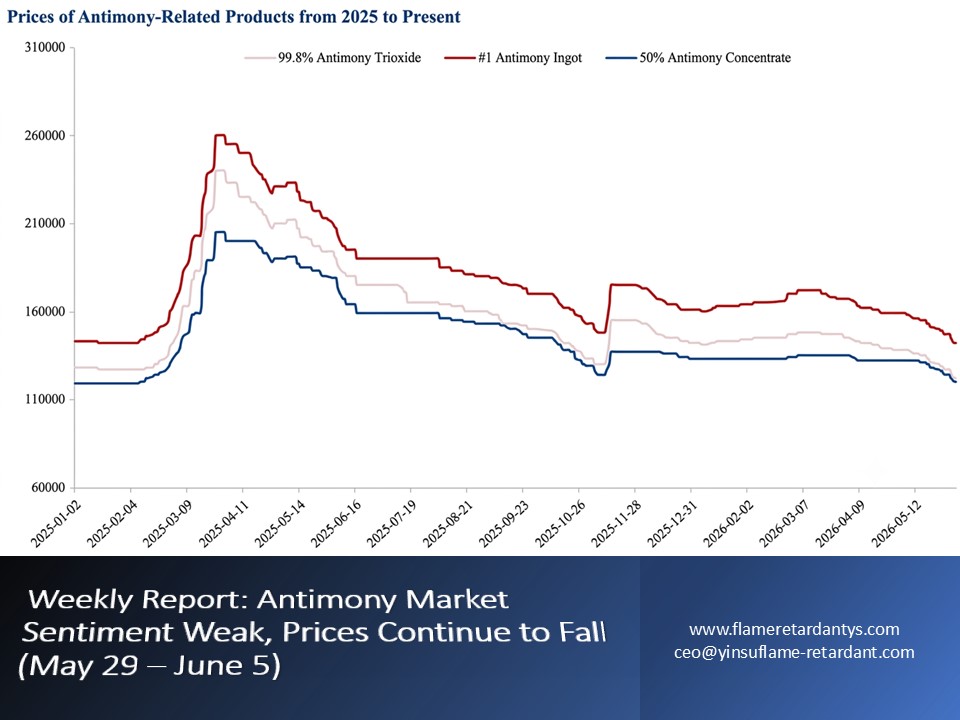
Antimony prices have completed a V-shaped bottoming-out and rebound, with No. 1 antimony ingots rising from 90,000 yuan per metric ton to 100,000 yuan per metric ton, while antimony trioxide has risen in tandem. Refineries are becoming increasingly reluctant to sell, leading to a sharp decline in low-priced supply. Yinsu Flame Retardants offers antimony-free and low-antimony solutions, such as the composite antimony substitute FR-03 and the magnesium-aluminum layered flame retardant HAM-300V, to mitigate the impact of raw material price fluctuations on formulation costs.
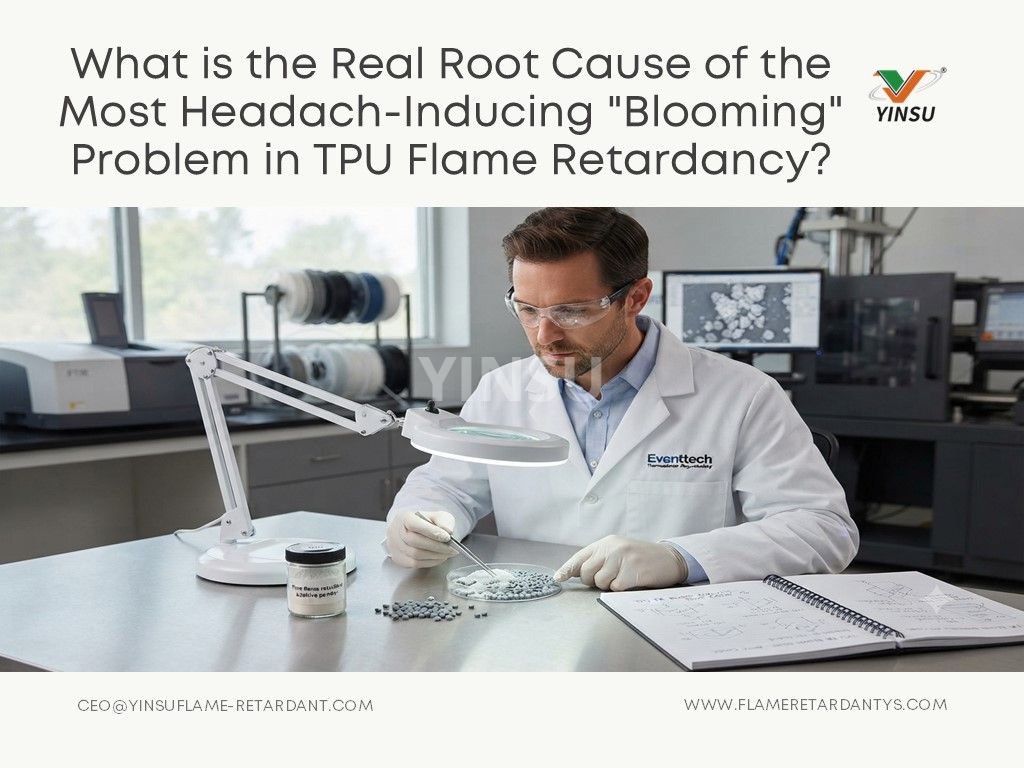
The whitening that occurs on the surface of flame-retardant TPU products is caused by poor compatibility between low-molecular-weight flame retardants and the base material, leading to migration and leaching. Hydrolysis of polyester-based TPU, excessively high processing temperatures, or high-temperature storage environments can all accelerate this process. Using coated flame-retardant masterbatches can effectively block the migration pathway, thereby resolving the blooming issue at its source.
